Introduction
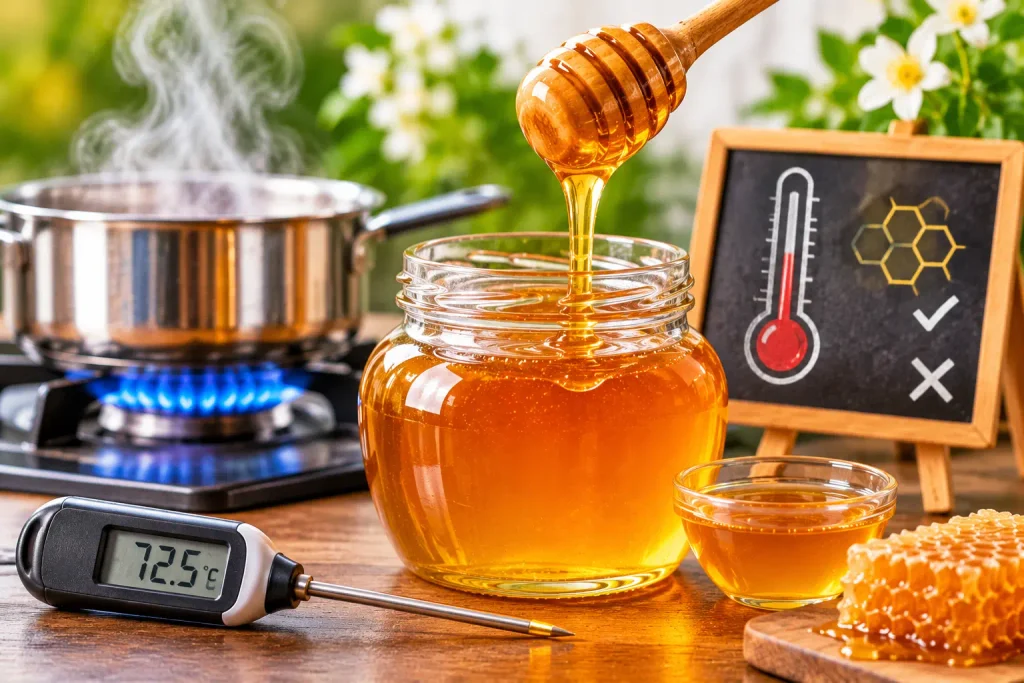
Honey has been valued for centuries as a natural sweetener and a traditional food. People enjoy it in tea, warm milk, breakfast bowls, homemade desserts, marinades, and baked goods. However, heating honey raises an important question: Should honey be heated or cooked, or does high heat destroy its benefits?
You may have heard that honey becomes toxic when heated, that adding it to hot tea is dangerous, or that cooking honey completely destroys its nutritional value. These claims are widely repeated, but the scientific picture is more nuanced.
Heating can change honey’s natural enzymes, flavor, color, and chemical composition. Prolonged exposure to high temperatures can also increase a compound called 5-hydroxymethylfurfural (HMF), which is used as an indicator of heat exposure and honey quality.
However, this does not mean that every warm drink or cooked recipe containing honey is automatically unsafe.
In this article, we will explore what happens when honey is heated, what scientific research says about HMF, whether honey can be added to hot tea, and how to use honey in cooking while preserving as much of its natural quality as practical.
1. What Happens to Honey When It Is Heated?
Honey is a natural mixture made primarily of sugars, especially fructose and glucose, along with water and small amounts of enzymes, organic acids, minerals, and plant-derived compounds.
Its composition varies according to the flowers visited by bees, the environment, processing, and storage conditions.
When honey is heated, several changes may occur.
Natural Enzymes May Lose Activity
Honey contains enzymes introduced during honey production by bees. One example is diastase, also known as amylase.
Enzymes are proteins that help carry out specific chemical reactions. Heat can change their structure and reduce their activity.
The extent of this effect depends on the temperature and how long the honey is exposed to it. Gentle warming for a short period is not the same as prolonged heating at a high temperature.
Honey’s Color and Flavor Can Change
Heating may make honey darker and can alter its aroma or flavor.
These changes depend on the honey’s original composition and the intensity of the heat treatment. Honey exposed to prolonged heat may develop a stronger cooked or caramel-like flavor.
Some Heat-Sensitive Compounds May Decrease
Honey contains different naturally occurring compounds, including some that may be sensitive to heat.
Heating can change the levels or activity of these components. The exact effect varies by honey type and processing conditions.
This is why food scientists assess honey quality using several indicators rather than relying on a single claim such as “heated” or “unheated.”
2. What Is HMF in Honey?
One of the most discussed compounds in heated honey is 5-hydroxymethylfurfural, commonly known as HMF.
HMF can form when sugars, particularly fructose, break down under certain conditions. Honey is naturally acidic, which can contribute to this process.
HMF may increase when honey is:
- Exposed to higher temperatures.
- Heated for a longer period.
- Stored for extended periods, especially in warm conditions.
- Subjected to certain processing conditions.
Fresh honey generally contains low levels of HMF, while levels can rise during heating or storage.
Is HMF Found Only in Heated Honey?
No. HMF can also form during storage and is found in various processed foods.
It is not an exclusive marker of honey being cooked at home. Its concentration depends on multiple factors, including the honey’s original composition, processing history, and storage conditions.
Does HMF Automatically Mean Honey Is Poisonous?
No. The presence of HMF does not automatically mean that honey is poisonous.
Food scientists use HMF as one indicator of honey quality and heat exposure. The scientific interpretation depends on the amount present, the food involved, and the overall context.
A review of HMF in honey and other foods discusses how HMF forms and why it is used as a quality indicator. It also notes that the human-health implications are more complex than simply labeling all HMF-containing foods as toxic.
You can explore the review in the National Library of Medicine:
https://pmc.ncbi.nlm.nih.gov/articles/PMC5884753/
3. Does High Heat Destroy Honey’s Benefits?
The answer depends on what you mean by “benefits.”
Honey provides carbohydrates that the body can use for energy. Heating does not remove all of those carbohydrates.
However, some of honey’s minor components may be affected by heat.
What Heating May Affect
- Enzyme activity.
- Aroma and flavor.
- Color.
- Some heat-sensitive compounds.
- HMF concentration, especially with prolonged or intense heating.
What Heating Does Not Automatically Remove
Honey’s main sugars remain a source of carbohydrates. A heated honey recipe still contains honey’s sugars and contributes energy.
Therefore, it is inaccurate to claim that heating honey destroys every nutritional component or makes it completely useless.
A more accurate statement is that intense or prolonged heating can reduce some quality characteristics of honey, while its main carbohydrate content remains.
A review of honey processing explains that heat treatment can affect honey quality, including HMF levels and enzyme activity.
https://onlinelibrary.wiley.com/doi/10.1111/jfpe.70033
4. Can You Add Honey to Hot Tea?
This is one of the most common questions about honey.
Many people add honey to tea immediately after pouring boiling water into the cup. Others wait until the tea cools slightly.
From a practical perspective, allowing tea to cool somewhat before adding honey can help reduce unnecessary heat exposure.
But there is no reason to assume that a cup of tea containing honey becomes poisonous simply because the honey was added while the tea was hot.
A Practical Way to Add Honey to Tea
- Prepare your tea as usual.
- Allow it to cool until it is comfortably warm for drinking.
- Add honey and stir.
- Enjoy it according to your taste.
This approach is useful if you want to avoid exposing honey to very hot liquid for longer than necessary.
Does Honey in Hot Tea Become Toxic?
There is no good basis for claiming that honey instantly becomes toxic when added to hot tea.
Heating can change honey’s composition, but the effects depend on temperature and duration. The presence of heat-related changes is not the same as proof that an ordinary cup of honey tea is harmful.
The more practical considerations are the amount of honey used, the overall sugar intake, and the temperature of the drink itself.
5. Can You Cook or Bake with Honey?
Yes. Honey is commonly used in cooking and baking.
It can be added to:
- Baked goods.
- Homemade granola.
- Sauces and marinades.
- Roasted vegetables.
- Desserts.
- Homemade snack bars.
When honey is used in a recipe, it may be exposed to heat for a period of time. This can affect its flavor, color, and some quality characteristics.
That does not mean every recipe containing heated honey must be avoided.
Honey in Baking
Honey can contribute sweetness, moisture, and a distinctive flavor to baked goods.
However, honey is not identical to table sugar. It contains water and has a different sugar composition, so replacing sugar with honey may change the texture and browning of a recipe.
Honey-based baked goods may brown more quickly because honey contains sugars that participate in browning reactions.
Honey in Marinades and Sauces
Honey is often used in marinades because it adds sweetness and helps create a browned surface during cooking.
When using honey in a sauce or marinade, avoid unnecessary prolonged burning. A burnt sauce may taste bitter and lose its intended flavor.
6. Is Raw Honey Better Than Heated Honey?
The term “raw honey” is commonly used for honey that has not undergone extensive processing. However, definitions and production practices can vary.
Raw honey may retain more of some naturally occurring components that can be reduced by certain processing methods. Yet, “raw” does not automatically mean that every product is superior in every respect.
Honey quality depends on:
- The source of the nectar.
- Harvesting and handling practices.
- Moisture content.
- Storage conditions.
- Processing methods.
- Product authenticity.
It is also important to distinguish between heating for food preparation and controlled processing used by honey producers.
Commercial processing may use heat to improve honey’s flow, reduce crystallization, or assist handling. The effect on quality depends on how the process is managed.
A scientific review of honey processing discusses the relationship between heat treatment and quality indicators such as HMF and diastase activity.
https://onlinelibrary.wiley.com/doi/10.1111/jfpe.70033
7. What Temperature Is Too Hot for Honey?
There is no single temperature that can be used as a universal point at which honey suddenly becomes toxic.
The effect of heating depends on both temperature and time.
For example:
- Brief exposure to warm liquid is different from prolonged heating.
- Gentle warming to soften crystallized honey is different from boiling it.
- A short processing treatment is different from leaving honey at a high temperature for a long time.
Scientific studies examine different temperature-and-time combinations because the effects are not determined by temperature alone.
A study on crystallized honey found that HMF levels varied with the temperature used in the experiment. This supports the idea that heating conditions matter, rather than there being one simple “safe” or “toxic” temperature for all honey.
https://pmc.ncbi.nlm.nih.gov/articles/PMC11079870/
A Practical Rule
If you want to preserve honey’s flavor and quality as much as practical:
- Avoid boiling honey on its own.
- Use gentle warming when you only need to soften it.
- Add honey to warm foods after they have cooled slightly, when practical.
- Avoid prolonged, unnecessary high-temperature exposure.
These are quality-preserving practices, not proof that every heated honey product is unsafe.
8. How to Warm Crystallized Honey Safely
Honey naturally crystallizes. Crystallization is a normal process and does not necessarily mean that honey has spoiled.
If your honey becomes thick or crystallized, you can gently warm it.
Simple Warm-Water Method
- Place the closed honey jar in a bowl of warm water.
- Make sure the water is not boiling.
- Allow the honey to soften gradually.
- Remove the jar and stir gently if needed.
- Avoid overheating the honey.
Do not place a sealed glass jar directly over a flame or use sudden, extreme temperature changes, which may damage the container.
Gentle warming is generally more suitable than intense heating when the goal is simply to make crystallized honey easier to pour.
9. Honey and High Heat: Common Myths vs. Scientific Facts
| Common Claim | What Science Suggests |
|---|---|
| Heated honey always becomes poisonous. | This is an oversimplification. Heating can change honey’s composition, but ordinary heating does not automatically make it poisonous. |
| Honey loses all its benefits when heated. | Some quality characteristics may change, but honey’s main sugars remain a source of energy. |
| Honey should never be added to hot tea. | Adding it after tea cools somewhat can reduce heat exposure, but hot tea containing honey is not automatically toxic. |
| HMF is found only in heated honey. | HMF can also form during storage and is found in other processed foods. |
| Crystallized honey has gone bad. | Crystallization is a natural process and does not necessarily indicate spoilage. |
| Raw honey is always better in every way. | Honey quality depends on several factors, including source, handling, storage, and processing. |
10. Important Safety Considerations
Honey is a food, but some precautions are important.
Honey and Infants
Do not give honey to babies younger than 12 months. Honey can contain spores that may cause infant botulism.
This warning applies to honey regardless of whether it is raw, pasteurized, heated, or mixed into another food.
Honey and Blood Sugar
Honey contains sugars and can raise blood glucose levels.
People with diabetes or those monitoring their carbohydrate intake should consider portion size and follow their healthcare professional’s dietary advice.
Honey Is Not a Substitute for Medical Treatment
Honey is a food and has been studied for certain specific uses, but it should not be treated as a cure for every illness.
If you have a medical condition, use honey as part of your diet rather than as a replacement for prescribed treatment.
11. Frequently Asked Questions (FAQs)
Q1. Should honey be cooked or eaten raw?
Honey can be eaten without cooking or used in cooked recipes. If your goal is to preserve its natural flavor and some heat-sensitive quality characteristics, avoid unnecessary prolonged high heat.
Q2. Does boiling honey make it toxic?
Boiling can change honey’s composition and may increase HMF, especially with prolonged heating. However, it is inaccurate to claim that every instance of boiled or heated honey automatically becomes poisonous.
Q3. Can I put honey in hot milk?
Yes, honey can be mixed into warm milk. If you prefer to minimize heat exposure, allow the milk to cool to a comfortably warm temperature before adding honey.
Q4. Is honey safe in hot tea?
Honey in hot tea is not automatically toxic. You can add it after the tea cools slightly if you want to reduce unnecessary heat exposure.
Q5. Does heating honey destroy its enzymes?
Heat can reduce the activity of some enzymes in honey. The extent depends on the temperature and duration of heating.
Q6. Is raw honey healthier than processed honey?
Raw honey may retain more of certain natural components, depending on how it was handled. However, quality also depends on source, authenticity, storage, and processing conditions.
Q7. Does crystallized honey mean it is spoiled?
No. Crystallization is a natural process in many types of honey. It does not automatically mean the honey has spoiled.
Q8. What is the best way to warm honey?
Use gentle warming, such as placing a closed jar in warm water. Avoid boiling or applying direct high heat when the goal is simply to soften crystallized honey.
Conclusion
Honey is a versatile natural sweetener that can be enjoyed in warm drinks, cooking, baking, and many everyday recipes. Heating can affect its enzymes, flavor, color, and some naturally occurring compounds. It can also increase HMF, particularly when honey is exposed to high temperatures for extended periods.
However, the scientific evidence does not support the blanket claim that all heated honey becomes toxic.
If you want to preserve honey’s natural quality, use gentle warming, avoid unnecessary prolonged high heat, and add it to warm drinks after they have cooled somewhat when practical.
The most useful takeaway is simple: heating honey may change its quality, but ordinary use in hot drinks and cooked foods should not be confused with an automatic poison risk.
Explore More About Pure Honey
Continue exploring our collection of helpful honey guides to learn more about choosing, using, storing, and enjoying pure natural honey.
-
10 Signs You’re Buying Fake Honey
Learn how to identify common warning signs before purchasing honey. -
How to Test if Your Honey is 100% Pure and Raw at Home
Discover simple ways to better understand the characteristics of genuine honey. -
Raw Honey vs Processed Honey: Which One Is Better?
Compare the differences between raw and processed honey. -
How to Use Honey Every Day: 15 Healthy Ideas
Learn about proper storage, shelf life, and crystallization. -
The Sunnah of Raw Honey: Healing and Health Benefits in Islamic Tradition
Explore the significance of honey in Islamic teachings and tradition.
🍯 Learn More About Heating Honey and Honey Quality
National Library of Medicine
HMF ResearchExplore how 5-hydroxymethylfurfural (HMF) forms in honey and other foods, and why it is studied as a quality indicator.
Journal of Food Processing
Heat TreatmentReview research on thermal processing and its effects on honey quality, including changes in HMF levels and enzyme activity.
Scientific Research on Honey
Temperature EffectsLearn how temperature and heating duration can influence the physicochemical and sensory properties of crystallized honey.
Frontiers in Nutrition
Honey QualityExplore research examining honey quality and biological functionality, including how processing and composition are considered in scientific studies.