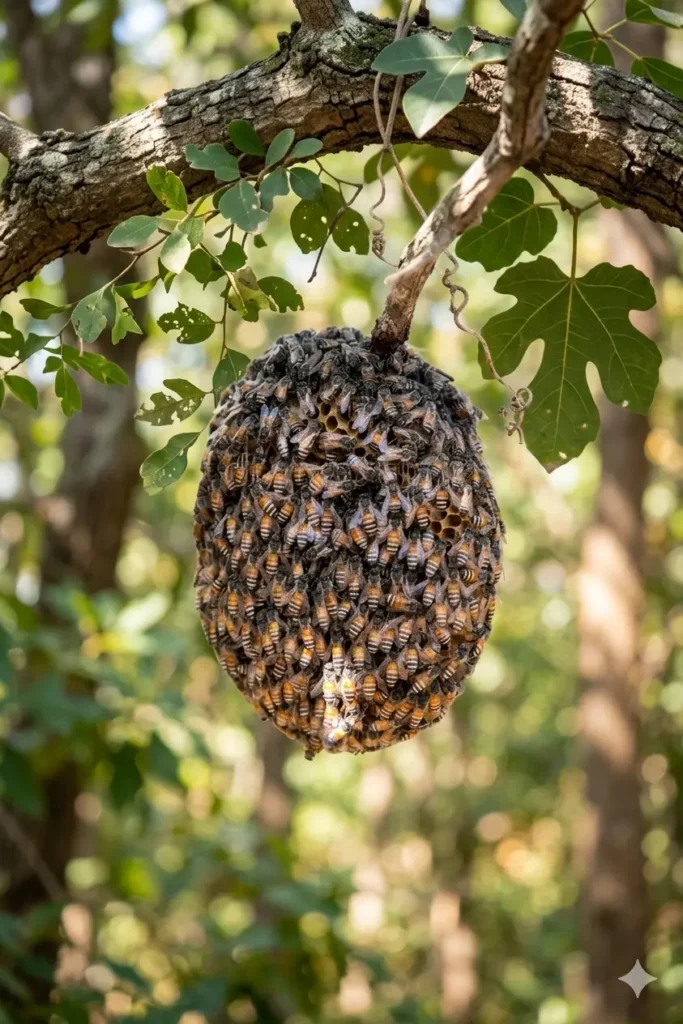
Introduction: The Amazing World of Honey Bees
Have you ever wondered how bee navigation allows a tiny honey bee to leave its hive, travel through the air, find flowers, collect nectar, and return home with remarkable accuracy? This amazing ability depends on the bee’s flight system, the position of the sun, visual landmarks, and its unique way of communicating with other bees.
A honey bee does not use a human-made GPS device or a physical map. Yet, it can navigate through its environment, remember familiar routes, and communicate important information about food sources to other bees.
This remarkable ability has attracted the attention of scientists for decades. Researchers have studied how honey bees use the sun, polarized light, visual landmarks, and internal biological mechanisms to find their way.
The honey bee is also mentioned in the Holy Quran. In Surah An-Nahl, Allah describes how bees are guided toward their homes, how they obtain nourishment, and how a drink of different colors emerges from their bodies.
These Quranic verses encourage reflection on the natural world and the remarkable abilities of living creatures.
In this article, we will explore the honey bee flight system, its navigation abilities, its famous waggle dance, and the relationship between Quranic references and modern scientific research.
The Honey Bee in the Holy Quran
The honey bee is mentioned in Surah An-Nahl, the 16th chapter of the Quran.
The word An-Nahl means “The Bees.” Verses 68 and 69 describe the bee’s homes, its guidance, its food, and the honey produced from its body.
Surah An-Nahl, Verse 68
Arabic Text:
وَأَوْحَىٰ رَبُّكَ إِلَى النَّحْلِ أَنِ اتَّخِذِي مِنَ الْجِبَالِ بُيُوتًا وَمِنَ الشَّجَرِ وَمِمَّا يَعْرِشُونَ
Urdu Translation:
اور آپ کے رب نے شہد کی مکھی کو الہام کیا کہ پہاڑوں میں گھر بنا، درختوں میں اور ان جگہوں میں بھی جو لوگ بناتے ہیں۔
English Translation:
“And your Lord inspired the bee: ‘Take for yourself among the mountains, houses, and among the trees and in that which they construct.'”
— Quran, Surah An-Nahl 16:68
This verse describes the guidance given to the bee and mentions the places where it makes its home.
Honey bees may establish colonies in natural cavities, tree hollows, and other suitable locations. Managed honey bee colonies can also live in hives constructed by humans.
The verse invites readers to reflect on the remarkable behavior of bees and the natural guidance that enables them to survive.
Surah An-Nahl, Verse 69
Arabic Text:
ثُمَّ كُلِي مِنْ كُلِّ الثَّمَرَاتِ فَاسْلُكِي سُبُلَ رَبِّكِ ذُلُلًا ۚ يَخْرُجُ مِنْ بُطُونِهَا شَرَابٌ مُّخْتَلِفٌ أَلْوَانُهُ فِيهِ شِفَاءٌ لِّلنَّاسِ ۗ إِنَّ فِي ذَٰلِكَ لَآيَةً لِّقَوْمٍ يَتَفَكَّرُونَ
Urdu Translation:
پھر ہر قسم کے پھلوں سے کھا اور اپنے رب کے آسان کیے ہوئے راستوں پر چل۔ اس کے پیٹ سے ایک مشروب نکلتا ہے جس کے رنگ مختلف ہوتے ہیں، اس میں لوگوں کے لیے شفا ہے۔ بے شک اس میں غور و فکر کرنے والوں کے لیے ایک نشانی ہے۔
English Translation:
“Then eat from all the fruits and follow the ways of your Lord laid down for you. There emerges from their bellies a drink, varying in colors, in which there is healing for people. Indeed, in that is a sign for a people who give thought.”
— Quran, Surah An-Nahl 16:69
This verse mentions the bee’s food, its paths, and the honey produced from its body.
The phrase “follow the ways of your Lord” is particularly interesting when considering the bee’s remarkable ability to navigate its surroundings.
Modern research helps us understand the biological mechanisms that bees use to find food and return to their colonies.
The Quranic verse and scientific findings should, however, be understood in their proper contexts. The verse provides religious guidance and reflection, while scientific studies investigate the physical mechanisms of bee navigation.
Note: The Urdu and English translations above are translations of the meaning. Different recognized Quran translations may use slightly different wording.
Understanding the Honey Bee Flight System
The honey bee’s flight system is a remarkable example of biological engineering.
A bee’s body contains specialized structures that allow it to fly, maintain balance, and move through the air with precision.
Its wings, flight muscles, sensory organs, and nervous system work together to support its movement.
1. How Honey Bees Move Their Wings
Honey bees have two pairs of wings.
During flight, their wings move rapidly and create aerodynamic forces that allow the bee to lift its body and move through the air.
Their wings do not simply move up and down like ordinary fans. Instead, they follow complex patterns involving changes in angle and direction.
These movements help bees:
- Lift their bodies into the air.
- Move forward and backward.
- Change direction.
- Hover near flowers.
- Adjust their flight in response to air movement.
The ability to control these movements is essential when bees collect nectar from flowers.
2. How Honey Bees Maintain Balance
A honey bee must maintain its balance while flying.
When it approaches a flower, it needs to control its position carefully. Even a small change in wind direction can affect its movement.
The bee’s visual system and sensory organs help it detect changes in its surroundings.
Its flight muscles then make adjustments that help maintain stability.
This is especially important when the bee is hovering near a flower or landing on a small surface.
3. The Role of Flight Muscles
Honey bees have powerful flight muscles inside their thorax, the middle section of their bodies.
These muscles generate the movement of the wings.
The muscles are adapted for repeated contractions, allowing bees to sustain flight and travel between food sources.
Their flight system is also closely connected to their energy requirements. A bee must balance the energy spent flying with the amount of food it collects.
This makes honey bee flight an important subject in biological research and the development of small flying robots.
How Do Honey Bees Navigate?
One of the most fascinating abilities of honey bees is their navigation system.
When a bee leaves its hive, it must determine where to fly, locate food sources, and find its way back home.
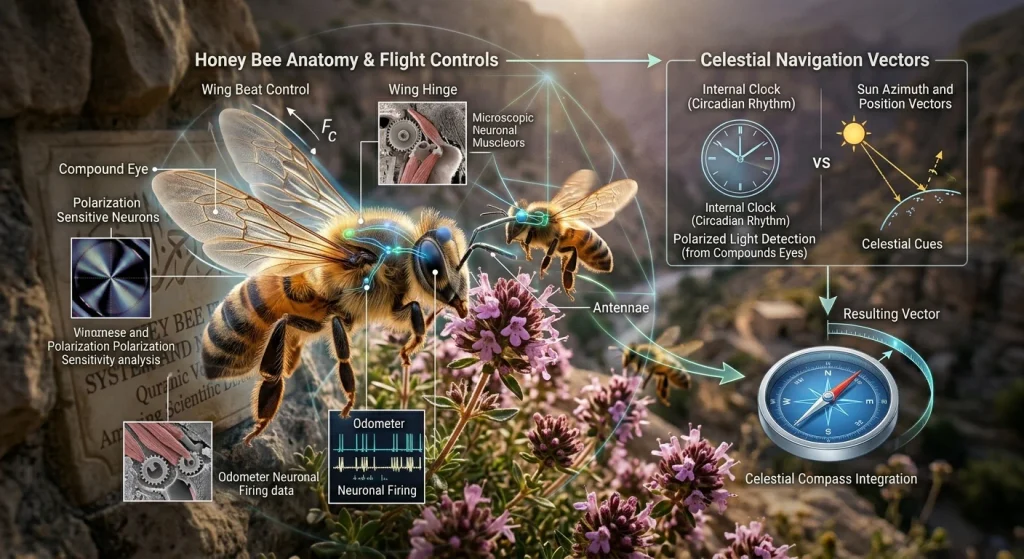
Scientific research has shown that honey bees use multiple sources of information to navigate. These include the sun, polarized light, familiar landmarks, and memories of their surroundings.
1. The Sun Compass
Honey bees can use the sun as a natural compass.
The position of the sun provides a directional reference that helps bees determine where to fly.
The bee’s navigation system compensates for this predictable movement.
For example, a bee may learn the direction of a food source during a morning flight. When it returns later, the sun may have moved across the sky.
Researchers have found that honey bees possess an internal time mechanism that helps them adjust their sun compass throughout the day.
This ability allows bees to maintain a useful directional reference even as the sun’s position changes.
2. Polarized Light and the Bee’s Vision
Another remarkable feature of honey bee navigation is its ability to detect polarized light.
When sunlight passes through Earth’s atmosphere, it is scattered in different directions. This scattering creates patterns of polarized light across the sky.
Humans generally cannot detect these patterns directly without special equipment.
Honey bees, however, have visual receptors that are sensitive to polarized light.
This allows them to obtain directional information from the sky.
Even when the sun is hidden behind clouds, a bee may still use the visible portion of the sky to obtain compass information.
Scientific experiments have demonstrated that honey bees can use polarized-light cues to navigate through specially designed flight environments.
This is an important discovery because it shows that bee navigation does not depend exclusively on seeing the sun directly.
3. Remembering Landmarks and Routes
Honey bees also use visual landmarks to navigate.
During their flights, they may learn the appearance of nearby trees, buildings, flowers, and other features of the landscape.
These visual memories can help them recognize familiar places.
For example, a bee may remember the position of a flowering garden relative to its hive.
When it returns to the area, familiar landmarks can help it identify the route.
Research suggests that honey bee navigation involves the integration of several types of information, including compass cues and landscape memories.
This combination of abilities makes the honey bee’s navigation system both flexible and efficient.
The Famous Honey Bee Waggle Dance
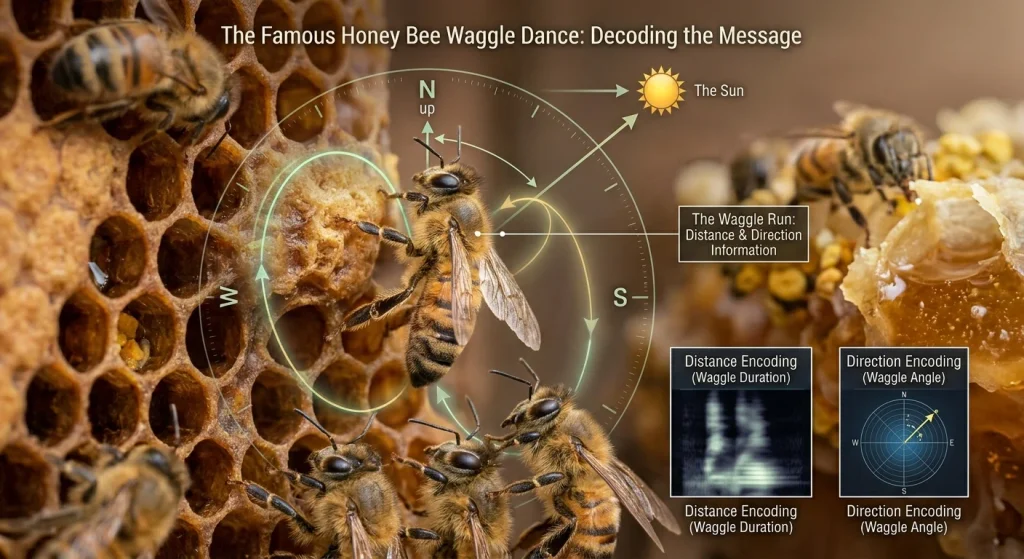
One of the most famous discoveries in honey bee research is the waggle dance.
The waggle dance is a communication system used by worker bees to share information about food sources with other members of their colony.
When a bee finds a valuable source of nectar or pollen, it may return to the hive and perform a special movement on the honeycomb.
Other bees can observe this dance and obtain information about the location of the food source.
How Does the Waggle Dance Work?
The waggle dance contains information about two important things:
1. Direction
The angle of the waggle run relative to the vertical direction of the honeycomb indicates the direction of the food source relative to the sun.
For example, a particular angle in the dance corresponds to a particular angle between the sun and the food source.
2. Distance
The duration of the waggle run provides information about the distance to the food source.
In general, a longer waggle run indicates a more distant food source, although the relationship can also be influenced by the route and environmental conditions.
These signals help other bees decide where to fly when searching for food.
The waggle dance is one of the best-known examples of communication in the animal kingdom.
It demonstrates how a small insect can share complex information through a combination of movement, timing, and orientation.
The Connection Between Honey Bee Navigation and Surah An-Nahl
Surah An-Nahl, verse 69, contains the phrase:
Arabic:
فَاسْلُكِي سُبُلَ رَبِّكِ ذُلُلًا
Urdu:
اور اپنے رب کے آسان کیے ہوئے راستوں پر چل۔
English:
“And follow the ways of your Lord laid down for you.”
— Quran, Surah An-Nahl 16:69
The verse describes the bee’s paths and the guidance provided to it.
Modern research has helped explain some of the biological mechanisms that allow bees to navigate these paths.
For example, scientists have studied how bees use the sun, polarized light, and familiar landmarks to find food and return to their colonies.
These scientific findings offer an opportunity to reflect on the remarkable abilities of bees and the natural world.
However, it is important to avoid claiming that the verse explicitly describes a particular modern scientific mechanism unless such an interpretation is supported by reliable Quranic scholarship.
The Quranic verse has its own religious meaning, while scientific research provides an explanation of the physical processes involved in bee navigation.
Both can be discussed thoughtfully without overstating what either one establishes.
Scientific Research on Honey Bee Navigation
Honey bee navigation has been studied extensively by researchers.
Some important findings include:
Research on Polarized Light
A study published in 2011 examined whether honey bees could use polarized light as a compass.
Researchers trained bees to navigate through a series of connected tunnels using directional information provided by polarized illumination.
The results demonstrated that bees could learn to use polarized-light information to navigate toward a food source.
Research on the Waggle Dance
A study published in 2014 investigated whether bees could obtain compass information from polarized light and communicate it through their waggle dance.
The researchers found that bees could use polarized-light information to signal possible directions of food sources to other bees.
Research on Navigation and Memory
A review published in 2023 examined how honey bees combine navigation, landscape memory, and dance communication.
The research discussed how bees form memories of their surroundings and use these memories during navigation and communication.
These findings show that honey bee navigation is not a simple process. It involves several interacting abilities that scientists continue to investigate.
Honey Bees and the Importance of Pollination
Honey bees are important not only because of their navigation abilities but also because of their ecological role.
When bees visit flowers to collect nectar and pollen, they may transfer pollen between flowers.
This process is known as pollination.
Pollination helps many flowering plants reproduce and is important for the production of numerous crops.
Honey bees therefore contribute to ecosystems and agricultural systems.
Their ability to locate flowers and communicate information about food sources supports the efficiency of their foraging activities.
The relationship between bees, flowering plants, and the environment is an important example of how different living organisms depend on one another.
Why Does Honey Come in Different Colors?
Surah An-Nahl, verse 69, mentions a drink that emerges from the bee and varies in color.
Honey can range from very light golden shades to darker brown colors.
Its color and flavor depend on several factors, including:
- The flowers from which nectar is collected.
- The natural composition of the nectar.
- The region where the bees forage.
- The processing and storage conditions.
Different floral sources produce honey with different characteristics.
This natural variation is one of the reasons honey is studied in food science and agricultural research.
Is Honey a Cure for Every Disease?
The Quran mentions that honey contains healing for people.
Modern research has also examined some potential health-related properties of honey.
However, it is important to understand that honey is not a guaranteed cure for every disease.
Some medical uses of honey have been studied, including its potential role in certain wound-care applications and its use for soothing coughs in some circumstances.
The evidence varies depending on the condition and the type of honey used.
Honey should not replace prescribed medical treatment, and people with specific health conditions should seek advice from qualified healthcare professionals.
10 Amazing Facts About Honey Bees
- Natural Compass: Honey bees can use the sun as a directional reference.
- Polarized-Light Vision: Their visual system can detect patterns of polarized light.
- Waggle Dance: They communicate food-source information through a special dance.
- Landscape Memory: They can learn and recognize familiar landmarks.
- Time Compensation: Their internal timing mechanisms help adjust for the sun’s movement.
- Efficient Flight: Their wings and flight muscles allow them to move through the air with precision.
- Pollination: They help transfer pollen between flowers.
- Social Organization: Honey bee colonies contain different groups of workers performing different tasks.
- Honey Production: They process collected nectar into honey.
- Collective Foraging: Their communication helps colonies exploit food sources more efficiently.
These abilities make honey bees an important subject in biology, ecology, and scientific research.
What Can We Learn From the Honey Bee?
The honey bee provides many opportunities for reflection.
Its flight system demonstrates the complexity of biological movement.
Its navigation system reveals how animals can combine sensory information, memory, and internal timing.
Its waggle dance demonstrates the importance of communication and cooperation.
The Quranic verses about bees encourage reflection on their homes, guidance, and the honey they produce.
When these subjects are studied together, they can inspire curiosity about the natural world and encourage a deeper appreciation of the remarkable abilities of living creatures.
Scientific research helps us understand how these systems operate, while the Quran invites believers to reflect on the signs of creation.
The honey bee is therefore an excellent example of how observation, learning, and thoughtful reflection can enrich our understanding of nature.
Conclusion: A Tiny Creature With Remarkable Abilities
The honey bee may be small, but its abilities are remarkable.
Its flight system allows it to move through the air with precision. Its navigation system helps it locate food and return to its hive. Its visual system can detect polarized light, and its waggle dance allows it to communicate information about food sources.
Modern scientific research continues to uncover more details about these abilities.
The Quran also mentions the honey bee in Surah An-Nahl, verses 68 and 69, describing its guidance, its paths, and the honey produced from its body.
These verses encourage people to reflect on the natural world and the signs found in living creatures.
The study of honey bees reminds us that even the smallest creatures can reveal fascinating aspects of nature.
By combining careful scientific research with thoughtful reflection, we can develop a deeper appreciation of the remarkable world around us.
Indeed, the natural world contains countless signs that invite us to observe, learn, and reflect.
Frequently Asked Questions (FAQs)
1. How do honey bees find their way home?
Honey bees use several navigation methods, including the sun compass, polarized light, visual landmarks, and memories of familiar routes.
2. What does the Quran say about honey bees?
The Quran mentions honey bees in Surah An-Nahl, verses 68 and 69. These verses discuss their homes, guidance, food, and the honey they produce.
3. What is the honey bee waggle dance?
The waggle dance is a special movement performed by worker bees to communicate the direction and approximate distance of food sources to other bees.
4. Can honey bees navigate when the sun is hidden?
Yes. Honey bees can use polarized-light patterns in the sky and familiar landmarks to obtain directional information even when the sun is not directly visible.
5. Why is honey bee navigation important to science?
Honey bee navigation helps scientists understand animal behavior, visual processing, memory, communication, and the development of biologically inspired navigation systems.
6. Is honey bee navigation a recent scientific discovery?
No. Honey bee navigation has been studied for decades. Modern research continues to investigate its mechanisms and uncover additional details.
7. Does the Quran explicitly describe the honey bee’s polarized-light compass?
Surah An-Nahl mentions the bee’s guidance and paths. Polarized-light navigation is a scientific explanation of one mechanism used by bees. The verse should not be presented as explicitly naming this particular mechanism.
Explore More About Pure Honey
Continue exploring our collection of helpful honey guides to learn more about choosing, using, storing, and enjoying pure natural honey.
-
10 Signs You’re Buying Fake Honey
Learn how to identify common warning signs before purchasing honey. -
How to Test if Your Honey is 100% Pure and Raw at Home
Discover simple ways to better understand the characteristics of genuine honey. -
Raw Honey vs Processed Honey: Which One Is Better?
Compare the differences between raw and processed honey. -
How to Use Honey Every Day: 15 Healthy Ideas
Learn about proper storage, shelf life, and crystallization. -
The Sunnah of Raw Honey: Healing and Health Benefits in Islamic Tradition
Explore the significance of honey in Islamic teachings and tradition.
🐝 Explore Honey Bee Navigation, Flight and Quranic References
Physiological Reviews
Flight ResearchExplore a scientific review of honey bee flight, visually guided movement, navigation, and how bee research inspires biologically based robotics.
Philosophical Transactions of the Royal Society B
Navigation StudyRead a scientific study examining how honey bees use polarized light as a compass and communicate directional information through their waggle dance.
Journal of Comparative Physiology A
2023 Research ReviewDiscover how honey bees combine navigation, landscape memory, and dance communication to locate food sources and share information with their colony.
The Noble Quran – Surah An-Nahl
Quranic ReferenceRead Surah An-Nahl, verses 68–69, with the original Arabic text and English translation. These verses discuss the bee, its guidance, and the honey it produces.