
Introduction
The Quran is not merely a book of words; it is a divine message of guidance, mercy, and healing for all of humanity. Sent down by Allah (SWT) to pull mankind out of darkness and into the light, it serves as a timeless roadmap for the human soul. Understanding how this sacred text was revealed illuminates its profound significance and underscores why it remains an unalterable source of light for every heart.
The Divine Origin: From the Preserved Tablet
Before its revelation to mankind, the Quran existed in a celestial realm. Allah (SWT) kept the entire text securely recorded in the Lauh al-Mahfuz (The Preserved Tablet).
From this highest station, Allah commanded the Quran to be brought down during the holiest night of the year—Laylat al-Qadr (The Night of Decree)—in the sacred month of Ramadan. It was sent as a whole down to the Bayt al-Izza (The House of Honor) in the lowest heaven, ready to be delivered to the earthly realm.
The Chosen Messenger and the First Revelation
To deliver this ultimate truth, Allah chose the most noble, trustworthy, and pure-hearted man in history: Prophet Muhammad (peace be upon him).
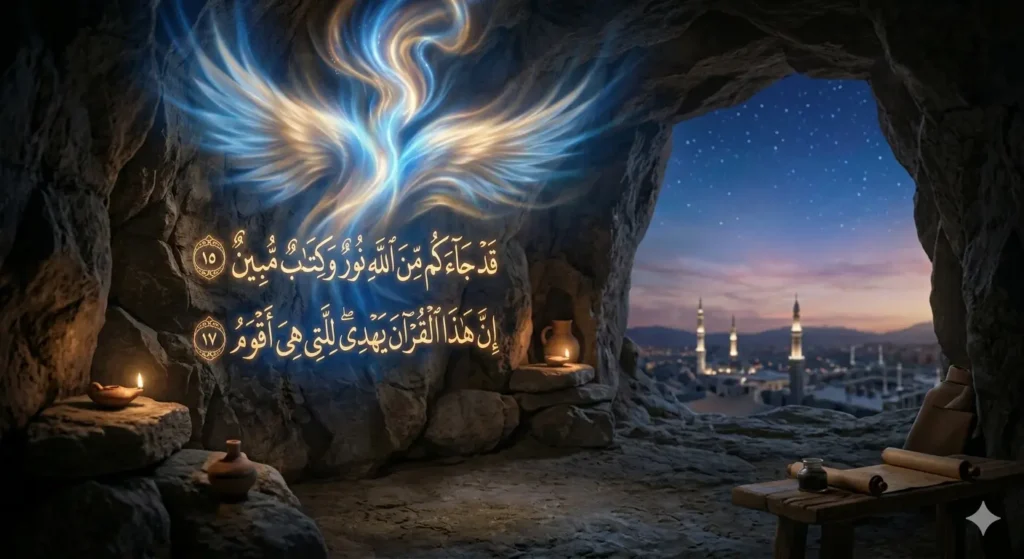
The revelation on earth began in the year 610 CE. Seeking spiritual solitude, the Prophet (PBUH) was meditating inside the secluded Cave of Hira on the Mountain of Light (Jabal al-Nour) near Mecca.
Suddenly, the Archangel Jibril (Gabriel)—the spirit of holiness and the chief of all angels—appeared before him in overwhelming majesty. He commanded the Prophet:
“Iqra!” (Read / Recite!)
The Prophet, who was unlettered, replied, “I cannot read.” The angel embraced him tightly until his breath was nearly spent, repeating the command three times. Then, the first light of the Quran pierced the earthly realm with the revelation of the first five verses of Surah Al-Alaq:
$$ \text{Recite in the name of your Lord who created—Created man from a clinging substance…} $$
A Gradual Guidance: The 23-Year Journey
Unlike previous scriptures that were delivered all at once, the Quran was revealed gradually over a span of approximately 23 years. This step-by-step revelation served a profound divine purpose:
- Strengthening the Prophet’s Heart: It provided continuous comfort, reassurance, and divine support to Prophet Muhammad (PBUH) as he faced intense opposition and hardships.
- Contextual Legislation: Verses were often revealed in response to specific events, questions, or challenges faced by the early Muslim community, making the guidance deeply practical.
- Ease of Memorization and Application: It allowed the companions to fully memorize, understand, and integrate the laws and spiritual teachings into their daily lives before new ones were introduced.
Meccan vs. Medinan Eras
The chronological journey of the revelation is distinctly divided into two major phases, reflecting the growth of the Islamic message:
The Meccan Period (Approx. 13 Years)
Focused on the core foundation of faith (Aqeedah). The verses revealed during this time are powerful, rhythmic, and deeply moving. They emphasize:
- The absolute Oneness of Allah (Tawhid).
- The reality of the Day of Judgment, Paradise, and Hellfire.
- Purity of character, patience, and steadfastness under persecution.
The Medinan Period (Approx. 10 Years)
Following the migration (Hijrah) to Medina, the Muslim community grew into a structured society. The verses from this era focus on:
- Social, civil, and criminal laws.
- Family structures, marriage, divorce, and inheritance.
- Statehood, justice, treaties, and community responsibilities.
The Structure of the Quran: A Divine Blueprint
To truly appreciate the flawless preservation and design of the Quran, it helps to understand how it is structurally organized. Though it was revealed over 23 years, its final arrangement was divinely ordered by Allah (SWT) through the Archangel Jibril.
1. Surahs (Chapters)
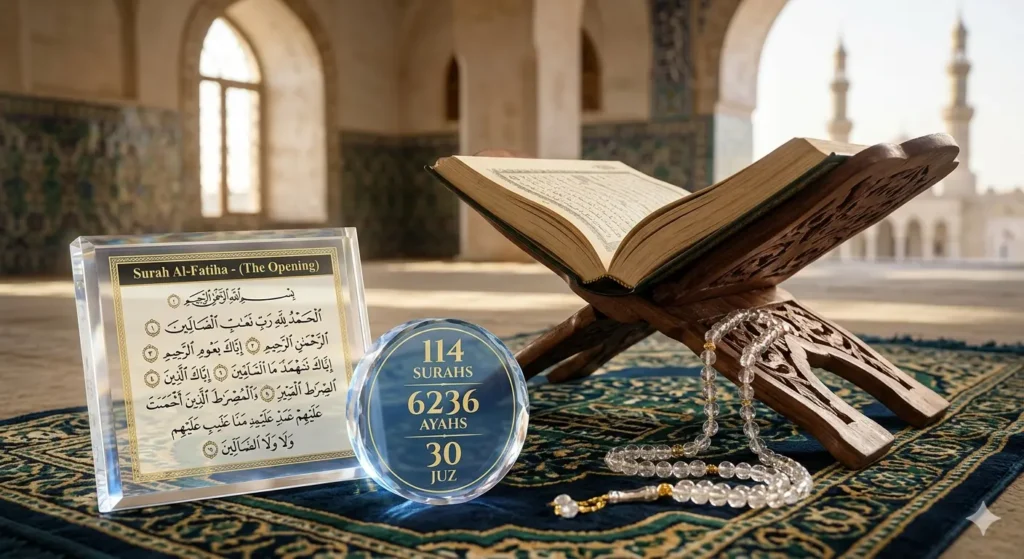
The Quran contains a total of 114 Surahs.
- They are not arranged chronologically (by the date they were revealed), but rather by a specific divine order.
- The longest chapter is Surah Al-Baqarah (The Cow) with 286 verses.
- The shortest chapter is Surah Al-Kawthar (The Abundance) with only 3 verses.
- Every single Surah begins with “Bismillahir-Rahmanir-Rahim” (In the name of Allah, the Entirely Merciful, the Especially Merciful), except for Surah At-Tawbah (Chapter 9).
2. Ayahs (Verses)
There are 6,236 Ayahs (verses) in the Quran.
- The word Ayah literally translates to a “sign” or “miracle.” Each verse is a divine sign pointing toward the truth of the Creator.
- The longest single verse in the Quran is the Verse of Loan (Surah Al-Baqarah, 2:282), which details commercial justice and contract laws.
3. Juz (Parts) and Hizb
To facilitate easy reading, recitation, and memorization—especially during the holy month of Ramadan—the text is divided into equal administrative portions:
- 30 Juz (Parts): The entire Quran is divided into 30 equal parts. This allows a reader to complete the entire book in one month by reading one Juz per day.
- 60 Hizb: Each Juz is further divided into two halves, known as a Hizb (making 60 total), allowing for even more structured daily pacing.
Summary Table
You can include this quick-reference table in your blog post or WooCommerce page for easy reading:
| Structural Element | Total Count | Key Detail |
| Total Chapters (Surahs) | 114 | 86 Meccan Chapters / 28 Medinan Chapters |
| Total Verses (Ayahs) | 6,236 | Each verse serves as a divine “sign” |
| Total Parts (Juz) | 30 | Perfect for completing the Quran in 30 days |
| Total Words | Approx. 77,430 | Rich, classical Arabic vocabulary |
| Total Letters | Approx. 323,670 | Tremendous reward: 10 rewards per letter recited |
Major Themes Covered in the Text
When explaining the content of these 114 chapters, they generally consolidate into five overarching themes:
Intellectual Reflection: Continuous commands from Allah for humans to use their intellect, observe nature, and ponder the cosmos.
Divine Preservation: An Unalterable Light
Tawhid (The Oneness of God): Establishing the absolute lordship, names, and attributes of Allah.
Prophethood (Risalah): Stories of the 25 prophets explicitly mentioned by name (such as Adam, Noah, Abraham, Moses, Jesus, and Muhammad) to serve as role models.
The Hereafter (Akhirah): Vivid descriptions of the soul’s journey, accountability, Judgment Day, Paradise (Jannah), and Hellfire (Jahannam).
Law and Ethics (Sharia): Practical guidance on prayer, charity, fasting, business transactions, marriage, and human rights.
One of the greatest miracles of the Quran is its flawless preservation. Allah (SWT) explicitly takes responsibility for safeguarding it from any human alteration, declaring in Surah Al-Hijr:
“Indeed, it is We who sent down the Quran and indeed, We will be its guardian.”
Throughout its 23-year revelation, as soon as verses were received, the Prophet (PBUH) would recite them to his companions. He appointed designated scribes to write them down on parchment, leather, and bone, while thousands of companions memorized the text verbatim.
Because it was preserved both in writing and in the hearts of men, the Quran read today across the globe is identical to the exact words uttered by Prophet Muhammad (PBUH) over 1,400 years ago—not a single letter has changed.
The Double-Lock System: Hearts and Parchment
The absolute preservation of the Quran was achieved through a flawless, simultaneous system of oral memorization and written documentation established right from the very first revelation.
- Preservation in the Hearts (Oral Tradition): Prophet Muhammad (PBUH) was the first Hafiz (memorizer) of the Quran. Every Ramadan, the Archangel Jibril would review the entire revealed text with him. The Prophet, in turn, recited it slowly to his companions, who instantly committed the rhythmic, poetic verses to memory. In an era where Arabs were renowned for their extraordinary oral memory, thousands of companions memorized whole chapters verbatim.
- Preservation on Material (Written Tradition): Whenever a verse was revealed, the Prophet (PBUH) immediately summoned his designated scribes—such as Zayd ibn Thabit, Ubayy ibn Ka’b, and Ali ibn Abi Talib—to write it down. They recorded the text on available materials of the time, including parchment, leather, shoulder blades of camels, and smooth stones. The Prophet would then visually verify the writing to ensure absolute accuracy.
The Compilation into a Single Volume
While the verses were completely written down during the Prophet’s lifetime, they were kept as separate manuscripts. The structural compilation happened in two historic phases:
- The First Official Book (The Caliphate of Abu Bakr): Following the Battle of Yamama, where many prominent Quran memorizers fell, Umar ibn al-Khattab realized the urgent need to collect all written pieces into one place. Caliph Abu Bakr commissioned Zayd ibn Thabit to lead this monumental task. Zayd utilized an incredibly strict verification process: he would not accept any written verse unless two independent witnesses swore it was written directly in the presence of the Prophet, and it matched the memorized recitations of the living companions. This gathered copy became the official master manuscript.
- The Standardization (The Caliphate of Uthman): As Islam expanded rapidly into non-Arabic regions like Persia and Byzantium, regional dialects began to cause slight variations in pronunciation. To safeguard the unity of the Ummah, Caliph Uthman ibn Affan retrieved the master manuscript, had flawless copies made in the primary Quraishi dialect, and distributed them to every major Islamic province. All subsequent copies made throughout history trace back directly to these Uthmanic codices (Mus’haf).
A Living Miracle of Textual Integrity
Today, the Quran stands as a unique linguistic phenomenon. If every printed book in the world were to vanish tomorrow, the Quran is the only book that could be perfectly restored in a single day. Millions of Muslims—men, women, and children from every linguistic background—have the entire book memorized from cover to cover. From the structural layout of its chapters to the precise rules of pronunciation (Tajweed), the light of the Quran has been passed down through an unbroken chain of narration, remaining a pure, unalterable guide for every heart.
1. Verses on Guidance and Light
Surah Al-Ma’idah (5:15–16)
“…There has come to you from Allah a light and a clear Book. By which Allah guides those who pursue His pleasure into the ways of peace and brings them out from darknesses into the light, by His permission, and guides them to a straight path.”
Surah Al-Isra (17:9)
“Indeed, this Quran guides to that which is most suitable and gives good tidings to the believers who do righteous deeds that they will have a great reward.”
2. Verses on Peace and Healing for the Heart
Surah Ar-Ra’d (13:28)
“Those who have believed and whose hearts are assured by the remembrance of Allah. Unquestionably, by the remembrance of Allah hearts are assured.”
Surah Yunus (10:57)
“O mankind, there has to come to you instruction from your Lord and healing for what is in the breasts and guidance and mercy for the believers.”
3. Verses on Divine Preservation (Matching Your Section)
Surah Al-Hijr (15:9)
“Indeed, it is We who sent down the Quran and indeed, We will be its guardian.”
Surah Al-Buruj (85:21–22)
“But this is an honored Quran. [Inscribed] in a Preserved Slate.”
4. Verses on Revelation and the Month of Ramadan
Surah Al-Baqarah (2:185)
“The month of Ramadan [is that] in which was revealed the Quran, a guidance for the people and clear proofs of guidance and criterion…”
Surah Al-Qadr (97:1)
“Indeed, We sent the Quran down during the Night of Decree.”
To truly appreciate the flawless preservation and design of the Quran, it helps to understand how it is structurally organized. Though it was revealed over 23 years, its final arrangement was divinely ordered by Allah (SWT) through the Archangel Jibril.
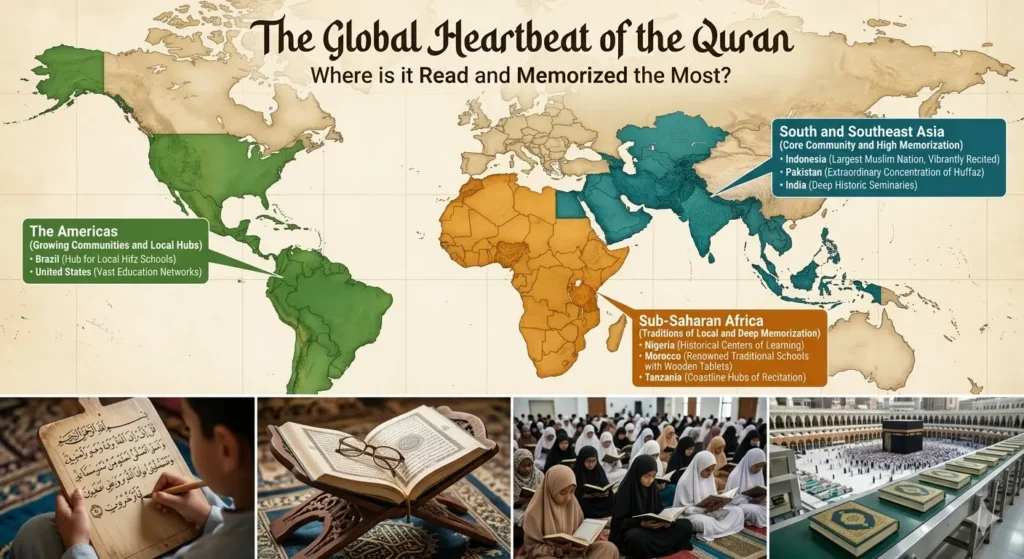
The Global Heartbeat of the Quran: Where is it Read and Memorized the Most?
The Holy Quran is the most recited book in the world, read daily by over two billion Muslims across every continent. While it is deeply integrated into daily life globally, certain regions and countries stand out due to their massive populations, cultural traditions, and dedicated institutions for Quranic memorization (Hifz) and reading (Tilawat).
Here is a look at the absolute hubs of Quranic recitation in the world today.
1. South and Southeast Asia (The Largest Volume of Readers)
By sheer numbers, the Asia-Pacific region is home to over 60% of the world’s Muslim population, making it the geographic center where the Quran is read by the most individuals on a daily basis.
- Indonesia: As the world’s largest Muslim-majority nation (home to over 242 million Muslims), it hosts an incredibly vibrant culture of daily recitation. The Quran is read in millions of homes, traditional boarding schools (Pesantren), and mosques daily.
- Pakistan & Bangladesh: Pakistan (over 240 million Muslims) and Bangladesh (over 150 million) feature deep-rooted traditions of Quranic education. Pakistan is widely recognized for having an extraordinarily high concentration of Huffaz (individuals who have memorized the entire Quran), with estimates exceeding 1 million people.
- India: Despite being a minority community in the country, India’s Muslim population stands at roughly 200 million, contributing significantly to global daily recitations through a vast network of historic Islamic seminaries.
2. Egypt (The Gold Standard of Recitation)
There is a famous saying in the Islamic world: “The Quran was revealed in Mecca, written in Istanbul, and recited in Egypt.”
Egypt is universally celebrated as the global epicenter for the art of beautiful recitation (Tajweed and Tarteel).
- Al-Azhar University: Based in Cairo, this legendary institution has trained the world’s most renowned professional reciters (Qaris), whose voices are broadcast across the globe.
- Egyptian families place immense cultural emphasis on beautiful, public, and private recitations of the text.
3. Morocco (The Leader in Memorization)
Morocco holds a fiercely proud, centuries-old tradition of preserving the Quran through traditional methods.
- Unrivaled Traditional Schools: Morocco utilizes traditional, local Quranic schools (Masjids and Zawiyas) where young children learn to write verses on wooden tablets to memorize them perfectly.
- According to international recognitions, including tracking from UNESCO, Morocco is frequently celebrated as a leading country for its sheer density of certified Quran memorizers, with well over 1.5 million people having committed the entire text to memory—a massive portion of which thrives in its rural communities.
4. Saudi Arabia (The Fountainhead of Islamic Scholarship)
As the birthplace of Islam and the home of the Two Holy Mosques in Makkah and Madinah, Saudi Arabia holds a unique place in Quranic reading.
- The King Fahd Holy Quran Printing Complex: Located in Madinah, this complex prints tens of millions of copies of the Quran each year, distributing them worldwide.
- Global Hub: Millions of pilgrims traveling for Hajj and Umrah read the Quran continuously within the holy sanctuaries, making it a place of non-stop, 24/7 recitation.
The Quran’s Recognition of Prior Revelations
A beautiful aspect of Islamic faith is its continuity; the Quran does not stand in isolation but validates the long chain of divine guidance sent to humanity. The Holy Quran explicitly commands Muslims to believe in the original scriptures revealed before it, describing them as sources of “guidance and light” for their respective times. As Muslims, our faith is incomplete without honoring these holy books and the noble Prophets who brought them.
The Quran specifically mentions three major divine books revealed before it:
- The Tawrat (Torah): Revealed to Prophet Musa (Moses) Alayhi Salam (A.S.). The Quran recognizes it as a magnificent source of law and guidance for the Children of Israel.
- The Zabur (Psalms): Revealed to Prophet Dawud (David) A.S., containing beautiful praises, prayers, and spiritual wisdom.
- The Injeel (Gospel): Revealed to Prophet Isa (Jesus) A.S., sent to confirm the truths before it and to preach compassion, love, and devotion.
While the Quran acknowledges that the text of these previous scriptures was not preserved in its original form over the centuries, it honors their divine origin. Today, the Holy Quran stands as the Furqan (the criterion) and the final, perfectly preserved testament—a ultimate light sent to guide all of humanity until the end of time.
Explore More About the Quran
Continue your journey of learning by exploring our helpful articles about the Holy Quran, its meanings, understanding, and guidance for everyday life.
-
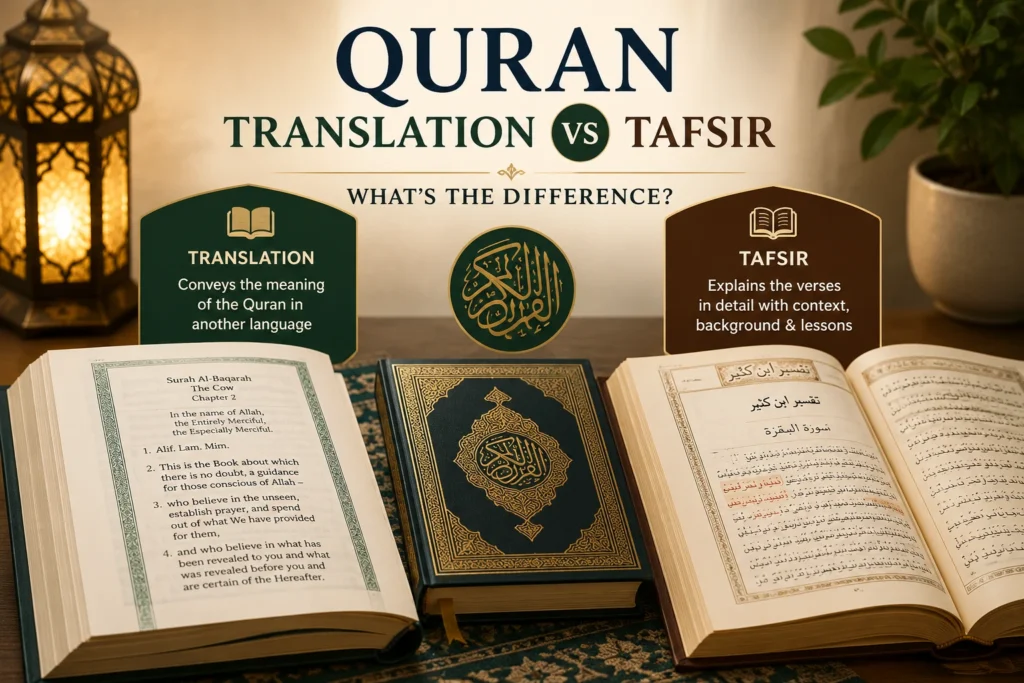
Quran Translation vs Tafsir
Understand the difference between reading a translation of the Quran and studying its detailed explanation through Tafsir. -
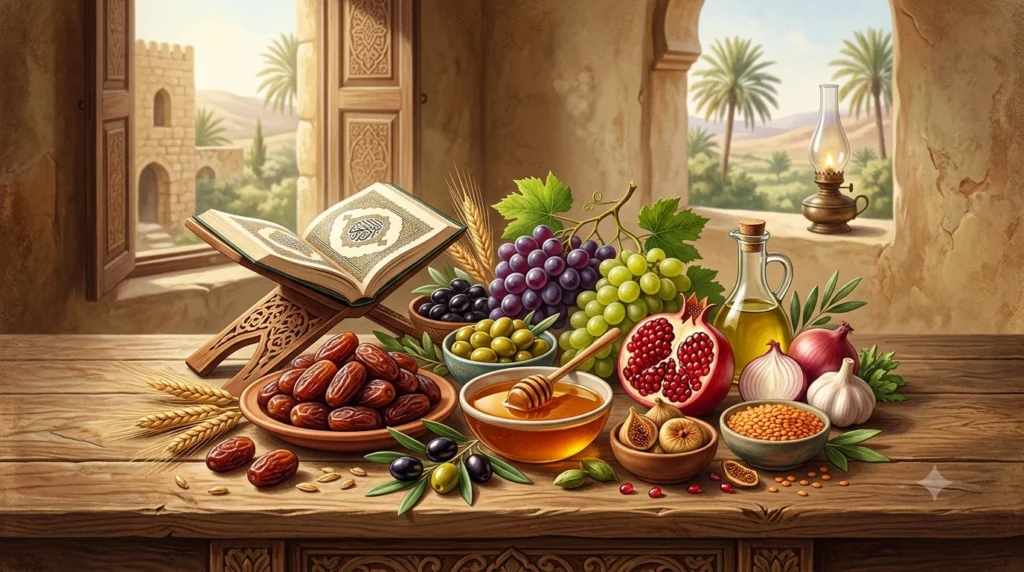
10 Foods Mentioned in the Quran and Their Benefits
Learn about the blessed foods mentioned in the Quran and explore their significance in Islamic tradition and everyday life.
📖 Authentic Repositories for Quranic Study
Quran.com (Digital Text & Recitation)
Primary TextAccess the complete Quranic text in Arabic with word-by-word translations, audio recitations, and verse commentary.
QuranicAudio (Authentic Recitations)
Audio LibraryHigh-quality audio recitations of the Holy Quran by renowned world reciters for spiritual reflection and listening.
Sunnah.com (Hadith on Virtues of Quran)
Prophetic WisdomAuthentic prophetic narrations regarding the virtues, spiritual healing, and rewards of reading and living by The Quran.
Very true the quran is the light for every heart