Introduction
The Holy Quran is more than a book to be recited; it is a divine source of guidance, wisdom, mercy, and spiritual nourishment. As Muslim parents, one of our greatest responsibilities is to instill a love for reading the Quran in children and help them develop a meaningful and lasting relationship with the Book of Allah. We want them not only to recognize Arabic letters and memorize Surahs but also to enjoy reciting the Quran, understand its message, and apply its teachings in their daily lives.
However, developing this love requires more than simply asking children to read a few pages every day. Children learn best when they feel encouraged, supported, and inspired by the example of the adults around them. A positive Quran-learning environment can help them associate recitation with peace, family bonding, curiosity, and closeness to Allah.
Allah reminds believers of their responsibility toward their families:
Quranic Reference: Surah At-Tahrim (66:6)
Arabic:
يَا أَيُّهَا الَّذِينَ آمَنُوا قُوا أَنْفُسَكُمْ وَأَهْلِيكُمْ نَارًا
Translation: “O you who have believed, protect yourselves and your families from a Fire…”
This verse establishes the importance of taking responsibility for our families’ spiritual well-being. Teaching children about the Quran is one meaningful way parents can help them grow in faith and learn to distinguish right from wrong.
So, how can parents nurture a genuine love for Quran recitation in their children? Here are five practical and faith-centered approaches supported by the Quran and authentic Hadith.
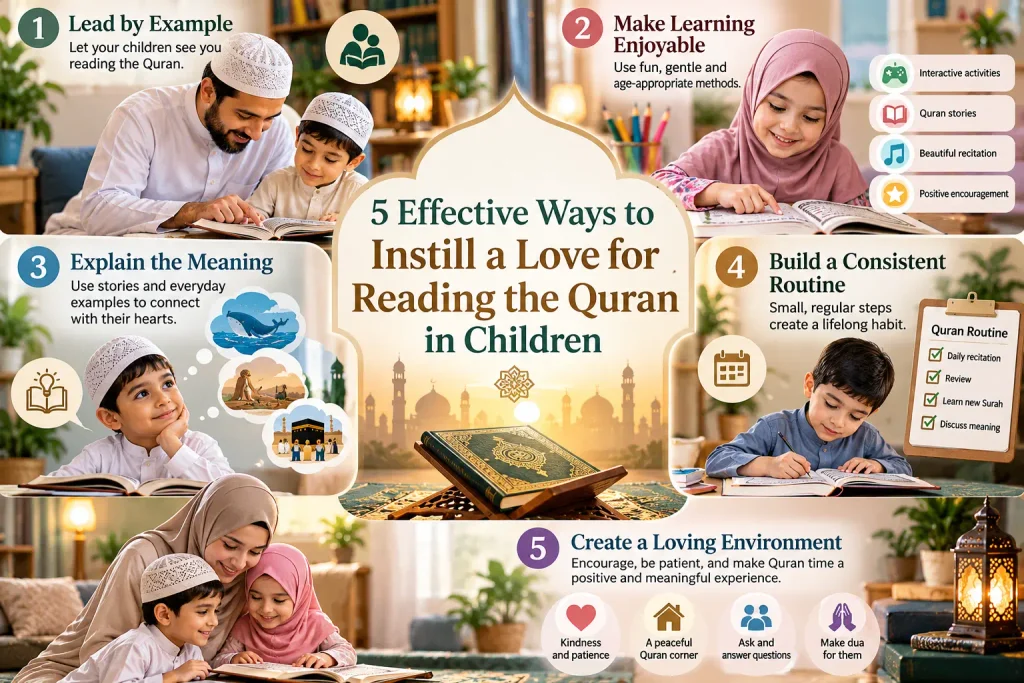
1. Lead by Example: Let Your Children See You Reading the Quran
Children are natural observers. They often develop habits by watching the people they love and trust. If parents want their children to love reading the Quran, one of the most effective steps is to make Quran recitation a visible and natural part of family life.
Instead of making Quran reading something that only children are expected to do, let them see you reciting the Quran regularly. Read after Fajr, before going to bed, or at another convenient time during the day. When children repeatedly observe their parents turning to the Quran, they begin to understand that it is an important part of a Muslim’s life.
You can also establish a small family Quran routine. For example, after Maghrib, family members might spend ten minutes reading or listening to the Quran together. Younger children can listen to a short Surah, while older children can take turns reciting a few verses.
The goal is to make Quran recitation feel like a natural family habit rather than an occasional assignment.
What does the Quran teach us?
Allah says:
Surah Al-Baqarah (2:44)
Arabic:
أَتَأْمُرُونَ النَّاسَ بِالْبِرِّ وَتَنْسَوْنَ أَنْفُسَكُمْ
Translation: “Do you order righteousness of the people and forget yourselves…?”
This verse addresses the inconsistency of instructing others to do good while neglecting it ourselves. Although its immediate context is broader, it offers an important reminder for parents: our own actions should support the values we teach our children.
Hadith: The virtue of learning and teaching the Quran
The Prophet Muhammad ﷺ said:
Arabic:
خَيْرُكُمْ مَنْ تَعَلَّمَ الْقُرْآنَ وَعَلَّمَهُ
Translation: “The best among you are those who learn the Quran and teach it.”
Reference: Sahih al-Bukhari, Hadith 5027. Read the Hadith on Sunnah.com.
This Hadith highlights the great virtue of learning the Quran and passing its knowledge on to others. Parents can put this teaching into practice by learning alongside their children, helping them with pronunciation, and sharing the lessons they discover.
Practical tip: Set aside a consistent ten-minute family Quran time. Keep it realistic and enjoyable. Children are more likely to develop a lasting habit when they see that their parents value the Quran themselves.
2. Make Quran Learning Enjoyable, Gentle, and Age-Appropriate
One common mistake is expecting children to approach Quran learning with the same attention span and discipline as adults. Young children naturally learn through repetition, stories, sounds, questions, and encouragement. Parents should consider these developmental needs when introducing Quran recitation.
For toddlers and preschoolers, begin with listening to short Surahs, repeating familiar verses, and learning simple Arabic letters. For primary-school children, introduce short recitation sessions, basic Tajweed, and simple explanations of what they read. Older children may enjoy discussing Quranic stories, reflecting on moral lessons, and exploring how Quranic guidance relates to everyday situations.
You can make learning more engaging through activities such as:
- Listening to a beautiful, clear recitation together.
- Practising one or two lines at a time instead of assigning a long passage.
- Using age-appropriate Quranic storybooks to introduce the context of selected verses.
- Asking simple questions about what a verse teaches.
- Creating a small progress chart that celebrates consistency rather than perfection.
The key is to avoid making the Quran feel like a burden. A child who struggles with pronunciation should receive patience and reassurance rather than criticism.
Hadith: There is reward even when recitation is difficult
The Prophet Muhammad ﷺ said:
Arabic:
وَالَّذِي يَقْرَأُ الْقُرْآنَ وَيَتَتَعْتَعُ فِيهِ وَهُوَ عَلَيْهِ شَاقٌّ لَهُ أَجْرَانِ
Translation: “And the one who recites the Quran and finds it difficult, stammering through it, will have two rewards.”
Reference: Sahih Muslim, Hadith 798a. Read the Hadith on Sunnah.com.
This beautiful Hadith reassures those who find Quran recitation difficult. It reminds us that sincere effort matters. Parents should therefore encourage children who struggle with Arabic pronunciation rather than making them feel embarrassed about their mistakes.
A child does not need to recite flawlessly before receiving encouragement. Learning itself is a journey, and patience is an essential part of that journey.
Practical tip: Use the small-steps approach
Try a simple ten-minute session:
- Spend two minutes listening to a short passage.
- Spend four minutes practising it together.
- Spend two minutes correcting pronunciation gently.
- Spend the final two minutes discussing a simple lesson or reviewing what was learned.
Adjust the duration according to the child’s age and attention span. Some children may benefit from even shorter sessions.
Remember, the aim is not merely to complete a lesson. It is to help children associate Quran learning with encouragement, achievement, and spiritual connection.
3. Explain the Meaning of the Quran Through Stories and Everyday Examples
Reciting the Quran is important, but helping children understand its message can deepen their appreciation for it. When children discover that the Quran teaches them about kindness, honesty, patience, gratitude, courage, and respect, its guidance becomes more relevant to their daily lives.
Parents can introduce Quranic lessons through stories and conversations. For example, the story of Prophet Yusuf عليه السلام can introduce patience and forgiveness. The story of Prophet Ibrahim عليه السلام can lead to discussions about faith and trust in Allah. The advice of Luqman to his son offers a particularly valuable example of how a parent can teach a child about faith, worship, and good character.
Quranic example: Luqman’s advice to his son
Allah says in Surah Luqman (31:13):
Arabic:
وَإِذْ قَالَ لُقْمَانُ لِابْنِهِ وَهُوَ يَعِظُهُ يَا بُنَيَّ لَا تُشْرِكْ بِاللَّهِ ۖ إِنَّ الشِّرْكَ لَظُلْمٌ عَظِيمٌ
Translation: “And [remember] when Luqman said to his son while he was instructing him, ‘O my dear son, do not associate anything with Allah. Indeed, association with Him is great injustice.’”
Reference: Surah Luqman, 31:13. Read the verses on Quran.com.
Notice the caring expression “O my dear son.” Luqman advises his son with affection while teaching him an essential principle of faith. The passage continues with guidance about gratitude to Allah and parents, accountability, prayer, encouraging good, avoiding evil, patience, and good manners (31:14–19).
Parents can use these verses as the basis for meaningful family discussions.
For example, after reading a short passage, ask your child:
- What do you think this verse is teaching us?
- How could we practise this lesson at home or at school?
- What would you do if you saw someone being treated unfairly?
- How can we show gratitude to Allah today?
These questions encourage children to think about the Quran rather than simply repeat its words.
Connect Quranic guidance with real-life situations
Suppose your child tells you that a classmate was unkind to them. You might discuss patience, controlling anger, forgiveness, and the importance of responding with good character. You can then introduce an appropriate Quranic verse or a reliable Hadith that addresses the situation.
Similarly, when your child shares a toy, helps a sibling, or tells the truth after making a mistake, use the opportunity to discuss Islamic values.
The purpose is not to force a verse into every conversation. It is to help children gradually recognize that the Quran provides guidance for real life.
Practical tip: Choose one short Quranic passage each week. Learn its recitation, read a reliable translation, discuss its message, and identify one simple way to practise it. This approach helps children connect the words they recite with the values they live by.
4. Build a Consistent Quran Routine and Celebrate Progress
Consistency is often more effective than occasional long sessions. A child who reads or listens to the Quran for a few minutes regularly may develop a stronger long-term habit than one who is expected to complete lengthy lessons only on certain days.
Parents can establish a routine that fits naturally into the family’s schedule. Depending on the child’s age, this might mean reading after Fajr, practising after school, or listening to a short passage before bedtime.
A practical routine might include:
- Daily: Five to ten minutes of recitation or listening.
- Several times a week: Guided practice with a parent or qualified Quran teacher.
- Weekly: Review previously learned verses and discuss their meanings.
- Monthly: Reflect on progress and choose a new learning goal together.
These are suggested routines, not religiously prescribed timings or fixed requirements. The best schedule is one that the family can maintain without overwhelming the child.
Quranic foundation: Prayer and perseverance
Allah says in Surah Taha (20:132):
Arabic:
وَأْمُرْ أَهْلَكَ بِالصَّلَاةِ وَاصْطَبِرْ عَلَيْهَا
Translation: “And enjoin prayer upon your family and be steadfast therein.”
This verse directly addresses the responsibility to encourage one’s family to establish prayer and to remain steadfast in that effort. Although it is about prayer rather than Quran reading specifically, its emphasis on family guidance and perseverance offers a useful principle for developing consistent religious habits.
Hadith: Teach children through gradual guidance
The Prophet Muhammad ﷺ instructed that children should be encouraged to establish prayer from the age of seven.
Reference: Sunan Abi Dawud, Hadith 495. Read the Hadith on Sunnah.com.
This narration concerns prayer, not Quran recitation. It nevertheless illustrates the importance of introducing religious practices during childhood through guidance and age-appropriate instruction. Parents should not treat it as a direct command establishing a specific age for beginning Quran reading.
Celebrate effort, not just achievement
Children often feel motivated when their progress is noticed. Praise them for sitting down to practise, improving a difficult letter, remembering a verse, or showing patience during a lesson.
You might say:
- “I love how patiently you practised that verse.”
- “You worked hard on that pronunciation today.”
- “Let’s listen to the Surah together again. You’re improving.”
A simple progress chart can help younger children see how regularly they have practised. Small rewards may also be appropriate, provided they do not become the only reason a child wants to read the Quran.
Most importantly, avoid comparing siblings or classmates. Every child develops at a different pace, and comparison can turn a meaningful spiritual practice into a source of anxiety.
Practical tip: Set one achievable weekly goal with your child. Review it together at the end of the week and celebrate the effort, even if the goal has not been completed perfectly.
5. Create a Loving Quran Environment and Encourage Children Through Kindness
A child’s relationship with the Quran is shaped not only by the lessons they receive but also by the emotions associated with those lessons. If Quran time regularly involves anger, humiliation, threats, or unrealistic expectations, children may begin to associate recitation with fear rather than love.
Parents should therefore aim to create a peaceful environment in which children feel comfortable asking questions, admitting mistakes, and learning at their own pace.
This does not mean abandoning discipline or giving up on regular practice. It means combining consistency with mercy, clear expectations, and appropriate encouragement.
Quranic foundation: Teach with wisdom and good instruction
Allah says in Surah An-Nahl (16:125):
Arabic:
ادْعُ إِلَىٰ سَبِيلِ رَبِّكَ بِالْحِكْمَةِ وَالْمَوْعِظَةِ الْحَسَنَةِ
Translation: “Invite to the way of your Lord with wisdom and good instruction…”
This verse establishes wisdom and good instruction as important principles in calling people toward Allah. While its direct context is broader than parenting, these principles are highly relevant when considering how to teach children about their faith.
A child who makes a mistake in recitation needs correction, but that correction should be delivered in a way they can understand and accept. Instead of saying, “You never learn properly,” try saying, “Let’s practise this word slowly together.”
The second response corrects the mistake while preserving the child’s confidence.
Hadith: Kindness is a virtue
The Prophet Muhammad ﷺ said:
Arabic:
إِنَّ الرِّفْقَ لَا يَكُونُ فِي شَيْءٍ إِلَّا زَانَهُ
Translation: “Kindness is not found in anything except that it beautifies it.”
Reference: Sahih Muslim, Hadith 2594a. Read the Hadith on Sunnah.com.
This Hadith teaches the value of gentleness. When applied to Quran education, it reminds parents that kindness and patience can make the learning experience more positive.
Practical ways to build a loving environment
Make a comfortable Quran corner. Choose a clean, quiet place where your child can sit comfortably and keep their Quran, reading stand, notebook, and learning materials.
Listen without constant interruption. Give your child opportunities to recite what they have learned while you listen attentively. Correct important mistakes gently, and allow a qualified teacher to guide more detailed Tajweed instruction when needed.
Avoid using the Quran as a punishment. Quran reading should not become a threat used whenever a child misbehaves. Teach children that the Quran is a source of guidance and a means of drawing closer to Allah.
Respect their questions. If a child asks why a verse says something or what a particular word means, respond patiently. If you do not know the answer, consult a reliable translation, tafsir, or qualified scholar together.
Pray for your children. Ask Allah to guide them, strengthen their faith, and make the Quran a source of light and wisdom in their lives.
Ultimately, children need to experience the Quran as something their parents cherish, not simply something their parents demand.
Conclusion: Help Your Child Build a Lifelong Relationship with the Quran
Instilling a love for reading the Quran in children is a gradual process that requires patience, consistency, encouragement, and sincere dua. There is no single method that works for every child, but parents can make a meaningful difference by modelling Quran recitation, keeping learning enjoyable, explaining its message, building a consistent routine, and creating a loving environment.
The teachings of the Quran and Sunnah remind us of the importance of family guidance, learning, perseverance, and kindness. These principles can help parents approach Quran education with both purpose and compassion.
Remember that the goal is not simply to raise a child who can finish a Surah or memorize a certain number of verses. The deeper goal is to help raise a child who turns to the Quran willingly, finds comfort in its recitation, seeks guidance from its teachings, and gradually develops a sincere relationship with Allah.
Begin with small steps. Read together, listen together, learn together, and make dua together. Over time, these moments can become treasured family habits that nurture faith long after childhood.
A Beautiful Dua for Your Children
One of the duas of Prophet Ibrahim عليه السلام is recorded in the Quran:
Surah Ibrahim (14:40)
Arabic:
رَبِّ اجْعَلْنِي مُقِيمَ الصَّلَاةِ وَمِنْ ذُرِّيَّتِي رَبَّنَا وَتَقَبَّلْ دُعَاءِ
Translation: “My Lord, make me an establisher of prayer, and [many] from my descendants. Our Lord, and accept my supplication.”
Although this dua specifically mentions establishing prayer, parents can recite it while asking Allah to help their children grow in faith and remain steadfast in worship.
May Allah make the Quran the light of our hearts, the guidance of our families, and a lifelong source of wisdom and mercy for our children. Ameen.
References
Quranic references
- Surah At-Tahrim, 66:6 — responsibility for the spiritual well-being of one’s family.
- Surah Al-Baqarah, 2:44 — the importance of practising the good one teaches.
- Surah Luqman, 31:13–19 — Luqman’s advice to his son concerning faith, gratitude, prayer, patience, and character.
- Surah Taha, 20:132 — family guidance and perseverance in prayer.
- Surah An-Nahl, 16:125 — wisdom and good instruction.
- Surah Ibrahim, 14:40 — the supplication of Prophet Ibrahim عليه السلام for steadfast worship among his descendants.
Hadith references
- Sahih al-Bukhari, Hadith 5027 — virtue of learning and teaching the Quran.
- Sahih Muslim, Hadith 798a — two rewards for a person who struggles while reciting the Quran.
- Sunan Abi Dawud, Hadith 495 — gradual instruction in prayer during childhood.
- Sahih Muslim, Hadith 2594a — the virtue of kindness and gentleness.
Explore More About Pure Honey
Continue exploring our collection of helpful honey guides to learn more about choosing, using, storing, and enjoying pure natural honey.
-
10 Signs You’re Buying Fake Honey
Learn how to identify common warning signs before purchasing honey. -
How to Test if Your Honey is 100% Pure and Raw at Home
Discover simple ways to better understand the characteristics of genuine honey. -
Raw Honey vs Processed Honey: Which One Is Better?
Compare the differences between raw and processed honey. -
How to Use Honey Every Day: 15 Healthy Ideas
Learn about proper storage, shelf life, and crystallization. -
The Sunnah of Raw Honey: Healing and Health Benefits in Islamic Tradition
Explore the significance of honey in Islamic teachings and tradition.
📖 Learn More About Teaching the Quran to Children
Quran — Surah Luqman
Quran 31:13–19Explore Luqman’s advice to his son about faith, gratitude, prayer, patience, and good character—a valuable Quranic example for parents teaching children.
Sahih al-Bukhari
Hadith 5027Read the authentic Hadith in which the Prophet Muhammad ﷺ explains the virtue of learning the Quran and teaching it to others.
Sahih Muslim
Hadith 798aDiscover the Hadith explaining that a person who struggles while reciting the Quran receives two rewards, offering encouragement to beginners and young learners.
Sahih Muslim
Hadith 2594aRead the authentic Hadith about kindness and gentleness, an important principle for creating a supportive and encouraging Quran-learning environment for children.