Honey is a natural sweetener known for its rich flavor, versatility, and long shelf life. However, knowing how to store honey properly is essential to maintaining its taste, aroma, texture, and quality. If you have ever noticed your honey becoming cloudy, thick, or grainy, you may have wondered whether it has gone bad.
The good news is that honey can remain usable for a very long time when stored properly. The key is to keep moisture out, close the container tightly, and protect the honey from excessive heat and direct sunlight.
In this guide, you will learn how to store honey properly, whether refrigeration is necessary, how to recognize possible spoilage, and what to do when honey crystallizes.
Why Is Proper Honey Storage Important?
Honey naturally contains a high concentration of sugars and relatively little available water. These characteristics help make it resistant to the growth of many microorganisms.
However, honey is hygroscopic, which means it can absorb moisture from the surrounding air. If excess moisture enters the container, fermentation may become more likely, especially in honey with a higher water content.
Poor storage can also cause honey to absorb nearby odors and gradually lose some of its desirable flavor and aroma.
Proper storage helps you:
- Maintain honey’s natural flavor and aroma.
- Reduce the risk of moisture contamination and fermentation.
- Protect its quality from excessive heat and sunlight.
- Keep the texture consistent for everyday use.
- Avoid unnecessary waste caused by mistaking crystallization for spoilage.
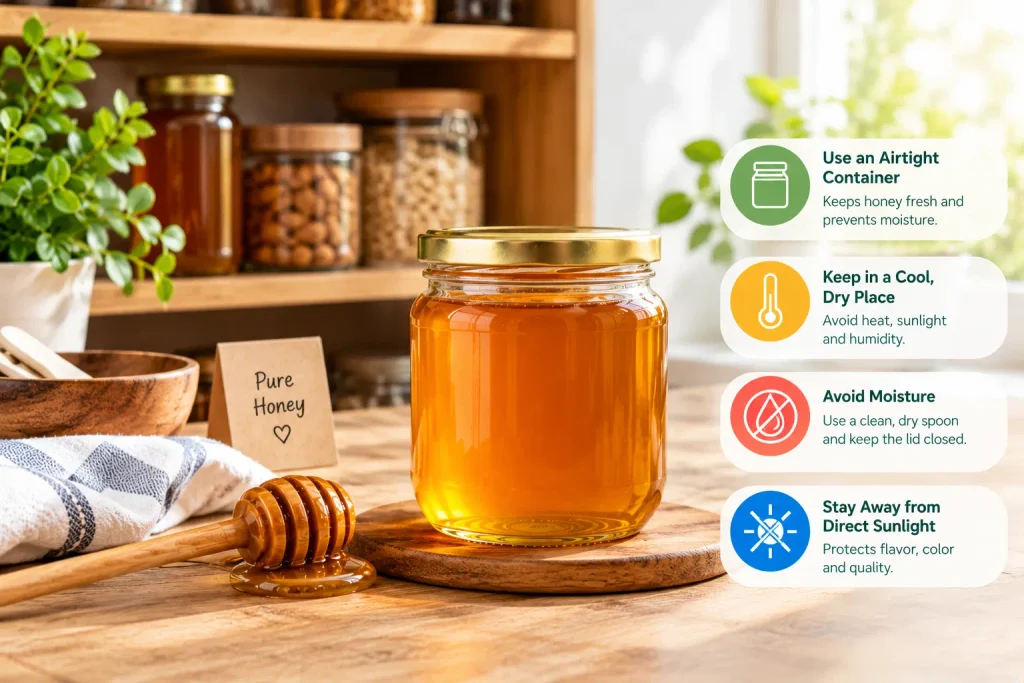
1. Store Honey in an Airtight Container
One of the easiest ways to protect honey is to keep it in a container with a tightly fitting lid.
After using honey, close the lid securely instead of leaving the jar open on the kitchen counter. An open container can absorb moisture and odors from the surrounding environment.
Which container is best for honey?
Glass jars are an excellent option because they are non-reactive, easy to clean, and do not readily absorb odors. Food-grade plastic containers designed for storing honey are also suitable.
Choose a container that is:
- Clean and completely dry.
- Food-safe and in good condition.
- Fitted with a secure, airtight lid.
- Large enough to avoid unnecessary spills during use.
If you transfer honey into a new jar, make sure the container and lid are thoroughly cleaned and completely dry before filling it.
2. Keep Honey in a Cool, Dry Place
The best everyday storage location for most honey is a cool, dry cupboard or pantry away from direct sunlight and heat-producing appliances.
You generally do not need a special storage cabinet. A clean kitchen cupboard is often sufficient, provided the temperature remains reasonably stable.
Avoid keeping honey:
- Next to an oven or stove.
- On a sunny windowsill.
- Near a dishwasher that releases frequent heat and steam.
- In a damp area where moisture can enter the jar.
Excessive heat can gradually affect honey’s color, flavor, and quality. A stable, moderate room temperature is generally preferable to repeated exposure to high temperatures.
3. Should You Refrigerate Honey?
For most ordinary honey, refrigeration is unnecessary.
Keeping honey in the refrigerator can cause it to crystallize more quickly, making it thicker and harder to pour. This change is usually harmless and does not mean the honey has spoiled.
Instead, keep the jar tightly sealed in a dry cupboard at room temperature.
There may be exceptions for certain specialty honey products, flavored honey, or products whose labels specifically require refrigeration. Always follow the manufacturer’s storage instructions for these products.
4. Protect Honey From Moisture
Moisture is one of the most important factors to control when storing honey.
Honey can absorb water from humid air, and adding water directly may dilute it. Under suitable conditions, this can encourage naturally occurring yeasts to ferment the sugars.
To reduce the risk:
- Always close the lid immediately after use.
- Use a clean, dry spoon each time.
- Never dip a wet spoon into the jar.
- Avoid pouring leftover honey or water-containing mixtures back into the original container.
- Keep the jar away from steam when cooking.
These small habits are particularly useful in humid kitchens and during rainy weather.
5. How to Store Honey in Hot Weather
Hot weather can make honey thinner and may gradually affect its quality if it is exposed to high temperatures for extended periods.
If you live in a hot climate, follow these precautions:
- Choose the coolest practical cupboard in your home.
- Keep the jar away from windows, direct sunlight, and kitchen appliances.
- Avoid leaving honey inside a hot car or near a heat source.
- Keep the lid tightly closed to prevent moisture from entering.
- Store large quantities in clean, sealed containers in a cool, dry location.
You do not need to refrigerate ordinary honey simply because the weather is hot. A consistently cool cupboard away from direct heat is generally a good choice.
6. Why Does Honey Become Thick or Crystallized?
Crystallization is a natural process in which glucose in honey forms solid crystals. Different varieties of honey crystallize at different rates depending on their sugar composition, moisture content, and storage conditions.
You may notice that your honey becomes cloudy, grainy, creamy, or almost solid. These changes do not automatically indicate spoilage or prove that the honey is fake.
In fact, crystallized honey is generally safe to eat if it has been handled and stored properly and shows no signs of spoilage.
How to make crystallized honey liquid again
If you prefer smooth, pourable honey, you can gently warm it.
Follow these steps:
- Place the closed honey jar in a bowl or saucepan of warm water.
- Allow the warmth to soften the crystals gradually.
- Stir the honey if practical and safe to do so.
- Replace the water with fresh warm water if needed.
- Once the honey becomes pourable, dry the outside of the jar and close it securely.
Avoid overheating the honey or placing a non-microwave-safe container in a microwave. Gentle warming is usually enough.
You can also eat crystallized honey as it is. There is no need to liquefy it unless you prefer that texture.
7. How Can You Tell If Honey Has Gone Bad?
Honey does not spoil as quickly as many other foods, but it can ferment or become contaminated if moisture enters it or it is handled improperly.
Look for unusual changes such as:
- Fermented or alcoholic smell: An unusual sour or alcohol-like odor may indicate fermentation.
- Unexpected bubbling or foaming: Persistent bubbling, particularly with an unusual smell, can be a warning sign.
- Unusual sour taste: A noticeable fermented flavor is another reason to avoid eating it.
- Visible mold or foreign contamination: If you see mold or suspect contamination, discard the honey.
Crystallization, ordinary thickening, or a gradual change in color alone does not necessarily mean honey has spoiled.
If you suspect fermentation or contamination, do not taste the honey to test whether it is safe. Discard it instead.
8. Common Honey Storage Mistakes to Avoid
Even though honey has a long shelf life, a few everyday mistakes can reduce its quality.
Leaving the lid open
An uncovered jar can absorb moisture and nearby odors. Close it after every use.
Using a wet spoon
Water introduced into the jar can dilute the honey and increase the risk of fermentation. Always use a clean, dry spoon.
Storing honey in direct sunlight
Sunlight can expose honey to unnecessary heat. Keep it in a shaded cupboard or pantry.
Refrigerating honey unnecessarily
Cold temperatures can accelerate crystallization. Refrigeration is usually not needed for ordinary honey.
Throwing away crystallized honey
Crystals are a natural feature of many honey varieties. If the honey has been stored correctly and shows no signs of spoilage, crystallization alone is not a reason to discard it.
9. How Long Does Properly Stored Honey Last?
Pure honey that is properly processed, sealed, and stored can remain usable for a very long time. However, its flavor, aroma, color, and texture may change gradually.
There is no single storage period that applies to every honey product. Processing methods, moisture content, packaging, handling, and the manufacturer’s recommendations all matter.
For the best quality:
- Check the label for a best-before date and storage instructions.
- Keep the original packaging information when possible.
- Use clean utensils and avoid introducing moisture.
- Inspect older honey for unusual odors, bubbling, or signs of contamination.
A best-before date often relates to expected quality rather than meaning that honey automatically becomes unsafe on that day. Nevertheless, follow product-specific guidance and discard honey that shows signs of spoilage.
Frequently Asked Questions
1. What is the best way to store honey at home?
Keep honey in a clean, dry, airtight container in a cool cupboard away from sunlight, heat, and moisture. Use a clean, dry spoon every time.
2. Does honey need to be refrigerated after opening?
Ordinary honey generally does not need refrigeration after opening. Store it tightly sealed at room temperature unless the product label specifies otherwise.
3. Is crystallized honey spoiled?
No. Crystallization is a natural process and does not automatically mean honey has spoiled. You can eat it in its crystallized form or gently warm the jar in warm water to restore a more liquid texture.
4. Can honey go bad if stored for years?
Properly stored honey can remain usable for a very long time, but its quality may change. Moisture contamination and fermentation can cause problems, so inspect older honey and follow the manufacturer’s guidance.
5. Can I store honey in a plastic container?
Yes, provided the container is food-grade, clean, dry, and suitable for honey storage. Glass is another excellent option.
6. Why does my honey smell sour?
A sour or alcoholic smell may indicate fermentation. If honey also shows unusual bubbling or foaming, do not consume it; discard it.
7. Can I store honey in the freezer?
Freezing is generally unnecessary for ordinary honey. A tightly sealed container in a cool, dry cupboard is usually sufficient for everyday storage.
8. Does crystallized honey mean it is pure?
No. Crystallization is a natural process, but it is not a reliable test of purity or authenticity. Honey composition varies, and different types crystallize at different rates.
Final Thoughts
Learning how to store honey properly can help preserve its flavor, aroma, and quality while reducing unnecessary waste. The most important habits are simple: use an airtight container, keep moisture out, store honey away from direct sunlight and excessive heat, and use clean, dry utensils.
Remember that crystallization is usually a natural change rather than a sign of spoilage. If honey develops an alcoholic or sour odor, unusual bubbling, or visible contamination, do not consume it.
With proper storage and careful handling, you can enjoy your honey for a long time without unnecessary worry.
Explore More About Pure Honey
Continue exploring our collection of helpful honey guides to learn more about choosing, using, storing, and enjoying pure natural honey.
-
10 Signs You’re Buying Fake Honey
Learn how to identify common warning signs before purchasing honey. -
How to Test if Your Honey is 100% Pure and Raw at Home
Discover simple ways to better understand the characteristics of genuine honey. -
Raw Honey vs Processed Honey: Which One Is Better?
Compare the differences between raw and processed honey. -
How to Use Honey Every Day: 15 Healthy Ideas
Learn about proper storage, shelf life, and crystallization. -
The Sunnah of Raw Honey: Healing and Health Benefits in Islamic Tradition
Explore the significance of honey in Islamic teachings and tradition.
🍯 Learn More About Honey Storage & Quality
Purdue Extension
Honey StorageLearn about honey storage, natural crystallization, and the factors that can affect honey’s quality over time.
Mississippi State University Extension
Spoilage SignsUnderstand why properly stored honey can last a long time and what to know about honey quality, storage, and possible spoilage.
Penn State Extension
Food StorageExplore practical guidance on storing common food ingredients correctly and maintaining their quality with appropriate storage conditions.
Oregon State University Extension
Honey SafetyLearn about safe honey handling, moisture-related concerns, and important precautions when working with honey and other ingredients.