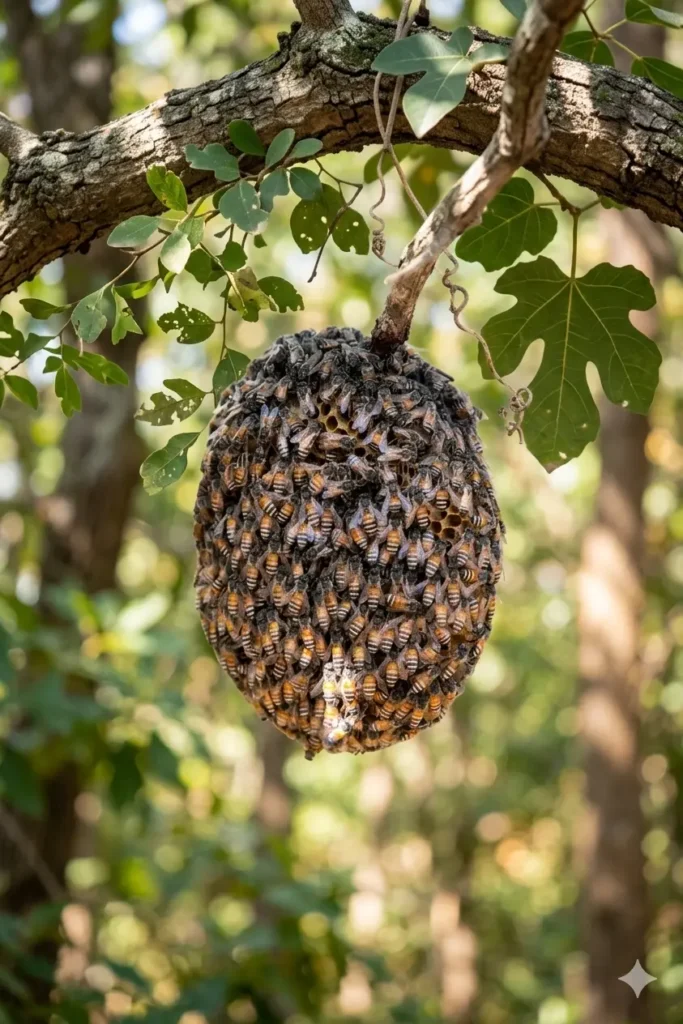
Wild honey harvesting has a special place in the world of natural foods and traditional honey collection. Unlike honey produced in managed beehives, wild honey may come from colonies that have established themselves naturally in trees, rock cavities, buildings, or other sheltered locations.
For centuries, people in many regions have collected honey from wild bee colonies as part of traditional livelihoods. FAO notes that honey hunting from wild bee colonies remains important for some forest-dependent communities, while bees also provide valuable pollination and ecosystem services.
However, harvesting wild honey is very different from simply removing honey from a managed hive. A wild colony may have no beekeeper to protect it, and careless harvesting can destroy the colony, expose the beekeeper to dangerous stings, damage surrounding habitat, or contaminate the honey.
That is why responsible wild honey harvesting should have two goals:
Collect honey while causing as little unnecessary harm to the bee colony and its surrounding environment as possible.
This guide explains what wild honey harvesting involves, the basic principles of safe collection, how to protect the colony, common mistakes to avoid, and why sustainability matters.
What Is Wild Honey?
Wild honey is honey produced by bees living in a naturally established or unmanaged colony rather than a colony maintained inside a conventional managed hive.
Wild colonies may establish themselves in places such as:
- Hollow trees
- Tree branches
- Rock cavities
- Caves and crevices
- Wall cavities
- Roof spaces
- Abandoned structures
- Other protected natural or man-made locations
The exact type of bee and the characteristics of the honey depend heavily on the region, climate, available flowers, season, and local bee populations.
The term “wild honey” does not automatically mean that the honey is purer, healthier, or nutritionally superior to honey from managed colonies. The characteristics of honey depend on many factors, including floral source, handling, storage, and processing.
What makes wild honey different is primarily where and how the bee colony lives and how the honey is obtained.
Why Responsible Wild Honey Harvesting Matters
Bees are not simply producers of honey. They are important pollinators and contribute to ecosystems, biodiversity, and agricultural production.
FAO describes bees as an important part of pollination and ecosystem health and recommends practices that conserve pollinator habitats and nesting sites.
When a wild colony is discovered, it is therefore important to consider the value of the colony itself.
A colony may contain:
- Adult worker bees
- A queen
- Developing brood
- Honey stores
- Pollen stores
- Wax comb
- Young bees at different stages of development
Taking every piece of comb simply because it contains honey can leave the colony without sufficient food or reproductive resources.
A responsible approach considers what the bees need to survive after harvesting.
Before Harvesting: Assess the Colony
One of the most important principles of responsible honey harvesting is simple:
Do not rush to harvest.
Before disturbing a colony, assess the situation.
Ask:
- Where exactly is the colony located?
- Is it accessible without climbing dangerously?
- How large does the colony appear to be?
- Is there visible brood?
- Is the colony in a protected or environmentally sensitive area?
- Is the colony causing a genuine problem for people?
- Is harvesting legally permitted in that location?
- Is there a safer alternative, such as professional bee removal or relocation?
If the colony is inside a wall, roof, public building, or another difficult location, attempting to remove it yourself may create unnecessary danger.
In such circumstances, contacting an experienced beekeeper or professional bee-removal specialist is usually the better choice.
Safety Should Come Before Honey
Wild bees can defend their colony aggressively when they feel threatened.
Wild honey harvesting can also involve other hazards, including:
- Falls from trees or elevated locations
- Difficult terrain
- Smoke or fire hazards
- Sharp branches and rocks
- Allergic reactions to bee stings
- Unstable structures
- Poor visibility
- Wild animals in remote areas
For this reason, inexperienced people should not attempt to harvest from dangerous or inaccessible colonies simply because honey is present.
Protective clothing, suitable footwear, gloves where appropriate, and proper face and head protection are important parts of responsible bee handling.
Most importantly, never assume that because a colony looks calm it cannot become defensive.
The Role of Smoke
Smoke has traditionally been used by beekeepers to influence bee behaviour during hive inspection and honey harvesting.
However, smoke should not be treated as a weapon against the bees.
Its purpose is to help make the interaction more manageable while reducing defensive behaviour.
Excessive smoke can create unnecessary stress and may also affect the quality and handling of hive products.
A responsible harvester should therefore use appropriate equipment and avoid creating uncontrolled fires or excessive smoke, especially in dry forests and grasslands.
Harvest Only What the Colony Can Spare
One of the most important differences between responsible harvesting and destructive honey hunting is what happens to the colony after the honey is removed.
A wild colony needs resources to continue living.
Honey provides energy, while pollen is an important food resource for developing bees. Brood is essential for replacing the colony’s population.
Therefore, a responsible approach should avoid treating the entire nest as a source of disposable honeycomb.
Traditional and sustainable beekeeping guidance emphasizes maintaining sufficient colony resources and protecting brood areas. FAO material on sustainable land management, for example, describes harvesting honey while leaving brood comb to help maintain the colony.
The exact amount that can safely be harvested depends on the colony, season, climate, bee species, and local conditions. There is no universal percentage that can responsibly be applied to every wild colony.
Protect Brood Comb
Brood comb is not the same as surplus honey comb.
Brood areas contain developing bees. Removing or destroying them can seriously weaken a colony.
This is one reason responsible harvesting should distinguish between:
Honey stores
Honey stored for food and energy.
Pollen stores
Important nutritional resources for the colony.
Brood comb
Areas containing developing bees.
A harvest that removes large amounts of brood can cause much more damage than simply reducing the colony’s available honey.
Whenever possible, the colony’s reproductive areas should be protected.
Avoid Destroying the Entire Colony
A common problem with destructive honey harvesting is that the harvester may remove or damage the entire nest.
This can leave the surviving bees without:
- Adequate food
- Protected brood
- Suitable comb
- A stable nest structure
- The resources required for recovery
Sustainable bee management aims to maintain healthy colonies rather than treating bees as a one-time source of honey.
FAO’s sustainable apiculture guidance emphasizes maintaining healthy colonies and protecting bee resources as part of good beekeeping practice.
In other words:
The best harvest is not necessarily the largest harvest. It is the harvest that leaves the colony with a realistic chance of continuing to thrive.
Do Not Destroy Bees Simply to Obtain Honey
The goal of honey harvesting should be to obtain honey without unnecessary destruction.
International guidance on organic production goes even further by stating that destruction of bees in combs as a method of harvesting bee products is prohibited within those organic-production guidelines.
This principle provides a useful standard even when dealing with traditional or wild honey collection:
Avoid killing bees when there is a practical alternative.
A sustainable honey industry depends on healthy bee populations.
When You Should Not Harvest
There are situations where leaving a wild colony alone is the better decision.
Avoid harvesting when:
- The colony is too small or weak.
- The colony appears recently established.
- There is little available forage.
- The colony is heavily dependent on its remaining food stores.
- The weather or season creates additional stress.
- The colony is located somewhere dangerous.
- The site is protected or harvesting is prohibited.
- You cannot safely reach the colony.
- You do not have suitable protective equipment.
- You cannot identify the risks involved.
- A professional bee relocation service would be more appropriate.
Sometimes the most responsible action is simply:
Leave the colony undisturbed.
Wild Honey Harvesting and Bee Conservation
Wild honey harvesting and bee conservation do not have to be opposites.
The key is how harvesting is carried out.
Healthy bee populations require suitable nesting locations, food sources, and safe habitats. FAO recommends protecting wild pollinator habitat, maintaining flower-rich areas, preserving nesting sites, and reducing risks from harmful agricultural practices.
For communities that depend on wild honey, protecting bee habitat can also protect future honey production.
This creates a simple long-term principle:
Protect today’s colony so that bees can continue producing honey tomorrow.
Equipment for Responsible Honey Harvesting
The exact equipment varies according to the location and type of colony, but responsible harvesting generally requires more than simply carrying a container for honey.
Basic protective and handling equipment may include:
- Proper bee veil or protective headgear
- Protective clothing
- Suitable gloves when appropriate
- Closed, protective footwear
- Appropriate smoker and fuel
- Clean food-grade containers
- Clean tools for handling comb
- Suitable storage containers
- Basic first-aid supplies
- Communication equipment when working in remote areas
For difficult colonies, additional climbing or access equipment may be required.
However, specialized equipment should only be used by people who understand how to operate it safely.
Never improvise dangerous climbing equipment simply to reach honey.
Keep Harvesting Equipment Clean
Honey is a food product, so cleanliness matters.
Honey can become contaminated through dirty equipment, hands, containers, dust, soil, insects, or other environmental sources.
FDA food-safety material notes that honey can be exposed to contamination from environmental sources and from post-harvest handling, equipment, food handlers, and cross-contamination.
For this reason:
- Use clean food-grade containers.
- Keep harvested honey away from soil and debris.
- Avoid placing comb directly on dirty surfaces.
- Keep animals and unnecessary people away from the processing area.
- Clean equipment before and after use.
- Store honey in suitable, clean containers.
- Protect harvested honey from moisture and contamination.
Good hygiene is just as important as the harvesting process itself.
Be Careful About Where Wild Bees Forage
One interesting aspect of wild honey is that bees may forage over a wide area.
The plants available to bees can influence the flavour, aroma, colour, and composition of honey.
However, wild honey should not automatically be assumed to be safer or healthier simply because it comes from nature.
In certain regions, bees can collect nectar from plants containing naturally occurring toxins. FDA, for example, notes that honey can contain grayanotoxins when bees collect nectar from certain plants such as rhododendrons or mountain laurel.
This is one reason local knowledge matters.
If wild honey is being harvested commercially, producers should understand the local floral environment and relevant food-safety requirements.
Wild Honey Should Be Handled Like Food
Once honey has been harvested, the work is not finished.
Honey should be:
- Collected in clean conditions.
- Protected from dirt and foreign material.
- Stored in suitable food-grade containers.
- Kept away from unnecessary contamination.
- Processed using hygienic equipment.
- Properly labelled when sold commercially.
Food businesses should also follow the laws and food-safety requirements applicable in their own country or region.
For commercial operations, food-safety systems such as HACCP provide a structured way to identify and control hazards throughout food production and handling.
Filtering Wild Honey
Wild honey is often harvested together with pieces of wax and other natural hive material.
Filtering can help separate honey from larger pieces of wax and debris.
However, filtration should be performed using clean food-grade equipment.
The objective is not to make honey unnaturally clear. The objective is to remove unwanted physical material while maintaining appropriate food quality.
Different producers use different levels of filtration depending on whether they sell raw, minimally processed, or more highly filtered honey.
Wild Honey vs. Managed Beekeeping
Wild honey harvesting and managed beekeeping are different systems.
| Wild Honey Harvesting | Managed Beekeeping |
|---|---|
| Colonies establish themselves naturally or outside managed hives | Colonies are kept in managed hives |
| Location may be difficult to access | Hive location is selected by the beekeeper |
| Colony condition may be harder to assess | Regular inspections are possible |
| Harvesting can be more unpredictable | Honey production can be monitored |
| Greater environmental and access challenges | More controlled management |
| Traditional methods may be used | Standard beekeeping equipment is commonly used |
Managed beekeeping also allows the beekeeper to monitor colony health, food stores, brood, pests, diseases, and hive condition more systematically.
Wild honey harvesting, by contrast, requires greater respect for the natural colony and its surroundings.
Common Mistakes in Wild Honey Harvesting
1. Taking all the honey
Removing everything can leave the colony without sufficient food.
Better approach: Consider the colony’s remaining food resources and seasonal conditions.
2. Removing brood comb
Brood is essential to colony reproduction.
Better approach: Identify and protect brood areas whenever possible.
3. Destroying the entire nest
A large harvest that kills or permanently displaces the colony is not sustainable.
Better approach: Aim to preserve the colony and its nesting structure whenever practical.
4. Using excessive smoke
Too much smoke can create unnecessary disturbance.
Better approach: Use appropriate equipment and controlled amounts.
5. Ignoring personal safety
Falls and bee stings can turn a honey harvest into an emergency.
Better approach: Do not attempt difficult colonies without appropriate training, protective equipment, and safe access.
6. Using dirty containers
Even good honey can become contaminated after harvest.
Better approach: Use clean food-grade containers and hygienic handling practices.
7. Assuming all wild honey is automatically superior
“Wild” is not a scientific guarantee of quality.
Better approach: Judge honey according to its floral source, handling, storage, authenticity, and food safety.
8. Ignoring local laws
Some forests, parks, protected areas, and private properties have restrictions on removing natural resources or disturbing wildlife.
Better approach: Check local regulations and obtain permission where required.
How to Make Wild Honey Harvesting More Sustainable
Sustainable harvesting means thinking beyond one harvest.
A responsible harvester should consider:
Protect the colony
Leave the colony with sufficient resources to continue functioning.
Protect bee habitat
Do not unnecessarily destroy nesting trees, vegetation, or surrounding habitat.
Avoid unnecessary pesticide exposure
Pollinator-friendly landscapes benefit bees and other insects. FAO recommends reducing pesticide risks and maintaining suitable habitats for pollinators.
Avoid repeated disturbance
A colony that is repeatedly disturbed may become stressed or abandon its nest.
Harvest according to local conditions
Weather, flowering seasons, drought, and colony strength can all affect how much honey is available.
Think long term
A sustainable honey hunter should want the colony to remain healthy after the harvest.
A Better Philosophy: Harvest With the Bees, Not Against Them
There is a major difference between taking honey from bees and managing a relationship with bees.
The first approach focuses only on the product.
The second considers:
- The colony
- The bees
- The habitat
- The season
- Future honey production
- Human safety
- Food safety
- Local ecosystems
That second approach is the foundation of responsible harvesting.
Bees provide much more than honey. Their pollination services support plants, agricultural systems, biodiversity, and natural ecosystems. FAO emphasizes the importance of protecting pollinators and their habitats for food systems and ecological health.
Explore More About Pure Honey
Continue exploring our collection of helpful honey guides to learn more about choosing, using, storing, and enjoying pure natural honey.
-
10 Signs You’re Buying Fake Honey
Learn how to identify common warning signs before purchasing honey. -
How to Test if Your Honey is 100% Pure and Raw at Home
Discover simple ways to better understand the characteristics of genuine honey. -
Raw Honey vs Processed Honey: Which One Is Better?
Compare the differences between raw and processed honey. -
How to Use Honey Every Day: 15 Healthy Ideas
Learn about proper storage, shelf life, and crystallization. -
The Sunnah of Raw Honey: Healing and Health Benefits in Islamic Tradition
Explore the significance of honey in Islamic teachings and tradition.
🌿 Further Reading & Trusted Sources
Learn more about responsible beekeeping, pollination, honey safety, and honey labeling from trusted organizations: