Wild honeycomb can contain delicious natural honey, but knowing how to extract wild honey from honeycomb requires the right equipment and proper handling. Once a honeycomb has been cut and separated from its original location, the next step is to remove the honey from the beeswax, collect it in a suitable container, filter out visible wax particles, and transfer it into clean jars.
Whether you are processing a small quantity of wild honey at home or preparing it for sale, the goal is the same: obtain clean honey while protecting its natural flavour and quality.
In this guide, you will learn which containers and tools are useful, how the crush-and-strain method works, how to fill jars neatly, and which mistakes can affect the quality of your honey.
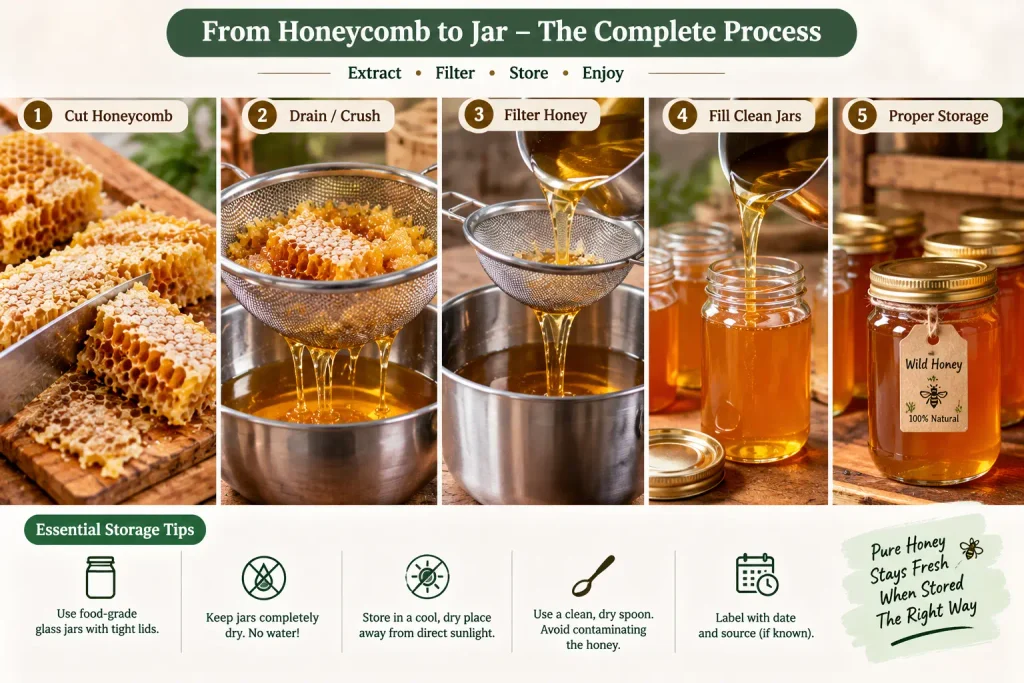
1. What Equipment Do You Need to Collect Wild Honey?
You do not necessarily need expensive machinery to process a small quantity of cut honeycomb. A few suitable food-grade tools can help you collect honey more cleanly.
Food-grade stainless steel bowl or collection vessel
A stainless steel vessel intended for food processing is a practical choice for collecting honey. It provides a stable surface for collecting the liquid and is easy to clean when made from suitable food-grade material.
For larger quantities, a food-grade honey bucket with a lid or a dedicated honey settling tank may be more convenient.
Food-grade strainer
A strainer helps separate larger pieces of beeswax from the honey. A coarse strainer can remove larger fragments, while a finer food-grade mesh can catch smaller visible particles.
Straining improves the appearance of the honey, but it does not remove every possible contaminant or prove that the honey is safe.
Food-grade draining tray or sieve
If the comb is suitable for draining without crushing, it can be placed in an appropriate food-grade sieve over a collection vessel. Gravity allows honey to flow down into the container while the wax remains above.
This method is simple, but it can take time and may leave some honey trapped in the comb.
Clean glass jars with secure lids
Glass jars are a good choice for the final product. Choose food-safe jars that are clean, completely dry, and free from cracks. The lids should fit securely to help prevent moisture and contaminants from entering.
Other useful items
For a more professional setup, you may also need clean utensils, a covered container for temporary storage, food-safe gloves, labels, and a honey moisture meter or refractometer designed for measuring honey moisture.
2. Prepare a Clean Honey Collection Area
Before opening or processing the cut comb, prepare a clean workspace. Honey can pick up dust, dirt, strong odours, and moisture during handling.
Follow these basic practices:
- Wash your hands thoroughly and dry them.
- Clean all food-contact surfaces and utensils.
- Ensure every bowl, strainer, bucket, and jar is completely dry.
- Keep pets, insects, smoke, fuel, and household chemicals away from the processing area.
- Keep the honey covered whenever you are not actively working with it.
Use only comb that is suitable for food processing. If the comb contains developing bees, larvae, extensive debris, or signs of disease, do not simply mix it into the edible honey. Separate questionable material and seek advice from a qualified local beekeeper or food-safety professional.
3. Method One: Drain Honey From the Comb
Draining is a useful option when the comb can remain largely intact and the honey flows freely.
Place suitable pieces of honeycomb in a clean, food-grade draining sieve positioned over a stainless steel collection vessel. Keep the setup covered with a clean protective cover that does not touch the honey.
Allow gravity to do the work. Depending on the honey’s thickness, temperature, and the shape of the comb, drainage may take several hours or longer.
Advantages of draining:
- It requires little specialised equipment.
- It can preserve more of the original comb structure.
- It avoids the need to crush the entire comb.
Limitations:
- Some honey remains trapped in the wax.
- It may be slower than other extraction methods.
- The honeycomb may still need to be processed further to recover additional honey.
Do not leave exposed honey in an area where flies, dust, or other insects can reach it. Keep the container covered and use clean equipment throughout the process.
4. Method Two: The Crush-and-Strain Method
The crush-and-strain method is often practical for small quantities of cut comb that cannot be placed in a conventional honey extractor.
In this method, the honeycomb is broken into smaller pieces so the honey can flow out. The mixture is then passed through a suitable food-grade strainer to remove larger wax fragments.
How the method works
First, place the suitable cut comb in a clean food-grade container. Use clean equipment to break the comb into smaller pieces, allowing the honey to escape from the wax cells.
Next, transfer the crushed comb into a food-grade strainer positioned over a collection vessel. Allow the honey to drain naturally. Avoid squeezing the mixture with dirty hands or using improvised materials that may shed fibres or introduce contaminants.
Once the honey has drained, it may be passed through a second, finer food-grade strainer if necessary.
The remaining beeswax can be collected separately. Do not heat the mixture excessively to force the honey out; high temperatures can change its flavour, colour, and quality.
Important: Crushing and straining is not the same as centrifugally extracting honey from managed hive frames. A conventional honey extractor is generally designed for compatible frames, not irregular pieces of wild comb.
5. Which Method Is Better: Draining or Crushing?
The best method depends on the condition of the comb and your intended final product.
| Feature | Draining | Crush-and-strain |
|---|---|---|
| Equipment | Sieve and collection vessel | Food-grade container, strainer and vessel |
| Comb structure | Mostly preserved | Broken into pieces |
| Speed | May be slower | Often practical for small quantities |
| Honey recovery | Some honey may remain in the wax | Can release more honey from broken comb |
| Best suited for | Suitable intact cut comb | Suitable comb that can be crushed |
Neither method guarantees that every drop of honey will be recovered. The important factors are clean handling, suitable comb, and avoiding excessive heat or moisture.
6. How to Filter Honey for a Professional Finish
After extraction, visible wax fragments may remain in the honey. A food-grade strainer can remove these larger particles.
For small-scale processing, a coarse strainer followed by a finer food-grade mesh is often sufficient to improve the appearance of the honey. Avoid using ordinary clothing fabric, dirty muslin, or any material that is not suitable for food contact.
There is also a difference between straining and fine commercial filtration. Straining removes larger particles, while more intensive filtration can remove much smaller particles, including some pollen. If you want to sell the honey, describe the processing accurately rather than calling it completely filtered when only a simple strainer was used.
Do not assume that honey becomes safe simply because it looks clear. Straining does not remove all chemical contaminants, microorganisms, or other potential hazards.
7. How to Transfer Honey Into Glass Jars
Once the honey has been collected and strained as appropriate, it is ready to be transferred into clean storage jars.
For a neat, professional result:
- Arrange clean, dry jars on a stable work surface.
- Use a suitable food-grade pouring vessel or honey dispenser.
- Pour carefully to reduce spills and keep the jar’s rim clean.
- Avoid introducing water, dust, or other materials into the honey.
- Close each jar securely with a suitable lid.
- Label the jars with the collection date and source information, where known.
For repeated filling or larger quantities, a dedicated food-grade honey bottling bucket with a dispensing gate can make the job easier. This allows honey to flow into jars with less spilling and handling.
Do not fill jars with wet utensils or use a jar that still contains water droplets after washing. Honey absorbs moisture, and excess moisture can increase the risk of fermentation.
8. How to Keep Wild Honey From Fermenting
One of the most important aspects of honey quality is its moisture content. Properly ripened honey generally stores well, but honey with excessive moisture can ferment.
Honey collected from wild comb should not automatically be assumed to have the correct moisture level. If you intend to sell it or store it for an extended period, use a refractometer designed for measuring honey moisture.
For good storage:
- Keep the honey in clean, dry, airtight containers.
- Store jars in a cool, dry place away from direct sunlight and excessive heat.
- Avoid adding water or other ingredients.
- Keep lids closed when the honey is not being used.
- Check for signs of fermentation, such as gas production, foaming, or an unusual fermented smell.
If the honey has an unusual smell or you suspect contamination, do not rely on filtering or heating to make it safe.
9. Can You Heat Wild Honey to Make It Flow Faster?
Gentle warming can make thick honey flow more easily, but excessive heating may affect its flavour, aroma, colour, and quality.
If warming is necessary, use a controlled, gentle method and avoid direct flame or overheating. A warm-water bath is generally easier to control than placing honey directly on a hot surface. Keep water out of the honey and ensure the container is suitable for the chosen method.
Heating is not a substitute for proper extraction, suitable moisture content, or hygienic handling.
10. Common Mistakes to Avoid
Using a non-food-grade container
Ordinary containers may contain residues or materials unsuitable for food contact. Use a food-grade collection vessel and suitable storage jars.
Filtering through dirty or wet cloth
This can introduce contamination or moisture. Use clean, dry, food-grade strainers or mesh.
Squeezing the comb with bare hands
Direct handling increases the chance of introducing dirt and other contaminants. Use clean tools and suitable food-handling practices.
Overheating the honey
Excessive heat can alter the honey’s natural properties. Avoid direct flame and unnecessary heating.
Assuming all wild honey is pure
Wild origin does not guarantee purity or safety. The source, environmental conditions, harvesting method, and storage all matter.
Sealing honey in a damp jar
Even small amounts of water can affect honey quality. Always ensure the jar and lid are completely dry before filling.
11. How to Make Your Wild Honey Look Professional for Sale
If you plan to sell your honey, presentation and traceability matter.
Use uniform, food-grade jars and secure lids. Wipe any honey from the outside of each jar, apply a clean label, and record the collection date and known source. Follow the applicable local food-safety, labelling, and business requirements.
Avoid making unverified claims such as “100% medicinal,” “cures every disease,” or “guaranteed pure” without suitable evidence and testing. Wild honey can have distinctive characteristics, but its quality should be supported by responsible handling and truthful labelling.
Frequently Asked Questions
What is the best container for collecting honey from cut comb?
A food-grade stainless steel bowl, collection vessel, or suitable food-grade bucket is a practical choice. For final storage, a clean, dry glass jar with a secure lid is a good option.
Can I collect wild honey without a honey extractor?
Yes. Suitable cut comb can be drained or processed using the crush-and-strain method. A conventional centrifugal extractor is generally intended for compatible honeycomb frames.
How long does it take for honey to drain from a comb?
The time varies with the thickness of the honey, the temperature, and the size and structure of the comb. It may take hours or longer. Keep the setup covered and protected from insects and dust.
Should I use a fine cloth or a metal strainer?
A clean, food-grade metal strainer or suitable food-grade mesh is a practical choice. The mesh size determines how much visible wax remains, but finer straining does not guarantee that honey is free from every contaminant.
Does wild honey need to be refrigerated?
Properly ripened honey is usually stored in a tightly sealed container in a cool, dry place. Refrigeration is generally unnecessary and can make some honey crystallise more readily.
Can I put pieces of honeycomb directly into a jar?
Yes, suitable edible comb can be packed into a clean jar as comb honey or chunk honey. This is a different product from liquid honey that has been extracted and strained. The comb must be suitable for consumption and handled hygienically.
Conclusion
Collecting wild honey professionally after the comb has been cut involves three main stages: separating the honey from the wax, straining it using suitable food-grade equipment, and transferring it into clean, dry jars.
For small quantities, draining or crush-and-strain methods may be practical. For compatible frames from managed hives, a honey extractor can be more efficient. Whichever method you choose, avoid excessive heat, protect the honey from moisture and contamination, and store it in tightly sealed food-grade containers.
Professional honey handling is not just about getting the honey into a jar. It is about preserving quality, maintaining hygiene, and ensuring that the finished product is suitable for its intended use.
Explore More About Pure Honey
Continue exploring our collection of helpful honey guides to learn more about choosing, using, storing, and enjoying pure natural honey.
-
10 Signs You’re Buying Fake Honey
Learn how to identify common warning signs before purchasing honey. -
How to Test if Your Honey is 100% Pure and Raw at Home
Discover simple ways to better understand the characteristics of genuine honey. -
Raw Honey vs Processed Honey: Which One Is Better?
Compare the differences between raw and processed honey. -
How to Use Honey Every Day: 15 Healthy Ideas
Learn about proper storage, shelf life, and crystallization. -
The Sunnah of Raw Honey: Healing and Health Benefits in Islamic Tradition
Explore the significance of honey in Islamic teachings and tradition.
🍯 Learn More About Honey Extraction and Storage
Food and Agriculture Organization
Beekeeping GuideExplore practical information about beekeeping and value-added bee products, including honey handling and processing.
U.S. Department of Agriculture
Honey InspectionRead official guidance on comb honey inspection and quality-related considerations when handling honey products.
Tanzania Bureau of Standards
Processing & PackagingConsult a code of practice covering honey processing and packaging, with useful considerations for hygienic handling and product quality.
University of Florida IFAS Extension
Honeybee BiologyLearn about honeybee biology and colony behaviour to better understand the bees and comb involved in honey harvesting.