Introduction: A Fascinating Connection Between the Quran and Nature
The Quran invites people to observe the natural world, reflect on the signs of creation, and think deeply about the wisdom behind everyday things. One fascinating example that raises the question “why does the Quran call the honeybee she” appears in Surah An-Nahl, the 16th chapter of the Quran, where Allah describes the honeybee, its dwelling places, its food, and the honey that comes from it.
A question often arises when readers examine these verses: Why does the Quran use feminine forms when addressing the honeybee? Interestingly, modern biology confirms that worker honeybees—the bees most people commonly see collecting nectar and maintaining the hive—are female.
This connection is worth exploring carefully. The Arabic wording is real, and the biological facts about honeybees are well established. However, understanding the Quranic passage also requires attention to Arabic grammar and the broader meaning of the verses. Rather than making exaggerated claims, we can appreciate the remarkable details of the Quran while distinguishing established scientific facts from interpretation.
1. What Does the Quran Say About the Honeybee?
The main passage is found in Surah An-Nahl, verses 68 and 69. The name An-Nahl is commonly translated as “The Bees.”
Surah An-Nahl (16:68) — Arabic
وَأَوْحَىٰ رَبُّكَ إِلَى النَّحْلِ أَنِ اتَّخِذِي مِنَ الْجِبَالِ بُيُوتًا وَمِنَ الشَّجَرِ وَمِمَّا يَعْرِشُونَ
English translation:
“And your Lord inspired the bees: ‘Make your homes in the mountains, the trees, and in what people construct.’”
— Quran 16:68; translation adapted from the Quran.com rendering.
Urdu translation:
“اور آپ کے رب نے شہد کی مکھی کو الہام کیا کہ پہاڑوں میں، درختوں میں اور ان جگہوں میں گھر بنا جو لوگ بناتے ہیں۔”
— مفہومی اردو ترجمہ
This verse describes Allah’s guidance to the bee in finding or making its dwelling places. These may include natural spaces in mountains and trees, as well as structures made by human beings.
The Arabic word commonly translated as “inspired” is أَوْحَىٰ (awḥā). In this context, it conveys the idea of divine guidance or direction. It should not automatically be understood as revelation in the same sense as the revelation given to prophets.
Surah An-Nahl (16:69) — Arabic
ثُمَّ كُلِي مِن كُلِّ الثَّمَرَاتِ فَاسْلُكِي سُبُلَ رَبِّكِ ذُلُلًا ۚ يَخْرُجُ مِن بُطُونِهَا شَرَابٌ مُّخْتَلِفٌ أَلْوَانُهُ فِيهِ شِفَاءٌ لِّلنَّاسِ ۗ إِنَّ فِي ذَٰلِكَ لَآيَةً لِّقَوْمٍ يَتَفَكَّرُونَ
English translation:
“Then eat from all the fruits and follow the ways of your Lord laid down for you. From their bellies comes forth a drink of varying colours, in which there is healing for people. Surely in this is a sign for people who reflect.”
— Quran 16:69; translation adapted from the Quran.com rendering.
Urdu translation:
“پھر ہر قسم کے پھلوں سے کھاؤ اور اپنے رب کے آسان کیے ہوئے راستوں پر چلو۔ ان کے پیٹوں سے مختلف رنگوں کا ایک مشروب نکلتا ہے، جس میں لوگوں کے لیے شفا ہے۔ بے شک اس میں غور و فکر کرنے والوں کے لیے ایک نشانی ہے۔”
— مفہومی اردو ترجمہ
The verse draws attention to several features of the bee’s life: its food, its movement along the paths made accessible to it, and the production of a liquid of different colours. This is understood in the context of honey and its benefits for people.
The closing phrase is particularly meaningful: “Surely in this is a sign for people who reflect.” The passage encourages contemplation rather than careless conclusions.
For the complete Arabic text, translations, and tafsir, readers can consult Quran.com — Surah An-Nahl 16:68–69.
2. Why Is the Word “Ittakhidhī” Feminine in Arabic?
The key linguistic detail appears in verse 16:68:
اتَّخِذِي — Ittakhidhī
This is an Arabic imperative verb meaning “take” or “make for yourself,” addressed to a singular feminine subject.
In verse 16:69, two further feminine imperative forms appear:
- كُلِي — Kulī: “Eat.”
- فَاسْلُكِي — Faslukī: “And follow” or “proceed along.”
The Quranic Arabic Corpus identifies these forms as second-person feminine singular imperatives. This is a verifiable fact of Arabic grammar, not merely a modern interpretation.
But there is an important distinction to understand: a feminine grammatical form does not always prove that a noun refers exclusively to biological females.
Arabic, like many other languages, assigns grammatical gender to nouns. The word an-naḥl (النحل), meaning bees collectively, can be treated as feminine in Arabic usage. Consequently, the feminine wording may be explained through ordinary Arabic grammar as well as being compatible with the biology of worker honeybees.
This means we should avoid claiming that the grammar alone conclusively proves a scientific miracle. A more accurate statement is that the feminine verb forms are present in the Quran, and the biology of worker honeybees provides an interesting point of comparison.
Reference: Quranic Arabic Corpus — Word-by-word analysis of 16:68.
3. What Does Modern Science Say About Honeybees?
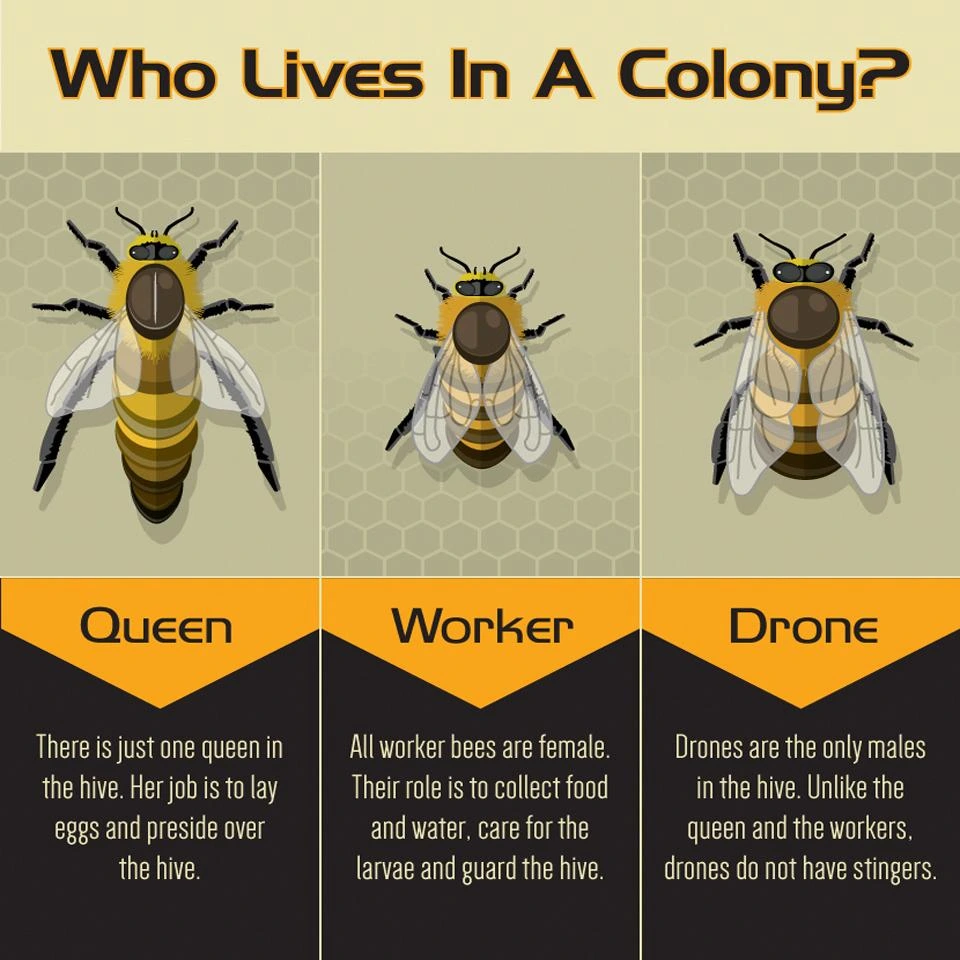
Modern entomology—the scientific study of insects—has established that a honeybee colony generally contains three types of adult bees: a queen, worker bees, and drones.
Worker bees are female
Worker bees are female honeybees. They perform many of the daily tasks required to maintain the colony, including collecting nectar and pollen, caring for developing young bees, cleaning the hive, producing wax, and helping defend the colony.
The worker bees that people commonly notice visiting flowers are female.
The queen is female too
A queen is a reproductive female whose principal role in a healthy colony is to lay eggs. She also produces chemical signals that help regulate the colony’s social organization.
Drones are male
Drones are the male honeybees. Their main reproductive role is to mate with a queen. Unlike worker bees, they do not normally perform the colony’s everyday tasks such as foraging, nursing young, or constructing comb.
These facts are documented by scientific and educational sources, including the University of Florida’s honeybee education resources and the United States Food and Drug Administration.
Sources:
Why is this fact important?
The Quranic passage addresses the bee using feminine verb forms. Modern science confirms that the worker bees responsible for many of the familiar activities associated with honey production and hive maintenance are female.
That is an interesting correspondence worth discussing. Nevertheless, because Arabic grammatical gender is not identical to biological sex, this observation should be presented with linguistic context rather than as proof that Arabic grammar could only have been chosen because of the sex of worker bees.
4. Do Female Worker Bees Actually Make Honey?
Honey production is a cooperative biological process. Worker bees collect nectar from flowers and transport it back to the colony. Inside the hive, the nectar is processed through enzyme activity and water reduction until it becomes honey.
Worker bees then place the honey in wax cells for storage. This stored food helps the colony survive periods when fresh nectar is scarce.
A simplified overview of the process is:
- Foraging: Worker bees visit flowers and collect nectar.
- Transport: They carry the nectar back to the hive.
- Processing: Enzymes and other processes alter the nectar’s composition.
- Water reduction: Bees help reduce moisture through handling and ventilation.
- Storage: The honey is placed in wax cells and may be capped for preservation.
The queen does not normally carry out these daily foraging and honey-processing tasks. These are primarily worker-bee activities.
It is therefore scientifically accurate to say that female worker bees play the central role in collecting nectar and producing stored honey. However, honey production should not be described as the work of one individual bee alone: it depends on the coordinated activity of the colony.
5. Is the Feminine Wording a Scientific Miracle?
Many Muslim writers and speakers find the feminine wording in Surah An-Nahl fascinating because it can be compared with what modern biology tells us about worker bees.
However, a responsible discussion should separate three points.
First: What the Quran says. The Arabic text uses feminine imperative forms in verses 16:68–69. This is directly verifiable.
Second: What science establishes. Worker honeybees are female, and they perform most of the colony’s everyday labour, including foraging and many tasks involved in honey production. This is also well established.
Third: What can be concluded from the connection. Whether this linguistic and biological correspondence should be understood as a specific scientific miracle is an interpretive and theological question. The feminine grammatical treatment of an-naḥl is also relevant, so the wording alone does not conclusively establish that the verse was intended as a biological statement about sex.
Muslims may reflect on this correspondence as one of the details that deepens their appreciation of the Quran. At the same time, presenting an interpretation as an uncontested scientific proof would go beyond what the grammar and biological evidence alone establish.
A thoughtful article can respect faith while being transparent about the limits of a scientific argument.
6. What Does “Inspired the Bee” Mean?
The phrase وَأَوْحَىٰ رَبُّكَ إِلَى النَّحْلِ means that the Lord inspired or guided the bee.
In this context, the verse is commonly understood as referring to the guidance Allah has placed within the bee’s natural behaviour. Honeybees can find food, recognize their surroundings, build comb, communicate with other bees, and carry out the activities needed for the colony to function.
Science investigates the biological mechanisms behind these behaviours. Researchers study sensory systems, learning, communication, genetics, and the organization of colonies. A religious interpretation may understand these remarkable natural abilities as part of Allah’s creation and guidance.
These approaches answer different kinds of questions. Biology examines how the behaviour works; the Quran invites believers to reflect on its meaning and significance.
It is unnecessary to claim that every detail of bee behaviour is fully explained by a single verse. The passage itself points readers towards reflection on the natural world.
7. Why Does the Quran Mention Honey of Different Colours?
Verse 16:69 describes a drink that comes from the bees and has varying colours. Honey can range from nearly transparent and pale gold to amber, dark brown, and other shades.
Its colour and flavour can vary according to the floral sources from which bees collect nectar, as well as factors such as processing and storage. Honey produced from different plants can therefore look and taste different.
The Quran’s reference to different colours fits the familiar diversity of honey. The verse also mentions healing for people, which deserves careful interpretation.
Does the Quran say honey can cure every disease?
No. The verse describes honey as containing healing for people, but it does not state that honey cures every illness or can replace every medical treatment.
Modern research has examined certain uses of honey, including some medical-grade honey preparations used in wound care. However, evidence depends on the particular condition, product, and method of use. Ordinary food honey is not a substitute for appropriate medical care.
Honey should not be given to children younger than 12 months because of the risk of infant botulism. People with diabetes should also consider its sugar content when planning their diet.
The responsible conclusion is that honey has recognised uses and potential health benefits, but specific medical claims must be supported by appropriate evidence.
8. The Deeper Lesson: Reflecting on Small Creatures
The honeybee is a small creature, yet its colony demonstrates cooperation, specialized roles, communication, and remarkable organization. Its activities also support pollination, which is important for many ecosystems and agricultural crops.
The Quran’s passage encourages readers to notice the signs in the world around them. Its message is not limited to memorizing a scientific detail. It also invites humility, gratitude, and reflection on the complexity of creation.
There is a valuable lesson here: sometimes an ordinary experience—seeing a bee visit a flower or finding honey on a table—can prompt deeper questions about nature and our place within it.
For Muslim readers, observing the natural world can become an opportunity to appreciate Allah’s creation. For all readers, it can encourage curiosity, careful study, and respect for the living world.
9. Common Questions About the Quran and Honeybees
Does the Quran use a feminine verb for the bee?
Yes. In Surah An-Nahl 16:68, the word ittakhidhī is a second-person feminine singular imperative. The following verse also uses feminine imperative forms, including kulī and faslukī.
Are worker honeybees female?
Yes. Worker honeybees are female. They carry out most of the routine tasks in the colony, including foraging, brood care, hive maintenance, and activities involved in honey production.
Are all honeybees female?
No. A honeybee colony generally includes female workers, a female queen, and male drones. It would be inaccurate to say that every honeybee is female.
Does the feminine wording prove a scientific miracle?
Not conclusively on its own. The feminine wording is present in the Arabic text, and worker-bee biology is consistent with an interesting comparison. However, Arabic grammatical gender and biological sex are not identical, and the grammatical treatment of the collective noun an-naḥl is relevant to interpretation.
What is the meaning of Surah An-Nahl?
An-Nahl means “The Bees.” Surah An-Nahl is the 16th chapter of the Quran and discusses numerous signs of Allah’s creation, blessings, and guidance.
What does the Quran say about honey?
Quran 16:69 describes a drink of varying colours emerging from the bees, in which there is healing for people. The verse invites reflection, but it should not be used to claim that honey is a cure for every disease.
Where can I read the original Arabic verses?
You can read Surah An-Nahl 16:68–69, alongside translations and tafsir, at Quran.com.
Conclusion: Faith, Language, and the Wonders of Nature
Surah An-Nahl 16:68–69 presents a beautiful passage about the honeybee, its dwelling places, its food, and the honey that benefits people. Its Arabic wording includes feminine imperative verbs, while modern biology confirms that female worker bees perform many of the tasks associated with maintaining the hive and producing honey.
The connection is genuinely interesting, but it should be explained accurately. Arabic grammatical gender does not always correspond directly to biological sex, so the feminine wording alone cannot settle every question about scientific interpretation.
What remains clear is the passage’s invitation to reflect. By studying the Quran carefully and learning about the natural world through reliable science, readers can explore this subject with both spiritual appreciation and intellectual honesty.
The honeybee reminds us that even a small creature can reveal a great deal about the complexity of nature—and that meaningful reflection begins with curiosity, evidence, and humility.
References and Further Reading
- The Quran, Surah An-Nahl 16:68–69 — Arabic text, translations, and tafsir: Quran.com
- Quranic Arabic Corpus, 16:68 — Word-by-word Arabic grammar and morphology: Quranic Arabic Corpus
- Quranic Arabic Corpus, 16:69 — Word-by-word Arabic grammar and morphology: Quranic Arabic Corpus
- University of Florida IFAS Extension — Honeybee colony members and their roles: Welcome to the Hive
- U.S. Food and Drug Administration — Honeybee workers, drones, and queens: Helping Agriculture’s Helpful Honey Bees
Explore More About the Quran
Continue your journey of learning by exploring our helpful articles about the Holy Quran, its meanings, understanding, and guidance for everyday life.
-
The Quran: A Light for Every Heart
Discover why the Holy Quran is a timeless source of guidance, hope, and spiritual peace for every believer. -
Quran Translation vs Tafsir
Understand the difference between reading a translation of the Quran and studying its detailed explanation through Tafsir. -
10 Foods Mentioned in the Quran and Their Benefits
Learn about the blessed foods mentioned in the Quran and explore their significance in Islamic tradition and everyday life.
📚 Recommended Quran & Honeybee Science Resources
Explore the original Quranic verses, Arabic grammar, and reliable scientific information about honeybees to understand Surah An-Nahl 16:68–69 and the fascinating connection between the Quran and modern science:
-
Quran 16:68 — Allah’s Guidance to the Honeybee:
Read the Arabic verse and translations describing how Allah guides the honeybee to establish its dwelling places in mountains, trees, and structures made by people.
Read Quran 16:68 → -
Quran 16:69 — Honey and Its Benefits:
Explore the verse about the drink of different colours that comes from bees, the healing mentioned in the Quran, and the invitation to reflect on Allah’s signs.
Read Quran 16:69 → -
Quranic Arabic Corpus — Feminine Arabic Verb Forms:
Study the word-by-word grammatical analysis of Quran 16:68, including the feminine imperative verb “ittakhidhi,” and explore the Arabic language used in the verse.
Explore Arabic Grammar → -
University of Florida — Honeybee Biology:
Learn about honeybee colonies, female worker bees, queens, and male drones through an educational resource from the University of Florida’s Institute of Food and Agricultural Sciences.
Explore Honeybee Science →