Introduction
World Religions have played an important role in human history, culture, family life, morality, traditions, and communities. Today, people around the world follow many different religions and spiritual traditions, while millions of others identify as having no religion. Each faith has its own beliefs, teachings, practices, and traditions that have shaped societies and cultures throughout history.
The world’s major religions include Christianity, Islam, Hinduism, Buddhism, Judaism, Sikhism, Jainism, Baháʼí Faith, Shinto, Daoism (Taoism), and many indigenous and traditional religions. These traditions differ greatly in their beliefs about God, worship, morality, human life, the afterlife, sacred texts, and spiritual practice.
According to the latest large-scale Pew Research Center analysis, based on more than 2,700 censuses and surveys covering 201 countries and territories, Christians were the world’s largest religious group in 2020, followed by Muslims and Hindus. Muslims were the fastest-growing major religious group between 2010 and 2020.
How Many Religions Are There in the World?
There is no universally agreed number of religions in the world.
This is because the word “religion” can refer to a large global tradition, a denomination within that tradition, an ethnic religion, an indigenous spiritual system, or a local folk tradition.
For example:
- Christianity contains Catholic, Orthodox, Protestant and many other traditions.
- Islam includes Sunni, Shia and other schools and traditions.
- Hinduism contains many philosophical and devotional traditions.
- Buddhism includes Theravada, Mahayana and Vajrayana traditions.
- Indigenous religions may be closely connected to particular cultures and communities.
Therefore, instead of claiming that there are exactly a certain number of religions, it is more accurate to discuss the major world religions and significant religious traditions.
1. Christianity
Christianity is the world’s largest religious group.
Christians believe in Jesus Christ and follow the Bible as their sacred scripture. Christianity includes several major traditions, including Catholicism, Eastern Orthodoxy and Protestantism.
According to Pew Research Center estimates, there were approximately 2.3 billion Christians worldwide in 2020, representing about 28.8% of the world’s population.
Major countries with large Christian populations
The United States had the world’s largest Christian population in 2020. Other countries with very large Christian populations include Brazil, Mexico, the Philippines, Russia, Nigeria, the Democratic Republic of the Congo, Ethiopia, South Africa, Italy, Germany and Kenya.
Christianity is also extremely geographically widespread. Unlike some religions that are heavily concentrated in a few countries, Christians are distributed across many regions of the world.
2. Islam
Islam is the world’s second-largest religious group and the fastest-growing major religion according to Pew Research Center’s latest global analysis of religious change from 2010 to 2020.
Muslims believe in one God (Allah) and regard Muhammad ﷺ as the final prophet and messenger. The Quran is the central scripture of Islam.
Islam teaches worship of Allah, prayer, charity, fasting, pilgrimage, moral responsibility, justice, mercy and accountability.
Pew estimates that Muslims numbered approximately 2.0 billion in 2020, or 25.6% of the world’s population.
Countries with the largest Muslim populations
The four countries with the largest Muslim populations in 2020 were:
- Indonesia — about 239 million
- Pakistan — about 227 million
- India — about 213 million
- Bangladesh — about 151 million
These figures are important because they show that the largest Muslim populations are not located primarily in the Middle East.
In fact, only about one-fifth of the world’s Muslims lived in the Middle East and North Africa region in 2020.
3. Hinduism
Hinduism is one of the world’s oldest major religious traditions and has a particularly deep historical connection with the Indian subcontinent.
Hindu traditions include diverse beliefs and philosophical schools concerning dharma, karma, rebirth, spiritual liberation, devotion and the nature of ultimate reality.
Pew estimates that approximately 1.2 billion Hindus lived worldwide in 2020, representing about 14.9% of the world’s population.
Countries with the largest Hindu populations
India is by far the largest center of Hinduism.
Approximately 95% of the world’s Hindus lived in India in 2020, and Hindus constituted about 79% of India’s population according to Pew’s estimates. Nepal is the other country where Hindus form a large majority.
4. Buddhism
Buddhism originated in South Asia and is associated with the teachings of Siddhartha Gautama, known as the Buddha.
Buddhist traditions focus on subjects such as suffering, ethical conduct, mental discipline, wisdom, compassion and liberation.
Pew estimated approximately 324 million Buddhists worldwide in 2020, around 4.1% of the global population.
Interestingly, Buddhism was the only major religious group in Pew’s analysis whose absolute population declined between 2010 and 2020.
Country with the largest Buddhist population
Thailand had the world’s largest Buddhist population in 2020, with approximately 68 million Buddhists.
China followed with about 53 million, although Buddhists represented a much smaller percentage of China’s overall population.
5. Judaism
Judaism is one of the world’s oldest monotheistic religious traditions.
Jewish religious life is centered on belief in one God, the Torah and a broad tradition of religious law, interpretation, ethics and community.
Pew estimated approximately 14.8 million Jews worldwide in 2020, equal to around 0.2% of the world’s population.
Countries with the largest Jewish populations
The two countries with millions of Jewish residents are:
- Israel
- United States
Approximately 85% of the world’s Jews lived in these two countries in 2020. Nearly half lived in Israel.
6. Sikhism
Sikhism originated in the Punjab region of South Asia and was founded through the teachings of the Sikh Gurus, beginning with Guru Nanak.
Sikhism teaches belief in one God and emphasizes:
- devotion to God
- equality
- honest living
- service to others
- sharing with those in need
- rejection of discrimination based on caste or social status
The Guru Granth Sahib is the central sacred scripture of Sikhism.
The overwhelming majority of the world’s Sikhs are connected to India, particularly Punjab, although large Sikh communities also exist in countries such as Canada, the United Kingdom and the United States.
Pew places Sikhism within its broader “other religions” category in its global seven-group analysis because the available worldwide data are not sufficient to estimate it separately with the same methodology.
7. Jainism
Jainism is an ancient Indian religious tradition particularly known for its emphasis on:
- Ahimsa — nonviolence
- self-discipline
- spiritual purification
- compassion toward living beings
- reducing attachment to material possessions
Jain communities are concentrated primarily in India, although Jain people also live in other countries.
Like Sikhism, Jainism is generally included within broader “other religions” categories in large global datasets rather than being separately measured by Pew’s seven-group global comparison.
8. Baháʼí Faith
The Baháʼí Faith emerged in nineteenth-century Persia.
Its teachings emphasize the unity of humanity, the unity of religions, spiritual development, peace, education and the elimination of prejudice.
Baháʼí communities exist in many countries around the world.
Because its global population is much smaller than Christianity, Islam, Hinduism and Buddhism, it is generally grouped within broader other religions categories in major global demographic studies.
9. Shinto
Shinto is a traditional Japanese religious and spiritual tradition.
It is closely associated with Japanese culture and includes reverence for kami, sacred places, ancestors, nature and traditional rituals.
Shinto does not fit neatly into the same religious framework as many Abrahamic religions, and many Japanese people have historically participated in both Shinto and Buddhist practices.
Shinto is therefore an important example of why counting religions can be complicated.
10. Daoism / Taoism
Daoism, also spelled Taoism, originated in China.
It emphasizes living in harmony with the Dao (Tao), along with ideas concerning balance, nature, simplicity and spiritual cultivation.
Daoist traditions have influenced Chinese philosophy, culture, spirituality, medicine and traditional practices.
Pew notes that Daoism, Jainism, Shintoism and Sikhism are among the traditions included within its broader “other religions” category.
11. Indigenous and Traditional Religions
Across Africa, Asia, the Americas, Australia and other regions, many indigenous communities maintain their own spiritual traditions.
These may include beliefs concerning:
- ancestors
- nature
- spirits
- sacred places
- community rituals
- traditional ceremonies
- relationships between humans and the natural world
It would be inaccurate to treat all indigenous religions as one single religion because they are extremely diverse.
Large demographic studies often place many of these traditions within broader categories such as “other religions” or folk religions.
12. Chinese Folk Religion
Chinese traditional and folk religious practices can include ancestor veneration, local deities, rituals, temples and elements associated with Buddhism, Daoism and Confucian traditions.
It is difficult to give one exact global population figure because people may participate in traditional practices without identifying themselves with a single formal religion.
This is another example of why global religious statistics should be treated as estimates rather than perfectly precise numbers.
13. Religiously Unaffiliated People
Although this is not a religion, it is important to include because it represents a very large part of the world’s population.
The religiously unaffiliated category includes people who identify as:
- atheist
- agnostic
- having no religion
- “nothing in particular”
Pew estimated approximately 1.9 billion religiously unaffiliated people in 2020, representing 24.2% of the world’s population.
China had the world’s largest unaffiliated population, with approximately 1.3 billion people, according to Pew’s 2020 estimates.
World Religions at a Glance
| Religious tradition / category | Approx. global population in 2020 | Country with major concentration |
|---|---|---|
| Christianity | 2.3 billion | United States |
| Islam | 2.0 billion | Indonesia |
| Hinduism | 1.2 billion | India |
| Religiously unaffiliated | 1.9 billion | China* |
| Buddhism | 324 million | Thailand |
| Judaism | 14.8 million | Israel |
| Sikhism | Smaller global population; included in “other religions” | India |
| Jainism | Smaller global population; included in “other religions” | India |
| Baháʼí Faith | Included in “other religions” | Globally distributed |
| Shinto | Included in broader categories | Japan |
| Daoism/Taoism | Included in “other religions” | China |
| Indigenous/Folk traditions | Highly diverse; included in broader categories | Various countries |
*Unaffiliated is a demographic category, not a religion.
The major population figures in this table come from Pew Research Center’s 2025 global analysis using 2020 estimates. Smaller traditions are not assigned artificial population numbers where the source does not provide a comparable estimate.
Which Religion Has the Most Followers?
Based on the latest comparable global estimates, Christianity remains the world’s largest religious group.
In 2020:
- Christianity: approximately 2.3 billion
- Islam: approximately 2.0 billion
- Hinduism: approximately 1.2 billion
- Buddhism: approximately 324 million
- Judaism: approximately 14.8 million
These figures should not be interpreted as exact headcounts because religious affiliation is measured differently from country to country and many estimates involve surveys, censuses and demographic modeling.
Which Is the Fastest-Growing Religion in the World?
This is perhaps the most interesting part of the comparison.
According to the latest Pew Research Center analysis, Islam was the world’s fastest-growing major religion between 2010 and 2020.
During that decade:
Muslim population increased by approximately 347 million people, reaching about 2.0 billion in 2020.
The Christian population increased by approximately 122 million, reaching about 2.3 billion.
Buddhism was the only major religious group in the analysis whose absolute population decreased, falling by approximately 19 million.
Why Is Islam Growing So Quickly?
It is important to explain this carefully and avoid misleading claims.
The main reason identified by demographic research is population structure, rather than simply religious conversion.
Muslims are, on average, younger than non-Muslims globally and have had higher fertility rates.
Pew estimated that during 2015–2020, Muslim women had an average of approximately 2.9 children, compared with about 2.2 among non-Muslim women. The global median age of Muslims in 2020 was about 24, compared with 33 among non-Muslims.
This younger age structure means that a relatively large proportion of the Muslim population is entering or already within childbearing ages.
What about conversion?
Conversion does occur in both directions, but Pew’s research indicates that global Muslim population growth from 2010 to 2020 was driven primarily by demographic factors rather than conversion.
Pew’s survey data across 117 countries and territories suggest that people raised Muslim who leave Islam are roughly offset at the global level by people who join Islam.
So saying simply “Islam is growing because millions of people are converting” would be an oversimplification.
Is Islam Already the World’s Largest Religion?
No.
According to the latest comparable Pew estimates, Christianity remained the world’s largest religious group in 2020, with approximately 2.3 billion Christians, while Muslims numbered approximately 2.0 billion.
However, the gap between the two groups became considerably smaller.
In 2010:
- Christians: 30.6%
- Muslims: 23.9%
By 2020:
- Christians: 28.8%
- Muslims: 25.6%
Therefore, Muslims gained global population share while Christians lost some share relative to the world’s total population.
Is Islam Growing Only in Muslim Countries?
No.
Muslim populations exist across almost every region of the world.
The largest Muslim population is actually in Indonesia, not in an Arab country. Pakistan, India and Bangladesh also have enormous Muslim populations.
Pew also found that the Muslim population increased in every geographic region between 2010 and 2020.
This demonstrates that Islam is a global religion rather than one confined to the Middle East.
What Does the Future of World Religions Look Like?
Religious demographics are constantly changing.
Population growth, fertility, age structure, migration, religious switching and changes in how people identify themselves can all influence the religious composition of countries.
One particularly important trend is that religiously unaffiliated populations are also growing.
From 2010 to 2020, the number of religiously unaffiliated people increased by approximately 270 million, reaching 1.9 billion.
Therefore, the future global religious landscape will not simply be a competition between two religions. It will involve changes among Christianity, Islam, Hinduism, Buddhism, other religions and people who identify with no religion.
A Respectful Look at Religious Diversity
Religion is deeply connected to people’s identities, families, cultures and communities.
Different religions have different answers to fundamental questions such as:
- Who is God?
- Why are human beings here?
- What is right and wrong?
- What happens after death?
- How should people treat one another?
- What is the purpose of worship?
- How can a person achieve spiritual fulfillment?
Understanding these differences does not require disrespecting another person’s beliefs.
A good study of world religions should distinguish between what a religion teaches, what its followers actually practice, and what demographic statistics tell us.
Conclusion
The world is home to an extraordinary diversity of religious traditions. Christianity is currently the world’s largest religious group, followed by Islam and Hinduism. Buddhism, Judaism, Sikhism, Jainism, Baháʼí, Shinto, Daoism and numerous indigenous and traditional religions also form important parts of humanity’s religious landscape.
At the same time, a significant portion of the world’s population identifies as religiously unaffiliated.
The most important demographic finding in the latest global comparison is that Islam was the fastest-growing major religion between 2010 and 2020. The growth was driven primarily by demographic factors such as a younger age structure and higher fertility, rather than by conversion alone.
These statistics provide a snapshot of the world’s religious population, but they do not determine the truth or spiritual value of any religion. Demographic research can tell us how many people identify with a tradition and how populations are changing; questions of faith, theology and religious truth belong to a different kind of discussion.
Explore More About the Quran
Continue your journey of learning by exploring our helpful articles about the Holy Quran, its meanings, understanding, and guidance for everyday life.
-
The Quran: A Light for Every Heart
Discover why the Holy Quran is a timeless source of guidance, hope, and spiritual peace for every believer. -
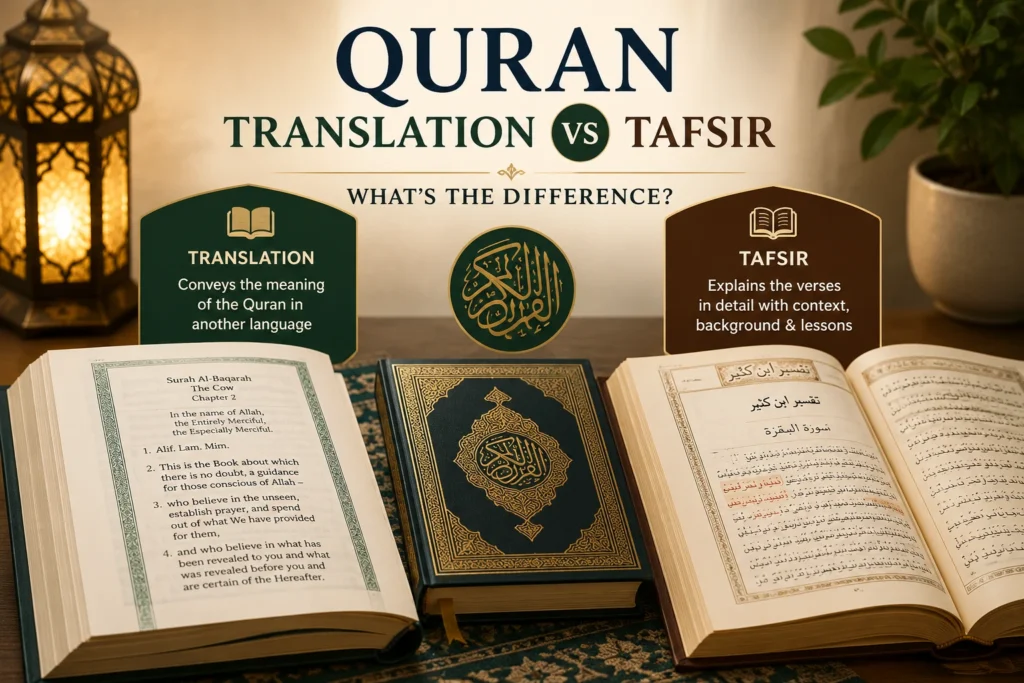
Quran Translation vs Tafsir
Understand the difference between reading a translation of the Quran and studying its detailed explanation through Tafsir. -
10 Foods Mentioned in the Quran and Their Benefits
Learn about the blessed foods mentioned in the Quran and explore their significance in Islamic tradition and everyday life.