Islam provides clear guidance about what is lawful (halal) and what is prohibited (haram). Alcohol Haram in Islam is a topic addressed through the Quran’s guidance on intoxicants and their effects on faith, judgment, relationships, and society. The Quran explains that intoxicants may contain some worldly benefit, but their harm and sin are greater. Islamic teachings therefore guide believers to avoid intoxicants and protect their faith, well-being, and responsibilities.
But why is alcohol haram in Islam? Is it only because alcohol can damage the human body, or is there a deeper reason behind its prohibition?
The Quran explains that intoxicants can have some worldly benefits, but their sin and harm are greater than their benefits. The Quran also connects intoxicants with conflict, hatred, distraction from the remembrance of Allah, and neglect of prayer. Modern medical research has additionally shown that alcohol can affect the brain, liver, heart, digestive system, immune system, and increase the risk of several diseases and cancers.
This article explains why alcohol is haram in Islam according to the Quran, the Quranic verses related to alcohol, the gradual prohibition of intoxicants, and the effects of alcohol on the human body and society.
What Does the Quran Say About Alcohol?
The Quran uses the term khamr (خمر) in its discussion of intoxicants. The Quranic guidance concerning alcohol developed through several stages, eventually leading to a clear command for believers to avoid intoxicants.
Three important Quranic passages are:
- Surah Al-Baqarah 2:219
- Surah An-Nisa 4:43
- Surah Al-Ma’idah 5:90–91
Together, these verses provide an important picture of the Islamic position on alcohol.
1. Surah Al-Baqarah 2:219 — The Harm Is Greater Than the Benefit
Allah says:
“They ask you about intoxicants and gambling. Say, ‘There is great sin in them and benefit for people. But their sin is greater than their benefit.'”
Quran — Surah Al-Baqarah 2:219
This verse is important because Allah acknowledges that intoxicants may have some benefits, but clearly states that their sin is greater than their benefit.
This teaches an important principle.
Something may provide temporary pleasure, financial benefit, social enjoyment, or another worldly advantage, but that does not automatically make it permissible.
The overall consequences must also be considered.
What does this verse teach us?
It teaches Muslims to look beyond temporary benefits and consider:
- spiritual consequences
- moral consequences
- physical consequences
- social consequences
- harm to individuals and families
The Quran therefore establishes that the harmful side of intoxicants outweighs their perceived benefits.
2. Surah An-Nisa 4:43 — Do Not Approach Prayer While Intoxicated
Allah says:
“O you who have believed, do not approach prayer while you are intoxicated until you know what you are saying.”
Quran — Surah An-Nisa 4:43
This verse came before the final prohibition of intoxicants.
It highlights one of the major problems associated with intoxication: a person may no longer have full awareness of what they are saying or doing.
Prayer requires consciousness, attention, understanding, and remembrance of Allah.
When a person is intoxicated, their:
- judgment can become impaired
- concentration can decrease
- speech can become affected
- coordination can be reduced
- understanding can become impaired
Modern medical evidence also confirms that alcohol can affect judgment, memory, coordination, reaction time, and behavior.
However, it is important to understand that Surah An-Nisa 4:43 was not the final complete prohibition of alcohol. The clearer and final command came later in Surah Al-Ma’idah.
3. Surah Al-Ma’idah 5:90 — The Clear Command to Avoid Intoxicants
Allah says:
“O you who have believed, indeed, intoxicants, gambling, stone altars, and divining arrows are but defilement from the work of Satan, so avoid it that you may be successful.”
Quran — Surah Al-Ma’idah 5:90
This verse contains the clearest Quranic command regarding intoxicants.
Allah tells believers to avoid them.
The wording is significant because the Quran does not simply tell Muslims to reduce alcohol consumption or drink responsibly. Instead, believers are instructed to stay away from intoxicants.
This is the basis for the Islamic prohibition of alcohol.
4. Surah Al-Ma’idah 5:91 — Alcohol Can Create Hatred and Distract From Allah
Allah continues:
“Satan only wants to cause between you animosity and hatred through intoxicants and gambling and to avert you from the remembrance of Allah and from prayer.”
Quran — Surah Al-Ma’idah 5:91
This verse explains several consequences of intoxicants.
The Quran specifically mentions:
1. Animosity
Alcohol can contribute to arguments and conflicts between people.
2. Hatred
Intoxication can contribute to aggressive or harmful behavior.
3. Being distracted from the remembrance of Allah
A person may become less concerned with worship and spiritual responsibilities.
4. Being distracted from prayer
Alcohol can interfere with the discipline and consciousness required for regular prayer.
The Quran therefore presents alcohol as a problem that can affect not only the body but also faith, behavior, relationships, and society.
Why Is Alcohol Haram in Islam?
The fundamental answer is simple:
Because Allah has prohibited intoxicants.
For Muslims, Allah’s command is the ultimate basis for determining what is halal and haram.
Medical research can help us understand the wisdom and consequences associated with the prohibition, but science is not the source of the Islamic ruling.
In other words:
Allah prohibited intoxicants → Muslims avoid them.
Medical research then helps us understand why alcohol can be harmful to human health and society.
The Major Reasons Behind the Prohibition of Alcohol
1. Alcohol Can Affect the Mind and Judgment
One of the most important effects of alcohol is its influence on the brain.
Alcohol can interfere with the brain’s communication pathways and affect:
- judgment
- memory
- concentration
- coordination
- reaction time
- decision-making
- behavior
This is particularly important from an Islamic perspective because Islam places significant value on reason, responsibility, awareness, and self-control.
A substance that significantly alters a person’s mental state can lead to decisions that they would not normally make while sober.
2. Alcohol Can Take a Persn Away From Prayer
The Quran specifically mentions that Satan seeks to use intoxicants to turn people away from:
the remembrance of Allah and prayer.
For Muslims, prayer is not simply a religious ritual. It is a central part of daily life and worship.
Five daily prayers provide regular opportunities to:
- remember Allah
- seek guidance
- repent
- develop discipline
- maintain spiritual awareness
- strengthen faith
Anything that repeatedly interferes with this relationship is spiritually serious.
3. Alcohol Can Damage Family and Social Relationships
The Quran mentions animosity and hatred in connection with intoxicants.
Alcohol-related problems can affect people beyond the individual who drinks.
They can contribute to:
- family conflicts
- marital problems
- financial difficulties
- workplace problems
- violence
- accidents
- neglect of responsibilities
Therefore, the Islamic prohibition also has a social dimension.
4. Alcohol Can Cause Physical Harm
The Quran’s prohibition does not depend on modern medicine. However, modern research has identified many health risks associated with alcohol consumption.
Alcohol can affect multiple organs and systems throughout the body.
Effects of Alcohol on the Human Body


1. Effects on the Brain
Alcohol affects the central nervous system.
Short-term effects can include:
- impaired judgment
- slower reaction time
- reduced coordination
- difficulty concentrating
- memory problems
- changes in mood and behavior
Long-term heavy alcohol consumption can also cause significant neurological problems.
2. Effects on the Liver
The liver plays a major role in processing alcohol.
Repeated heavy alcohol consumption can contribute to alcohol-associated liver disease.
Possible stages include:
fat accumulation → inflammation → fibrosis → cirrhosis
Severe liver damage can eventually become life-threatening.
Alcohol is also associated with an increased risk of liver cancer.
3. Effects on the Heart
Heavy alcohol consumption can negatively affect cardiovascular health.
It has been associated with conditions such as:
- high blood pressure
- irregular heartbeat
- cardiomyopathy
- stroke
- heart disease
Therefore, alcohol should not simply be viewed as a harmless recreational beverage.
4. Alcohol and Cancer Risk
Alcohol is associated with an increased risk of several cancers.
These include cancers affecting areas such as:
- mouth
- throat
- esophagus
- liver
- colon
- rectum
- breast
The risk generally increases with greater alcohol exposure.
This is one reason modern health organizations emphasize that alcohol consumption is not completely risk-free.
5. Effects on the Pancreas
Heavy alcohol consumption can damage the pancreas.
One serious condition associated with alcohol is pancreatitis, which is inflammation of the pancreas.
Severe or repeated pancreatic inflammation can cause serious health complications.
6. Effects on the Digestive System
Alcohol can also affect the digestive system.
Heavy consumption may contribute to:
- irritation
- inflammation
- gastrointestinal problems
- reflux
- digestive tract damage
- increased risk of certain cancers
7. Effects on the Immune System
Heavy alcohol consumption can weaken the body’s immune response.
This can make it more difficult for the body to defend itself against certain infections and can interfere with recovery from illness or injury.
8. Effects on Mental Health
Alcohol can also affect mental and emotional well-being.
Alcohol misuse has been associated with:
- depression
- anxiety
- alcohol-use disorder
- impaired decision-making
- behavioral problems
For some people, alcohol can create a cycle in which drinking temporarily changes mood but contributes to longer-term psychological and social problems.
9. Alcohol and Accidents
One of the most immediate dangers of intoxication is impaired coordination and judgment.
This can increase the risk of:
- road accidents
- falls
- injuries
- dangerous decisions
- violence
- workplace accidents
This is another example of how the consequences of alcohol can extend beyond the person consuming it.
Why Does Islam Prohibit Something That May Have Some Benefits?
This is an important question because the Quran itself acknowledges that intoxicants can have benefits.
In Surah Al-Baqarah 2:219, Allah says that there is benefit in intoxicants, but their sin is greater than their benefit.
This teaches us that Islam does not judge something solely by whether it has a benefit.
Many harmful things may provide temporary benefits.
For example, something may provide:
- pleasure
- entertainment
- financial profit
- temporary relaxation
but still have greater long-term harm.
Islam therefore considers the overall effect rather than only the immediate benefit.
Why Was Alcohol Prohibited Gradually?
The prohibition of alcohol is often described as having occurred gradually.
The Quran provides a progression:
Stage 1 — Surah Al-Baqarah 2:219
The Quran explained that intoxicants contain both benefit and sin, but their sin is greater than their benefit.
Stage 2 — Surah An-Nisa 4:43
Believers were instructed not to approach prayer while intoxicated until they knew what they were saying.
Stage 3 — Surah Al-Ma’idah 5:90–91
Believers were instructed to avoid intoxicants, and the Quran explained their potential spiritual and social consequences.
This progression is an important part of understanding the Quranic treatment of alcohol.
Is a Small Amount of Alcohol Also Prohibited?
The final Quranic instruction is to avoid intoxicants.
Therefore, Muslims are not instructed to find a “safe” amount of intoxicating alcohol that they can consume recreationally.
The Islamic approach is avoidance rather than attempting to calculate an acceptable amount of intoxication.
The broader Islamic teachings from the Sunnah and Islamic jurisprudence further explain this principle.
Is Alcohol Haram Only Because It Damages the Body?
No.
This is one of the most important points to understand.
Alcohol is not haram merely because modern medicine has discovered health risks.
The Islamic prohibition is fundamentally based on Allah’s command.
The Quran additionally explains several consequences:
- intoxicants involve great sin
- their harm outweighs their benefit
- they can create animosity
- they can create hatred
- they can distract people from remembering Allah
- they can distract people from prayer
Modern medicine provides additional information about the physical and psychological harms associated with alcohol.
So the relationship can be summarized as:
Islamic ruling = based on revelation.
Medical evidence = helps us understand physical consequences and possible wisdom behind the prohibition.
Quran and Science: How Should We Understand Them Together?
It is important not to claim that the Quran is a medical textbook.
The Quran’s purpose is guidance.
When the Quran prohibits intoxicants, it gives Muslims a religious and moral command.
Modern science, meanwhile, investigates the physical consequences of alcohol.
The two can therefore be discussed together without claiming that the Quran’s prohibition depends upon modern scientific discoveries.
The Quran tells us:
Avoid intoxicants.
Medical research tells us:
Alcohol can cause or contribute to numerous physical, psychological, and social harms.
This distinction keeps the discussion both Islamically accurate and scientifically responsible.
What Can Muslims Learn From the Prohibition of Alcohol?
The prohibition of alcohol teaches several broader principles.
Protect Your Mind
Islam encourages people to maintain awareness and sound judgment.
Protect Your Worship
A Muslim should protect the relationship with Allah and maintain prayer and remembrance.
Protect Your Family
Avoiding intoxicants can help protect relationships and responsibilities.
Protect Your Health
Islam encourages Muslims to avoid things that cause serious harm.
Protect Society
A person’s actions can affect other people. Islam therefore considers social consequences as well as individual choices.
Explore More About the Quran
Continue your journey of learning by exploring our helpful articles about the Holy Quran, its meanings, understanding, and guidance for everyday life.
-
The Quran: A Light for Every Heart
Discover why the Holy Quran is a timeless source of guidance, hope, and spiritual peace for every believer. -
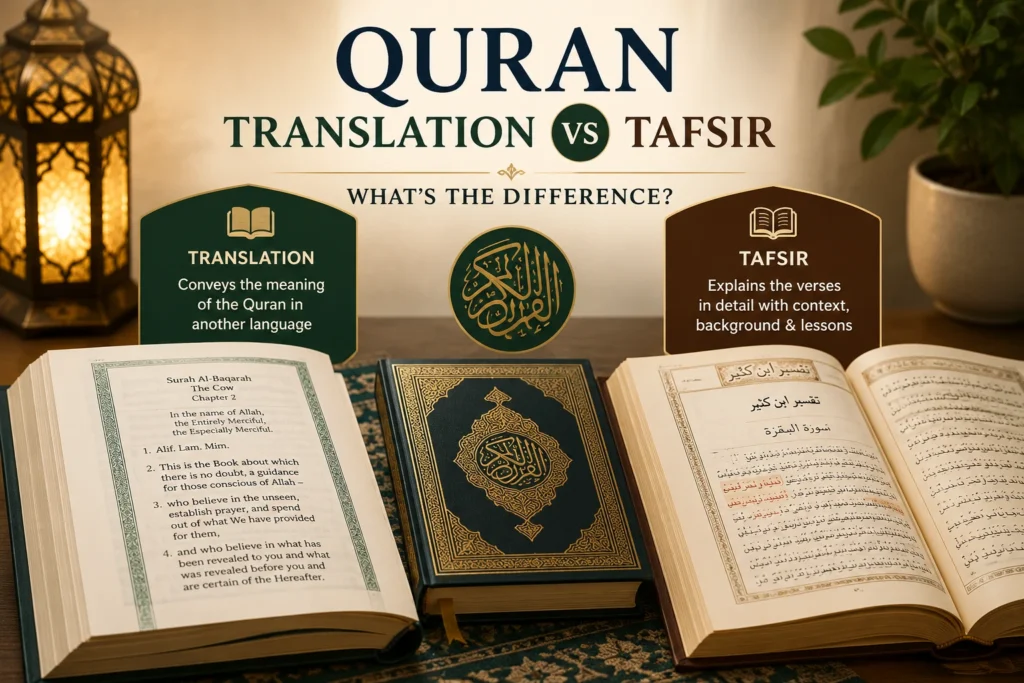
Quran Translation vs Tafsir
Understand the difference between reading a translation of the Quran and studying its detailed explanation through Tafsir. -
10 Foods Mentioned in the Quran and Their Benefits
Learn about the blessed foods mentioned in the Quran and explore their significance in Islamic tradition and everyday life.