The Quran is the Book of Allah and a source of guidance, reflection, mercy, and spiritual direction for Muslims around the world. Beautiful Quran recitation allows listeners to hear the words of the Quran with careful pronunciation, Tajweed, rhythm, and reverence.
A beautiful voice can make the listening experience peaceful and moving, but the deeper purpose of Quran recitation is to listen attentively, understand the message, reflect upon its verses, and allow the guidance of the Quran to influence our lives.
In this article, we explore the beauty of Quran recitation, how to listen respectfully, the importance of Tajweed, and selected Quran recitation videos that can be embedded from their original YouTube sources.
What Is Quran Recitation?
Quran recitation, commonly known as Tilawah, means reciting the Quran. Muslims recite the Quran in its original Arabic language while observing established rules of pronunciation and recitation.
A good Quran recitation involves several important elements:
- Correct pronunciation of Arabic letters
- Proper Tajweed
- Appropriate pauses and stopping points
- Clear pronunciation of Quranic words
- A balanced and respectful tone
- Attentiveness to the meaning of the verses
Different reciters may have different voices and styles. Some voices are soft and gentle, while others are powerful and emotional. What matters most is that the Quran is recited correctly and respectfully.
Why Listen to Beautiful Quran Recitation?
Listening to the Quran can be a meaningful way to spend time with Allah’s Book. The Quran itself instructs believers:
“When the Quran is recited, listen to it attentively and be silent, so you may be shown mercy.”
Surah Al-A’raf 7:204
This verse highlights attentive listening and respectful silence when the Quran is being recited.
For Muslims, listening to Quran recitation can therefore be more than simply enjoying a beautiful voice. It can become an opportunity for remembrance, reflection, learning, and spiritual connection.
Beautiful Quran Recitation for Reflection
A peaceful Quran recitation can help create an environment in which a person can focus on the verses and reflect upon their meaning.
However, the Quran should not be treated merely as background music. Its words carry guidance and meaning, so listeners should try to give the recitation appropriate attention and respect.
When possible, follow the Arabic verses in a Quran while listening and read a reliable translation in a language you understand.
This allows you to connect the sound of the recitation with the message of the verses.
Selected Beautiful Quran Recitation Videos
The sections below can be used for original YouTube video embeds. Rather than downloading and re-uploading videos, embed the original videos from YouTube where embedding is available and permitted.
1. Beautiful Recitation of Surah Ar-Rahman
Surah Ar-Rahman is well known for its repeated reminders of Allah’s blessings, mercy, power, and perfect creation. Listening to a careful and peaceful recitation can provide an opportunity to slow down, reflect, and become more conscious of the blessings Allah has given us. Throughout the Surah, Allah draws attention to the Quran and its teaching, the creation of human beings, speech and communication, the sun and moon, plants and trees, the sky, the balance and order of creation, the earth, fruits, crops, fresh and salt water, ships sailing on the sea, and many other signs of His power. The Surah repeatedly asks, “So which of the favors of your Lord will you deny?” (Surah Ar-Rahman 55:13), encouraging people to recognize and appreciate Allah’s countless favors.
The Surah also reminds us that everything on the earth is temporary, while Allah alone is everlasting. It speaks about Allah’s authority, His knowledge, the Day of Judgment, accountability, Paradise, and the rewards prepared for those who fear their Lord. For this reason, Surah Ar-Rahman can be meaningful for personal reflection, gratitude, remembrance of Allah, and contemplation of the blessings surrounding us every day.
2. Beautiful Recitation of Surah Yasin
Surah Yaseen focuses strongly on Allah’s oneness, revelation, resurrection, accountability, and the signs of Allah’s power in creation. Listening to a beautiful recitation can be a peaceful way to reflect on these important Quranic teachings.
In Surah Yaseen, Allah reminds people about the Quran as a source of guidance, the mission of the Prophet Muhammad ﷺ, and the consequences of accepting or rejecting the truth. The Surah also draws attention to Allah’s signs in the earth, including the revival of dead land, the growth of crops and fruits, and the creation of pairs.
One of its important themes is resurrection and life after death. The Surah reminds us that the One who created human beings in the first place has the power to bring them back to life. It also describes Allah’s complete knowledge and power over creation, including the night and day, the sun and moon, ships travelling across the sea, and the many blessings provided for people.
For reflection, Surah Yaseen encourages us to recognize Allah’s power, mercy, signs, and authority, while remembering that every person will ultimately be accountable before Him.
3. Beautiful Recitation of Surah Al-Mulk
Surah Al-Mulk emphasizes Allah’s absolute sovereignty, power, wisdom, and control over all creation. Listening to a careful and beautiful recitation of this Surah can be an opportunity to reflect on the greatness of Allah and the purpose of human life.
The Surah begins by declaring that blessed is the One in whose hand is the dominion, reminding us that all authority ultimately belongs to Allah. It draws our attention to the creation of death and life as a test, asking people to consider how they use their lives and whether their actions are righteous.
Surah Al-Mulk also encourages reflection on the seven heavens and the perfection of Allah’s creation. Allah invites people to look again and again at the sky and observe whether they can find any flaw or disorder. It also mentions the stars, which are part of the beauty and order of the heavens, and warns about the consequences awaiting those who reject their Lord.
Another important theme is Allah’s knowledge of what is hidden and what people keep secret. The Surah reminds us that Allah knows what is within the hearts and that nothing is beyond His knowledge. It also points to blessings such as the earth being made accessible for people, provision from Allah, birds held in the sky, hearing, sight, and the ability to think and understand.
The Surah concludes with a powerful reminder about Allah’s mercy and complete dependence upon Him, asking who could provide water if Allah were to withhold it. This encourages gratitude and reminds us that even something as essential as water and sustenance is ultimately a blessing from Allah.
For personal reflection, Surah Al-Mulk encourages us to think about Allah’s greatness, the perfection of creation, life and death, accountability, gratitude, repentance, and our dependence upon Allah. Listening to its recitation while following the meaning can make the experience more reflective and spiritually meaningful.
4. Beautiful Recitation of Surah Al-Kahf
Surah Al-Kahf is a powerful Surah that focuses on faith, patience, trials, Allah’s guidance, knowledge, and the temporary nature of worldly life. Listening to a beautiful and careful recitation of Surah Al-Kahf can provide an opportunity to reflect on these important lessons and strengthen our awareness of Allah’s guidance.
One of the central stories is the Companions of the Cave (Ashab Al-Kahf), young believers who remained firm in their faith despite facing pressure from their people. Their story teaches us about steadfastness in faith, trust in Allah, patience, and seeking protection from trials.
The Surah also presents the story of the two men and the gardens, reminding us that wealth, property, and worldly success are temporary blessings. It teaches the importance of gratitude, humility, and remembering that true power and provision belong to Allah.
Another important section is the story of Prophet Musa (Moses) and Khidr, which highlights the limits of human knowledge. It teaches that Allah’s knowledge is greater than our own and that events we may not immediately understand can have wisdom behind them. The story encourages patience, humility, and seeking knowledge.
Surah Al-Kahf also describes Dhul-Qarnayn, a powerful ruler who used the authority and resources Allah had given him with justice. His story highlights responsible leadership, strength, justice, and recognizing Allah as the ultimate source of power.
The Surah repeatedly reminds us about the temporary nature of worldly life, the Day of Judgment, good deeds, sincerity, and Allah’s ultimate authority. It encourages believers not to become deceived by wealth, status, or worldly attractions.
For personal reflection, Surah Al-Kahf offers valuable lessons about protecting faith, dealing with trials, remaining patient, avoiding pride, understanding the limits of human knowledge, using blessings responsibly, and trusting Allah. Listening to its recitation while following a reliable translation can help make the experience more meaningful and encourage deeper reflection on its message.
5. Beautiful Recitation of Surah Maryam
Surah Maryam is a deeply moving Surah that highlights Allah’s mercy, His power over creation, faith, patience, prayer, and trust in Allah during difficult circumstances. Listening to a beautiful and careful recitation of Surah Maryam can provide an opportunity to reflect on the stories of the prophets and the mercy and wisdom of Allah.
One of the central stories is the story of Prophet Zakariyya (Zechariah) and his sincere supplication to Allah. Despite his old age and difficult circumstances, he continued to place his trust in Allah and asked Him for righteous offspring. Allah answered his prayer by giving him Yahya (John). This story teaches us about hope, sincere dua, patience, and never losing hope in Allah’s mercy.
Surah Maryam also gives special attention to Maryam (Mary) and the miraculous birth of Prophet Isa (Jesus). Allah describes the difficult circumstances Maryam faced and how Allah supported and honored her. The story highlights purity, devotion, patience, trust in Allah, and His ability to create in ways beyond ordinary human expectations.
The Surah also mentions several other prophets, including Ibrahim (Abraham), Musa (Moses), Harun (Aaron), Ismail (Ishmael), and Idris, emphasizing their sincerity, prayer, righteousness, patience, and obedience to Allah. Through these accounts, believers are reminded of the importance of remaining faithful even when facing hardship or opposition.
Another important theme is Allah’s mercy and the reality of the Hereafter. Surah Maryam reminds people that worldly life is temporary and that everyone will ultimately return to Allah. It also warns against associating partners with Allah and emphasizes worshipping Allah alone.
For personal reflection, Surah Maryam offers powerful lessons about Allah’s mercy, the importance of dua, patience during hardship, family and faith, purity, trust in Allah, the miracles of His creation, and accountability in the Hereafter. Listening to its recitation while reading a reliable translation can help the listener better appreciate the stories and guidance contained in this beautiful Surah.
6. Beautiful Recitation of Surah Al-Waqi’ah
Surah Al-Waqi’ah is a powerful Surah that focuses on the Day of Judgment, resurrection, accountability, the different groups of people in the Hereafter, and the absolute power of Allah. Listening to a beautiful and careful recitation of Surah Al-Waqi’ah can be an opportunity to reflect on the reality of the Hereafter and the purpose of our worldly life.
The Surah begins by describing the inevitable event—the Day of Judgment. It explains that on that Day people will be divided into different groups according to their deeds and their relationship with Allah. It particularly mentions the foremost believers, the people of the right, and the people of the left, describing the different outcomes awaiting them.
Surah Al-Waqi’ah gives a detailed description of the rewards of Paradise. It mentions gardens of delight, flowing springs, fruits, shade, comfort, and honorable companionship, illustrating the blessings prepared for those who are successful in the Hereafter. In contrast, the Surah warns about the punishment and suffering of the people of the left, reminding us that human beings will ultimately be accountable for their choices.
Another important theme is Allah’s power of creation. The Surah asks people to reflect on things they experience every day: human creation, the crops they grow, the water they drink, and the fire they use. These examples encourage people to recognize that the blessings around them are ultimately provided by Allah and that human beings do not possess independent control over creation.
The Surah also draws attention to the Quran and its noble status, encouraging people to recognize the seriousness and truth of Allah’s revelation. Near the end, it reminds us of the reality of death and the helplessness of human beings at the moment when a person’s soul reaches the point of departure.
For personal reflection, Surah Al-Waqi’ah encourages us to think about the certainty of resurrection, accountability for our deeds, Allah’s power, gratitude for His blessings, the temporary nature of worldly life, and the importance of preparing for the Hereafter. Listening to its recitation while reading a reliable translation can help deepen understanding and reflection on these important Quranic messages.
Important note: It is commonly said that “whoever recites Surah Al-Waqi’ah every day will never experience poverty.” However, there is no strong authentic hadith establishing this specific guarantee. Therefore, we should not present it as a guaranteed benefit mentioned by Allah in the Qur’an. Reciting the Qur’an itself, however, is a great act of worship and brings reward.
What Makes a Quran Recitation Beautiful?
A beautiful Quran recitation is not simply about having a pleasant voice.
Several qualities contribute to a good recitation:
Correct Tajweed
Tajweed refers to rules that help a person pronounce Quranic letters and words correctly.
Clear Pronunciation
Arabic letters have specific characteristics and points of articulation. Correct pronunciation is essential when reciting the Quran.
Proper Pauses
Knowing where to stop and where to continue can help preserve the intended meaning of the verses.
Calm and Balanced Delivery
A measured and controlled voice can make it easier for listeners to follow the recitation.
Understanding the Message
The beauty of recitation should ultimately encourage listeners to think about what Allah is saying.
The Quran describes its message as something to be explained so that people may reflect. Surah An-Nahl 16:44 connects the revealed Reminder with understanding and reflection.
Quran Recitation and Understanding the Meaning
Listening to the Arabic Quran is important for Muslims, but understanding its message is also essential for meaningful reflection.
If you do not understand Arabic, you can read a reliable translation alongside the Arabic recitation.
For example:
Arabic recitation → Translation → Reflection → Learning
This approach allows you to appreciate the sound of the original Arabic while also learning what the verses mean.
A translation should be understood as a translation of the Quran’s meaning and should not be treated as identical to the original Arabic Quran.
How to Listen to the Quran Respectfully
When listening to Quran recitation, try to approach it with respect and attention.
1. Listen Attentively
Avoid unnecessary distractions when possible. The Quran instructs listeners to listen attentively when it is recited.
2. Follow the Verses
If you have access to a Quran, follow the Arabic text while listening.
3. Read the Translation
If Arabic is not your first language, use a reliable translation to understand the message.
4. Reflect on the Meaning
Think about what the verses teach about faith, worship, character, life, and the Hereafter.
5. Learn Proper Recitation
If you want to improve your own recitation, consider learning Tajweed from a qualified teacher.
Can Quran Recitation Be Used Before Sleeping?
Many Muslims listen to or recite the Quran as part of their personal nighttime routine.
If you choose to listen before sleeping, it is better to approach the Quran with respect rather than treating it simply as background audio.
You can listen attentively, read the verses, reflect upon their meaning, and then make the Quran part of a peaceful personal routine.
Quran Recitation for Children
Quran recitation can also be introduced to children in an age-appropriate way.
Parents can encourage children to:
- Listen to clear Quran recitation
- Learn short Surahs
- Practice Arabic pronunciation
- Learn basic Tajweed
- Read translations appropriate for their age
- Memorize verses gradually
- Understand the basic lessons of the Surahs
Children may naturally enjoy different reciters, so parents can choose clear and accurate recitations that are suitable for learning.
Quran Recitation and Tajweed
Tajweed is an important part of learning how to recite the Quran correctly.
A beginner may start by learning:
- Arabic letters and their pronunciation
- Makharij
- Basic characteristics of letters
- Rules of Noon Sakinah and Tanween
- Rules of Meem Sakinah
- Madd
- Qalqalah
- Correct stopping and starting
Learning Tajweed from a qualified teacher can help prevent pronunciation mistakes and improve confidence in recitation.
Should You Listen to Quran Recitation or Read the Quran?
Both listening and reading can be valuable ways to engage with the Quran.
Reading allows you to directly follow the Arabic text, while listening allows you to hear accurate pronunciation and observe the recitation of experienced reciters.
A useful routine can combine both:
Read → Listen → Understand → Reflect → Practice
This can gradually improve both Quranic understanding and recitation skills.
Using YouTube Quran Recitations on Your Website
If you are publishing Quran recitation videos on a website, using the official YouTube embed is preferable to downloading and re-uploading someone else’s video.
For each video:
- Use the original YouTube video.
- Check that embedding is available.
- Identify the reciter or original channel where appropriate.
- Do not remove attribution from the original source.
- Avoid downloading copyrighted audio or video for re-uploading without permission.
- Prefer reliable and authentic sources.
This approach allows visitors to watch the original video through YouTube while your article provides additional educational context.
How to Choose a Quran Reciter
There are many Quran reciters with different voices and recitation styles.
When choosing a recitation, consider:
Accuracy: Is the Quran being recited correctly?
Tajweed: Does the reciter follow recognized Tajweed principles?
Clarity: Can you clearly hear the Arabic pronunciation?
Learning value: Is the recitation useful for following along and improving your own reading?
Source: Is the video published by a reliable or authorized source?
A beautiful voice is welcome, but correctness and respect for the Quran should come first.
Create a Simple Daily Quran Listening Routine
You do not necessarily need a long session to begin developing a regular habit.
A simple routine could be:
10 minutes: Listen to a short Surah.
5 minutes: Read its translation.
5 minutes: Reflect on one or two important verses.
Optional: Repeat the recitation while following the Arabic text.
Over time, this can become a consistent habit of listening, reading, learning, and reflection.
Final Thoughts
Beautiful Quran recitation can be a meaningful way to spend time with the words of Allah. A peaceful and melodious voice may make the listening experience beautiful, but the real value of Quran recitation goes deeper than the voice of the reciter.
The Quran encourages attentive listening when it is recited, and its message calls people toward understanding and reflection.
Whether you choose Surah Ar-Rahman, Surah Yasin, Surah Al-Mulk, Surah Al-Kahf, Surah Maryam, or another part of the Quran, try to listen respectfully, follow the verses, understand their meaning, and reflect upon their guidance.
Explore More About the Quran
Continue your journey of learning by exploring our helpful articles about the Holy Quran, its meanings, understanding, and guidance for everyday life.
-
The Quran: A Light for Every Heart
Discover why the Holy Quran is a timeless source of guidance, hope, and spiritual peace for every believer. -
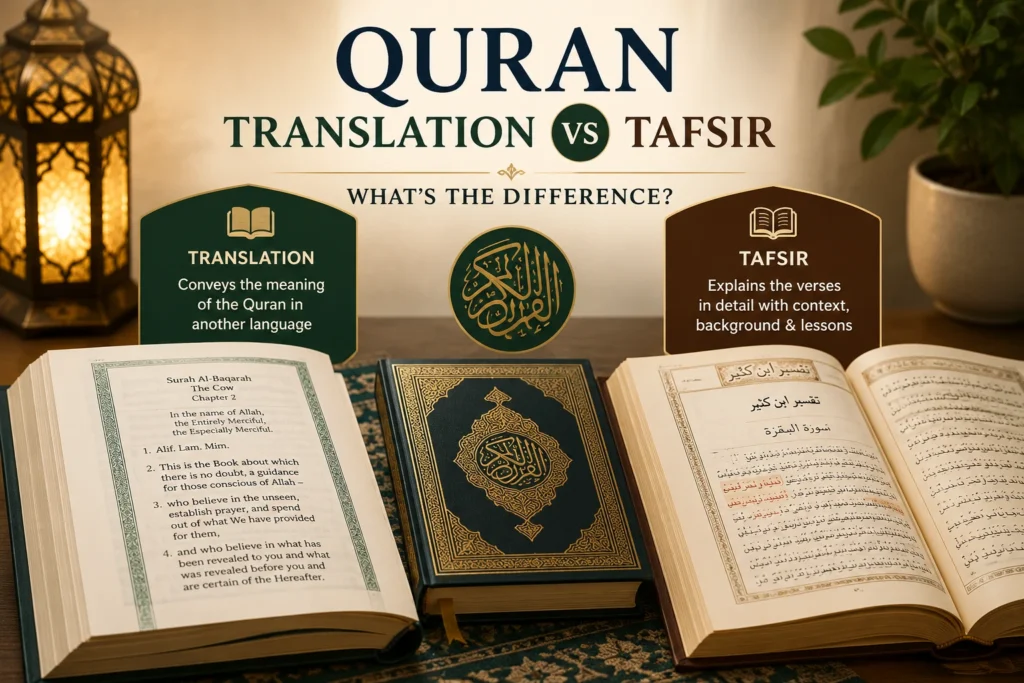
Quran Translation vs Tafsir
Understand the difference between reading a translation of the Quran and studying its detailed explanation through Tafsir. -
10 Foods Mentioned in the Quran and Their Benefits
Learn about the blessed foods mentioned in the Quran and explore their significance in Islamic tradition and everyday life.