Introduction: Human Development and the Quran
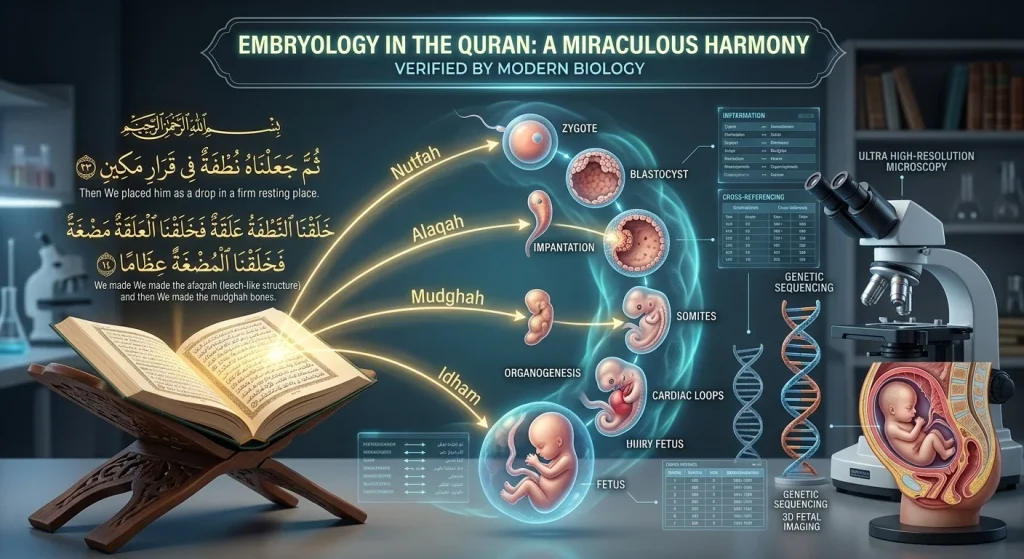
Embryology in the Quran is a subject that invites readers to reflect on the beginning of human life and the stages through which a human being develops. The Holy Quran describes human creation through a series of expressions, including nutfah, alaqah, and mudghah. These terms appear in passages that speak about human development, Allah’s power, and the signs of creation.
Modern biology studies human development through observation, microscopy, and scientific research. It describes processes such as fertilization, cell division, implantation, the formation of tissues and organs, and growth before birth.
Many readers compare Quranic descriptions with modern embryology. Such comparisons can be meaningful, but they require care. Quranic expressions are part of a religious text, and their meanings may be broader than a modern scientific label. Likewise, biological development is continuous and complex; it does not always occur in sharply separated stages.
This article explores relevant Quranic verses in Arabic, Urdu, and English. It also explains related biological concepts while distinguishing the wording of the Quran from modern scientific terminology.
1. Human Creation from an Extract of Clay
Surah Al-Mu’minun — 23:12
Arabic:
وَلَقَدْ خَلَقْنَا الْإِنسَانَ مِن سُلَالَةٍ مِّن طِينٍ
Urdu Translation:
اور یقیناً ہم نے انسان کو مٹی کے خلاصے سے پیدا کیا۔
English Translation:
And indeed, We created the human being from an extract of clay.
Quranic Reflection:
This verse speaks of human creation from “سُلَالَةٍ مِّن طِينٍ” — “an extract of clay.” The passage then continues by describing the development of human beings through stages.
The verse begins with the origin of humanity and moves toward the development of an individual in the womb. It reminds readers of the relationship between human existence and the created world.
Biological Context
Modern biology explains that human beings are composed of elements and compounds found throughout the natural world. The human body contains elements such as oxygen, carbon, hydrogen, nitrogen, calcium, and phosphorus.
The Quranic phrase “extract of clay” is a theological description of human origin. It should not be treated as a technical chemical formula or as a claim that an embryo literally develops from soil.
The verse invites reflection on creation and human origin, while modern biology describes the material composition and development of the human body.
2. Nutfah: A Drop in a Secure Place
Surah Al-Mu’minun — 23:13
Arabic:
ثُمَّ جَعَلْنَاهُ نُطْفَةً فِي قَرَارٍ مَّكِينٍ
Urdu Translation:
پھر ہم نے اسے ایک محفوظ ٹھکانے میں نطفہ بنا دیا۔
English Translation:
Then We placed it as a drop in a secure place.
Quranic Reflection:
The verse contains two important expressions:
- نُطْفَةً — Nutfah: commonly translated as a drop or a small quantity of fluid.
- قَرَارٍ مَّكِينٍ — Qarar Makin: a secure or firmly established place.
The passage describes the beginning of human development in a protected place. In the context of the following verse, it leads into a sequence of descriptions of development.
Biological Context: Fertilization and the Uterus
In modern biology, human development begins when a sperm cell fertilizes an egg cell. The resulting cell is called a zygote. It begins dividing and develops into a group of cells that eventually reaches the uterus and implants in its lining.
The uterus provides an environment in which the developing embryo can continue to grow. The placenta later develops as an important interface for the exchange of oxygen, nutrients, and waste between the mother and the developing fetus.
The Quranic expression “a secure place” can be considered alongside the protective role of the womb. However, the verse does not use modern anatomical terms such as uterus, zygote, or placenta.
3. Alaqah: A Clinging Stage
Surah Al-Mu’minun — 23:14, Part 1
Arabic:
ثُمَّ خَلَقْنَا النُّطْفَةَ عَلَقَةً
Urdu Translation:
پھر ہم نے نطفے کو علقہ بنا دیا۔
English Translation:
Then We developed the drop into an alaqah.
Quranic Reflection:
The word “عَلَقَة” (alaqah) is often translated as “a clinging clot” or “a clinging substance.” The English translation varies because the Arabic term carries a range of meaning.
The verse describes a transition from nutfah to alaqah. It is important not to assume that one English translation captures every aspect of the Arabic word.
Biological Context: Implantation and Early Development
After fertilization, the developing human embryo travels toward the uterus. It eventually attaches to the uterine lining through a process known as implantation.
Implantation is essential for continued development. The embryo becomes closely associated with the uterine lining, where further development and the formation of supporting structures take place.
Some readers compare the Quranic term alaqah, understood as something that clings, with the attachment of the early embryo. Others emphasize the term’s traditional translation as a clot-like form.
A careful comparison should acknowledge that the Arabic term is not a modern embryological label. The Quran describes a stage using its own language, while biology describes implantation and early embryonic development through specialized terminology.
4. Mudghah: A Chewed-Like Lump
Surah Al-Mu’minun — 23:14, Part 2
Arabic:
فَخَلَقْنَا الْعَلَقَةَ مُضْغَةً
Urdu Translation:
پھر ہم نے علقہ کو مضغہ بنا دیا۔
English Translation:
Then We developed the alaqah into a mudghah.
Quranic Reflection:
The word “مُضْغَة” (mudghah) is commonly translated as “a lump of flesh” or “a morsel.” The word is associated with something that has been chewed.
The Quran describes a transition from alaqah to mudghah. This expression is part of the passage’s broader description of human development.
Biological Context: Early Embryonic Form
During early embryonic development, the embryo changes rapidly. Cells differentiate, tissues begin to form, and structures that will contribute to the body’s organs develop.
One notable feature of early human development is the appearance of somites—segments of tissue that contribute to the formation of parts of the vertebral column, skeletal muscles, and other structures.
Some writers have compared the segmented appearance of early embryos with the description of a mudghah. Such a comparison is an interpretation, not a direct equivalence established by the Quranic wording.
Modern embryology uses precise developmental stages and measurements. The Quranic expression provides a description in a different linguistic and religious context.
5. The Formation of Bones and Flesh
Surah Al-Mu’minun — 23:14, Part 3
Arabic:
فَخَلَقْنَا الْمُضْغَةَ عِظَامًا فَكَسَوْنَا الْعِظَامَ لَحْمًا
Urdu Translation:
پھر ہم نے مضغہ سے ہڈیاں بنائیں، پھر ہڈیوں کو گوشت پہنایا۔
English Translation:
Then We developed the mudghah into bones, then clothed the bones with flesh.
Quranic Reflection:
This portion of the verse describes the formation of bones and the covering of bones with flesh. The imagery is direct and memorable: bones are described, followed by flesh covering them.
The verse continues the sequence of development and ends by describing a further stage of creation.
Biological Context: Skeletal and Muscular Development
Modern embryology explains that the skeleton and muscles develop through coordinated processes.
- Some embryonic tissues contribute to the formation of cartilage and bones.
- Other tissues contribute to skeletal muscles.
- The developing skeleton and muscles grow and change together.
- Bone formation occurs through processes that include the development of cartilage models and the formation of bone tissue.
These processes are not completely separate events in which all bones finish forming before any muscle tissue develops. Different tissues develop in overlapping and coordinated ways.
The Quranic wording describes a sequence using the image of bones and flesh. A scientific comparison should therefore avoid claiming that modern biology establishes a strict, universal timetable in which bones are fully formed first and muscles only begin afterward.
The verse can be read as a description of development, while modern embryology provides detailed accounts of how skeletal and muscular tissues form.
6. A Further Stage of Creation
Surah Al-Mu’minun — 23:14, Part 4
Arabic:
ثُمَّ أَنشَأْنَاهُ خَلْقًا آخَرَ فَتَبَارَكَ اللَّهُ أَحْسَنُ الْخَالِقِينَ
Urdu Translation:
پھر ہم نے اسے ایک دوسری ہی مخلوق بنا دیا۔ پس بہت بابرکت ہے اللہ، جو سب سے بہتر پیدا کرنے والا ہے۔
English Translation:
Then We brought it into being as another creation. So blessed is Allah, the Best of creators.
Quranic Reflection:
The verse concludes with “خَلْقًا آخَرَ” — “another creation.” It emphasizes a further transformation in the development of the human being.
The passage then praises Allah as the Best of creators. Its focus is not only on the sequence of physical development, but also on the wonder of creation.
Biological Context: Growth and Maturation
Human development continues beyond the earliest embryonic stages. Organs grow, body systems become more functional, and the fetus continues to develop before birth.
After birth, growth and maturation continue through infancy, childhood, adolescence, and adulthood.
The Quranic phrase “another creation” is a broad description. Modern biology uses more specific terminology to describe fetal growth, organ development, and maturation.
7. The Quran Describes Human Development in Another Passage
Surah Al-Hajj — 22:5, Part 1
Arabic:
يَا أَيُّهَا النَّاسُ إِن كُنتُمْ فِي رَيْبٍ مِّنَ الْبَعْثِ فَإِنَّا خَلَقْنَاكُم مِّن تُرَابٍ ثُمَّ مِن نُّطْفَةٍ ثُمَّ مِنْ عَلَقَةٍ ثُمَّ مِن مُّضْغَةٍ مُّخَلَّقَةٍ وَغَيْرِ مُخَلَّقَةٍ
Urdu Translation:
اے لوگو! اگر تم دوبارہ اٹھائے جانے کے بارے میں شک میں ہو تو بے شک ہم نے تمہیں مٹی سے پیدا کیا، پھر نطفے سے، پھر علقہ سے، پھر مضغہ سے، جو مکمل صورت میں بھی ہوتا ہے اور نامکمل صورت میں بھی۔
English Translation:
O mankind, if you are in doubt about the Resurrection, then indeed, We created you from dust, then from a drop, then from a clinging substance, then from a lump of flesh, formed and unformed.
Quranic Reflection:
This verse presents stages of human creation in the context of the Resurrection. It mentions nutfah, alaqah, and mudghah, and describes the mudghah as formed and unformed.
The phrase “مُّخَلَّقَةٍ وَغَيْرِ مُخَلَّقَةٍ” is translated in different ways. The wording indicates a distinction between formed and not fully formed, while the precise interpretation may vary among translations.
The verse also connects human development with the Quran’s argument about resurrection. It invites people to reflect on their own creation and on Allah’s power.
Biological Context: Development Is Not Identical in Every Pregnancy
Modern embryology studies how development proceeds and how outcomes can vary. Not every pregnancy develops in the same way, and early development may not always continue to birth.
The Quranic wording “formed and unformed” is sometimes discussed in relation to developmental variation. However, it should not be presented as a precise modern clinical description of a particular pregnancy outcome without further evidence.
The verse’s direct context is a reminder of creation and resurrection.
8. The Human Being Begins as a Nutfah
Surah Al-Qiyamah — 75:37
Arabic:
أَلَمْ يَكُ نُطْفَةً مِّن مَّنِيٍّ يُمْنَىٰ
Urdu Translation:
کیا وہ ٹپکائے جانے والے نطفے میں سے ایک نطفہ نہ تھا؟
English Translation:
Was he not a drop from semen emitted?
Quranic Reflection:
The verse asks the human being to consider an earlier stage of existence. It describes the human being as having once been a nutfah.
The question encourages reflection on the contrast between the beginning of human life and the person who later becomes capable of thought, speech, and action.
Biological Context: Reproductive Cells
Human reproduction involves sperm and egg cells. When fertilization occurs, their genetic material combines, forming a zygote.
The zygote begins a sequence of cell divisions and developmental changes. This is the beginning of a new developmental process.
The Quranic verse describes the beginning in a concise form. Modern biology provides a detailed explanation of the cells and processes involved.
9. Development, Formation, and the Human Pair
Surah Al-Qiyamah — 75:38–39
Arabic:
ثُمَّ كَانَ عَلَقَةً فَخَلَقَ فَسَوَّىٰ
فَجَعَلَ مِنْهُ الزَّوْجَيْنِ الذَّكَرَ وَالْأُنثَىٰ
Urdu Translation:
پھر وہ علقہ بنا، پھر اللہ نے اسے پیدا کیا اور درست کیا۔ پھر اسی سے دو قسمیں، نر اور مادہ، بنائیں۔
English Translation:
Then he became a clinging substance; then He created and proportioned him. And made from him the two mates, the male and the female.
Quranic Reflection:
These verses continue the reflection on human development. They describe the transition from nutfah to alaqah, followed by creation and proportioning, and then mention male and female.
The passage reminds readers of the stages of human existence and the power of Allah.
Biological Context: Sex Development
Modern biology describes sex development through genetic, hormonal, and anatomical processes. In typical human development, chromosomal patterns are established at fertilization, while reproductive structures develop over time.
Biological sex development is complex, and variations in sex development also occur. The Quranic verses present male and female in concise language; they do not provide a detailed account of chromosomes, hormones, or reproductive anatomy.
10. Historical Context: Human Development Before Modern Microscopes
The study of human development has a long history. People observed pregnancy and childbirth long before modern microscopes and imaging technologies existed. However, the earliest stages of development are not directly visible to the unaided eye.
Modern embryology became increasingly detailed as microscopes, laboratory methods, imaging, and scientific investigation developed. Researchers can now study cells, tissues, genes, and the stages of embryo development in ways that were not available to earlier observers.
The Quranic passages about human development were revealed in a historical setting very different from modern scientific laboratories. Readers often find this context meaningful when reflecting on the Quran’s descriptions.
At the same time, historical comparisons require careful evidence. It is not enough to state that a particular biological concept was completely unknown in the past. Historical knowledge varied across cultures and periods, and claims about what ancient people knew should be supported by reliable historical research.
The strongest approach is to examine the Quranic wording directly, understand the range of its meanings, and compare it carefully with what modern biology has established.
11. What Modern Biology Can and Cannot Verify
Modern biology can investigate and describe:
- Fertilization and the formation of a zygote
- Cell division and early embryonic development
- Implantation in the uterine lining
- The development of tissues and organs
- The formation of skeletal and muscular systems
- Fetal growth and maturation
These are observable biological processes that can be studied through scientific methods.
The Quran, however, is a religious text. Its descriptions of human development appear within passages about creation, resurrection, and Allah’s power.
Therefore, it is useful to distinguish three things:
1. The Quranic wording:
The actual Arabic terms and expressions used in the verses.
2. Translation and interpretation:
The ways Arabic terms such as alaqah and mudghah are rendered and understood.
3. Modern biological explanation:
Scientific descriptions of cells, tissues, organs, and developmental processes.
Keeping these categories distinct allows readers to explore the relationship between the Quran and biology without overstating what either source says.
12. Quranic Reflection on Human Development
The Quran’s descriptions of human development encourage several reflections.
Human beings begin in a humble state
The Quran asks people to remember their beginning as a nutfah. This encourages humility and reflection on human existence.
Development occurs through stages
The passages describe transitions from one stage to another. Modern biology also studies development as a process involving many changes over time, although its stages are defined through scientific observations.
The womb is described as a secure place
Surah Al-Mu’minun 23:13 speaks of a qarar makin, a secure place. This wording invites reflection on the protected environment in which development occurs.
Human creation is a sign
The passage concludes by praising Allah as the Best of creators. Its central message is connected with creation and divine power, not simply a sequence of physical events.
Conclusion: Reflecting on Embryology in the Quran
The Quran describes human development through expressions such as nutfah, alaqah, and mudghah. Surah Al-Mu’minun 23:12–14 presents a sequence from an extract of clay to a drop, a clinging stage, a lump, bones, flesh, and a further stage of creation. Surah Al-Hajj 22:5 and Surah Al-Qiyamah 75:37–39 also invite reflection on the beginning and development of human life.
Modern biology explains the development of the human embryo through fertilization, implantation, cell differentiation, tissue formation, organ development, and growth. These scientific descriptions provide context for readers considering the Quranic passages.
A responsible comparison does not force every Quranic word into a modern scientific term. It recognizes the Quran’s own language, the range of translation, and the complexity of biological development.
The Quran’s central invitation in these passages is to reflect on human creation and recognize the power of Allah. The development of a human being—from a tiny beginning to a complex living person—remains a profound subject for reflection.
Frequently Asked Questions
Which Quranic verses describe embryonic development?
Surah Al-Mu’minun 23:12–14, Surah Al-Hajj 22:5, and Surah Al-Qiyamah 75:37–39 contain descriptions of human creation and development.
What does the Quran mean by nutfah?
Nutfah is commonly translated as a drop or a small quantity of fluid. The term appears in Quranic passages describing human creation.
What does alaqah mean?
Alaqah is translated in different ways, including “clinging substance” and “clinging clot.” The Arabic term has a range of meaning, so no single English rendering should be treated as the only possible interpretation.
What is mudghah?
Mudghah is commonly translated as a lump or morsel of flesh. It appears in verses describing a stage of human development.
Does modern biology describe development in stages?
Yes. Modern embryology uses defined stages and developmental milestones. However, development is continuous, and different tissues and organs form through overlapping processes.
Does the Quran describe bones forming before flesh?
Surah Al-Mu’minun 23:14 uses the wording of bones followed by flesh covering the bones. Modern embryology describes skeletal and muscular development as coordinated and overlapping. A careful comparison should not claim that all bones are fully formed before muscle tissue begins to develop.
Is every Quranic term an exact scientific term?
No. Quranic Arabic and modern scientific terminology belong to different contexts. The Quranic terms can be explored alongside biology, but they should not automatically be treated as exact equivalents of modern anatomical or embryological labels.
Explore More About the Quran
Continue your journey of learning by exploring our helpful articles about the Holy Quran, its meanings, understanding, and guidance for everyday life.
-
The Quran: A Light for Every Heart
Discover why the Holy Quran is a timeless source of guidance, hope, and spiritual peace for every believer. -
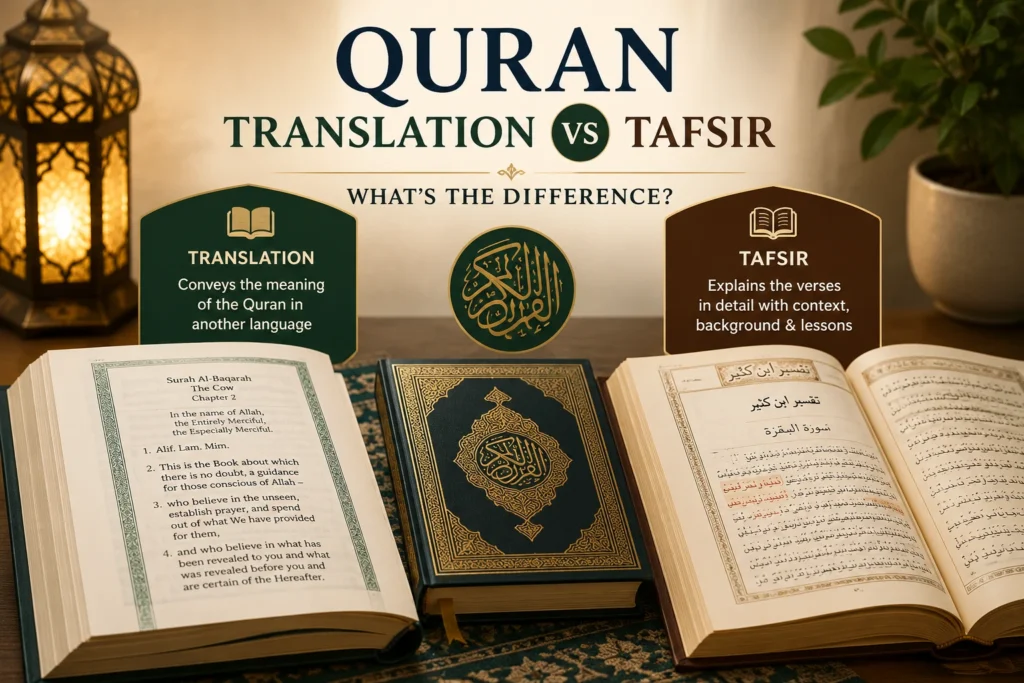
Quran Translation vs Tafsir
Understand the difference between reading a translation of the Quran and studying its detailed explanation through Tafsir. -
10 Foods Mentioned in the Quran and Their Benefits
Learn about the blessed foods mentioned in the Quran and explore their significance in Islamic tradition and everyday life.
Recommended Quran & Embryology Resources
Explore the Quranic passages about human development and consult educational resources about embryology. These references provide the Arabic Quranic text, translations, word-by-word analysis, and scientific background for further study.
-
Quran 23:12–14 — Stages of Human Creation
Read the Quranic passage mentioning the extract of clay, nutfah, alaqah, mudghah, bones, and flesh, with the Arabic text and translations.
Read Quran 23:12–14 ↗ -
Quran 22:5 — Formed and Unformed Development
Explore the verse describing human creation through stages and mentioning a formed and unformed mudghah.
Read Quran 22:5 ↗ -
Quran 75:37–39 — Nutfah, Alaqah, and Human Formation
Read the verses that refer to the human being’s beginning as a nutfah, the alaqah stage, and the creation of male and female.
Read Quran 75:37–39 ↗ -
Quranic Arabic Corpus — Word-by-Word Analysis
Study Arabic vocabulary, grammar, and morphology in Quran 22:5 to explore the wording of the verse more closely.
Explore Quranic Arabic ↗ -
Quranic Arabic Corpus — Quran 23:14
Compare English translations of the verse and examine the Arabic terms used in the description of human development.
Compare Quran Translations ↗ -
Quran 23:12–14 — Urdu Translation
Read the Arabic verses with an Urdu translation to review the Quranic wording in the language of the article’s Urdu-speaking audience.
Read Urdu Translation ↗