Introduction: The Ocean and the Signs of Creation
Oceanography and the Quran is a fascinating topic that invites readers to reflect on the oceans and the signs of Allah’s creation. The oceans cover vast areas of the Earth and contain an extraordinary variety of water conditions, currents, marine life, and underwater environments. Their depths remain a subject of scientific exploration, while their surface and coastlines have shaped human life throughout history.
The Holy Quran invites people to reflect on the natural world and recognize the signs of Allah’s creation. Among its descriptions are verses about two bodies of water meeting, a barrier or partition between them, and the darkness of the deep sea.
These verses have inspired many readers to consider the relationship between the Quran and oceanography—the scientific study of the oceans.
This article explores the Quranic passages often discussed in connection with ocean waters and their boundaries. It presents the Arabic text, Urdu translation, English translation, and reflections based on the wording of each verse. Scientific explanations are included as context, while the Quranic text remains the foundation of the discussion.
1. The Two Seas That Meet
Surah Ar-Rahman — 55:19
Arabic:
مَرَجَ الْبَحْرَيْنِ يَلْتَقِيَانِ
Urdu Translation:
اس نے دو سمندروں کو چھوڑ دیا کہ وہ آپس میں ملتے ہیں۔
English Translation:
He released the two seas, meeting together.
Quranic Reflection:
This verse describes two seas meeting. The Arabic word “يَلْتَقِيَانِ” means that they meet one another.
The verse draws attention to the meeting of bodies of water. It does not name a particular ocean, river, or geographic location. Instead, it presents the meeting of waters as a sign of Allah’s creation.
Oceanography Connection
In oceanography, bodies of water can meet while differing in characteristics such as salinity, temperature, density, and the direction of their movement.
For example, freshwater from a river can flow into saltwater at an estuary. Water from different ocean regions can also meet and form fronts or transition zones. These areas may show visible or measurable differences, even though the water is not permanently separated by a solid wall.
The Quranic verse describes the meeting of two seas. The scientific examples help readers understand how different bodies of water may come into contact while retaining some distinguishable properties.
2. The Barrier Between the Two Seas
Surah Ar-Rahman — 55:20
Arabic:
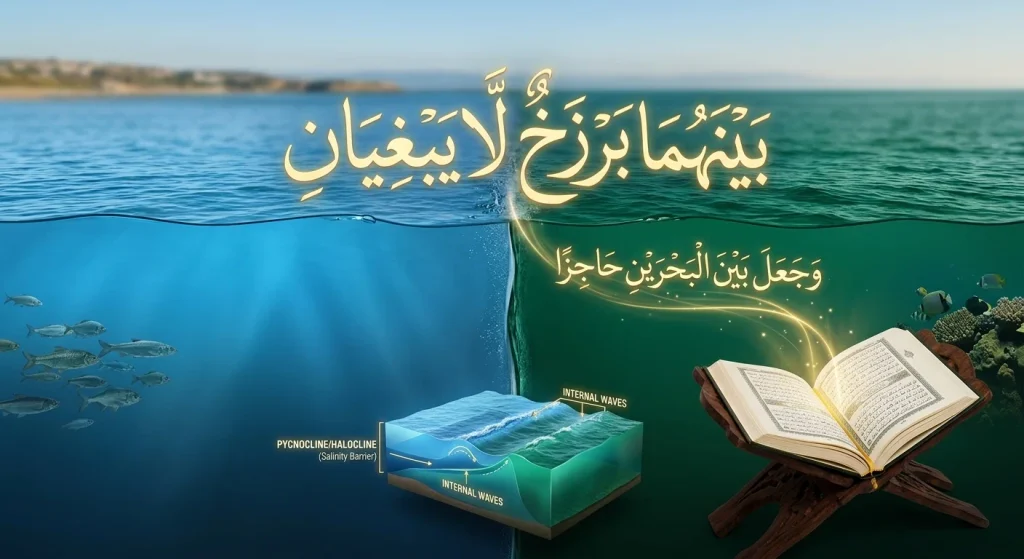
بَيْنَهُمَا بَرْزَخٌ لَّا يَبْغِيَانِ
Urdu Translation:
ان دونوں کے درمیان ایک آڑ ہے کہ وہ اس سے آگے نہیں بڑھتے۔
English Translation:
Between them is a barrier which they do not overstep.
Quranic Reflection:
This verse follows the description of two seas meeting. It speaks of a “بَرْزَخٌ” — “barrier” or “partition” between them.
The expression “لَّا يَبْغِيَانِ” is translated as “they do not overstep” or “they do not transgress.” The verse describes a boundary between the two waters.
The Quran does not describe this barrier as a visible wall made of stone or another solid material. It uses the word barzakh, a term translated as a partition or barrier.
Oceanography Connection: Boundaries Between Water Masses
Oceanographers study boundaries between water masses. A water mass may have distinctive properties because of its temperature, salinity, or density.
A boundary between water masses is not necessarily a solid object. It may be a region where properties change over a distance. Such boundaries can influence how water moves and mixes.
This scientific context can help readers consider how two bodies of water may meet while still having distinguishable characteristics.
However, ocean water does not remain completely unmixed. Mixing can occur through currents, turbulence, tides, and other processes. The scientific explanation should therefore not be simplified into the claim that two seas never mix at all.
The Quranic verse speaks of a barrier and the limits between the waters. The oceanographic examples offer context without claiming that the verse specifies a particular scientific mechanism.
3. Fresh Water and Salty Water: A Barrier and a Partition
Surah Al-Furqan — 25:53
Arabic:
وَهُوَ الَّذِي مَرَجَ الْبَحْرَيْنِ هَٰذَا عَذْبٌ فُرَاتٌ وَهَٰذَا مِلْحٌ أُجَاجٌ وَجَعَلَ بَيْنَهُمَا بَرْزَخًا وَحِجْرًا مَّحْجُورًا
Urdu Translation:
اور وہی ہے جس نے دو پانیوں کو جاری کیا، ایک میٹھا اور خوشگوار ہے اور دوسرا کھاری اور کڑوا، اور اس نے ان دونوں کے درمیان ایک آڑ اور مضبوط رکاوٹ بنا دی۔
English Translation:
And He is the One Who has released the two bodies of water: one fresh and sweet, and the other salty and bitter; and He placed between them a barrier and a prohibiting partition.
Quranic Reflection:
This verse gives a more detailed description than the preceding verses. It identifies two kinds of water:
- عَذْبٌ فُرَاتٌ — fresh and pleasant water
- مِلْحٌ أُجَاجٌ — salty and bitter water
It then describes a “بَرْزَخًا” and “حِجْرًا مَّحْجُورًا” between them, terms translated as a barrier and a prohibiting partition.
The verse directly describes the difference between fresh and salty water. It also emphasizes the boundary placed between them.
Oceanography Connection: Freshwater and Seawater
Freshwater and seawater differ in their dissolved salt content. This difference is called salinity.
When freshwater enters the sea, the two waters come into contact. Depending on conditions such as flow, temperature, and density, the freshwater may spread over the saltwater, mix with it, or form a transition zone.
An estuary is one example of this interaction. It is an area where river water and seawater meet. The salinity in an estuary can change from place to place and with the tides.
The scientific explanation shows that freshwater and seawater can meet while retaining differences in their properties for a time. It does not mean that they are permanently isolated from one another.
The Quranic verse itself identifies the two types of water and the barrier between them. The details of salinity and estuary dynamics are scientific explanations, not additional wording from the verse.
4. What Does “Barzakh” Mean in the Quranic Description?
The Arabic word “بَرْزَخ” (barzakh) appears in the verses about the two bodies of water.
In these verses, it is commonly translated as:
- Barrier
- Partition
- Boundary
The Quran uses the word in a description of two bodies of water meeting, with a barrier between them.
It is important to distinguish the Quranic wording from a modern scientific label. The verse does not use terms such as halocline, thermocline, or ocean front. These are scientific terms used to describe particular features or transitions in water.
A careful discussion can compare the general idea of a boundary with oceanographic observations without claiming that the Quran explicitly names a modern scientific concept.
5. Water Boundaries in Oceanography
Oceanography studies the physical, chemical, biological, and geological features of the oceans. Water boundaries are part of physical oceanography.
Salinity
Salinity refers to the concentration of dissolved salts in water. Seawater generally has a higher salinity than river water.
When waters of different salinities meet, their differences can affect their density and movement.
Density
Water density depends on several factors, including temperature and salinity. In many circumstances, saltier water is denser than fresher water at a similar temperature.
Density differences can influence whether one water mass flows above or below another. They can also affect how water masses mix.
Water-Mass Fronts
A front is a boundary or transition zone between water masses with different properties. Oceanographers may identify fronts by changes in temperature, salinity, density, or current patterns.
A front is not necessarily a sharp, permanent line. Its position and strength may change as currents and environmental conditions change.
Gradual Mixing
When two bodies of water meet, mixing may occur gradually. The degree of mixing depends on the surrounding conditions.
This is an important point when discussing the Quranic verses: the existence of boundaries or differences between water masses does not mean that ocean waters never mix.
6. The Deep Sea and Its Darkness
The Quran also describes the darkness of the deep sea in a striking passage.
Surah An-Nur — 24:40
Arabic:
أَوْ كَظُلُمَاتٍ فِي بَحْرٍ لُّجِّيٍّ يَغْشَاهُ مَوْجٌ مِّن فَوْقِهِ مَوْجٌ مِّن فَوْقِهِ سَحَابٌ ۚ ظُلُمَاتٌ بَعْضُهَا فَوْقَ بَعْضٍ ۚ إِذَا أَخْرَجَ يَدَهُ لَمْ يَكَدْ يَرَاهَا ۗ وَمَن لَّمْ يَجْعَلِ اللَّهُ لَهُ نُورًا فَمَا لَهُ مِن نُّورٍ
Urdu Translation:
یا اس کی مثال ایسی تاریکیوں کی ہے جو گہرے سمندر میں ہوں، جسے ایک موج ڈھانپے، اس کے اوپر ایک اور موج ہو، اور اس کے اوپر بادل ہوں۔ تاریکیاں ایک دوسرے کے اوپر ہیں۔ جب وہ اپنا ہاتھ نکالے تو اسے بھی نہ دیکھ سکے۔ اور جس کے لیے اللہ نور نہ بنائے، اس کے لیے کوئی نور نہیں۔
English Translation:
Or they are like darknesses within a deep sea, covered by waves, above which are waves, above which are clouds. Darknesses, one above another. When one puts out his hand, he can hardly see it. And whoever Allah does not grant light, for him there is no light.
Quranic Reflection:
The verse describes layers of darkness in a deep sea. It mentions waves, further waves, and clouds, followed by the image of a person who can hardly see his own hand.
The verse is part of a passage using the image of darkness to convey a spiritual meaning. Its imagery also invites reflection on the conditions of deep water.
Oceanography Connection: Light in the Ocean
Sunlight does not penetrate the ocean equally at every depth. As light travels through water, it is absorbed and scattered.
The amount of light that reaches a given depth depends on factors such as water clarity, particles, and the wavelength of light. In deeper regions, natural sunlight becomes extremely limited.
This is why the deep ocean can be dark even during the daytime. Scientists use instruments and underwater vehicles to explore regions where sunlight is insufficient for ordinary vision.
The Quranic verse describes darkness in a deep sea. The scientific explanation about light penetration is context that helps readers understand the physical environment of the deep ocean.
The verse should not be reduced only to a scientific statement, because its surrounding passage also uses darkness as a spiritual image.
7. The Quran Invites People to Reflect on Creation
Surah Aal-e-Imran — 3:190
Arabic:
إِنَّ فِي خَلْقِ السَّمَاوَاتِ وَالْأَرْضِ وَاخْتِلَافِ اللَّيْلِ وَالنَّهَارِ لَآيَاتٍ لِّأُولِي الْأَلْبَابِ
Urdu Translation:
بے شک آسمانوں اور زمین کی پیدائش میں اور رات اور دن کے بدلنے میں عقل والوں کے لیے نشانیاں ہیں۔
English Translation:
Indeed, in the creation of the heavens and the earth and the alternation of night and day are signs for people of understanding.
Quranic Reflection:
This verse calls attention to signs in creation. It speaks of the heavens, the Earth, and the alternation of night and day.
The verse invites people to reflect and use understanding. When readers study the oceans—their depths, currents, water masses, and boundaries—they can reflect on the complexity of creation.
This reflection is consistent with the Quranic invitation to consider the signs of Allah in the world.
8. The Oceans as Signs of Allah’s Power
Surah Al-Jathiyah — 45:3
Arabic:
إِنَّ فِي السَّمَاوَاتِ وَالْأَرْضِ لَآيَاتٍ لِّلْمُؤْمِنِينَ
Urdu Translation:
بے شک آسمانوں اور زمین میں ایمان والوں کے لیے نشانیاں ہیں۔
English Translation:
Indeed, in the heavens and the earth are signs for the believers.
Quranic Reflection:
The verse speaks broadly of signs in the heavens and the Earth. The oceans are part of the Earth and may be among the natural features that people contemplate.
The Quran does not require readers to make unsupported claims about nature. Rather, it directs attention to the signs of creation and encourages reflection.
9. The Ocean and Human Knowledge
The oceans are vast, and human knowledge of them continues to develop. Oceanography uses observations, measurements, and scientific methods to investigate the sea.
The Quranic passages discussed in this article focus on:
- Two bodies of water meeting
- A barrier or partition between them
- Fresh and salty water
- Darkness in a deep sea
- Signs in the creation of the heavens and Earth
These themes can be considered alongside oceanographic knowledge. A balanced approach respects both the Quranic text and the methods of scientific investigation.
It is not necessary to claim that every modern oceanographic term appears explicitly in the Quran. The verses can be read for their own meaning, while scientific explanations can provide context for reflection.
10. Important Reflections from the Quranic Verses
The passages in this article provide several points for reflection:
The meeting of waters
Surah Ar-Rahman 55:19 describes two seas meeting. It directs attention to the meeting of bodies of water.
A barrier between them
Surah Ar-Rahman 55:20 describes a barzakh between the two seas and says they do not overstep it.
Fresh and salty water
Surah Al-Furqan 25:53 distinguishes fresh, pleasant water from salty, bitter water and mentions a barrier and partition between them.
Darkness in the deep sea
Surah An-Nur 24:40 describes darkness in a deep sea, with waves and clouds in its imagery.
Reflection on creation
Surah Aal-e-Imran 3:190 and Surah Al-Jathiyah 45:3 call attention to signs in the creation of the heavens and the Earth.
These verses encourage reflection on the natural world while keeping the Quranic wording at the center of the discussion.
Conclusion: The Unseen Boundaries of the Ocean
The Holy Quran describes two seas meeting, a barrier between them, the difference between fresh and salty water, and the darkness of the deep sea.
Surah Ar-Rahman 55:19–20 presents the meeting of two seas and the barzakh between them. Surah Al-Furqan 25:53 describes fresh and salty water and a barrier between them. Surah An-Nur 24:40 presents the image of darkness in a deep sea.
Oceanography offers scientific context for understanding water masses, salinity, density, gradual mixing, and the limited penetration of sunlight into deep water. These explanations help readers consider the physical world described in the verses, but they should not be presented as exact scientific terminology used by the Quran.
The central lesson is to reflect carefully on the signs of creation. The Quran’s words invite people to observe, think, and recognize the order and wonder of the natural world.
The ocean remains a vast environment of meeting waters, changing boundaries, and deep darkness—an invitation to reflect on the signs described in the Holy Quran.
Frequently Asked Questions
What does the Quran say about the barrier between two seas?
Surah Ar-Rahman 55:19–20 describes two seas meeting and says that a barzakh, or barrier, is between them. Surah Al-Furqan 25:53 also describes a barrier between fresh and salty water.
Does the Quran mention fresh and salty water?
Yes. Surah Al-Furqan 25:53 describes one body of water as fresh and pleasant and the other as salty and bitter.
Do ocean waters never mix?
Ocean waters can mix. Scientific processes such as currents, tides, turbulence, and density differences influence how water masses interact. The Quranic verses describe a barrier or boundary; they should not be interpreted as a claim that all water remains completely unmixed.
What is a “barzakh” in the verses about the seas?
In Surah Ar-Rahman 55:20 and Surah Al-Furqan 25:53, barzakh is translated as a barrier or partition between bodies of water.
Which Quranic verse describes darkness in the deep sea?
Surah An-Nur 24:40 describes darkness in a deep sea, using imagery of waves, further waves, and clouds.
Does the Quran use modern oceanographic terms?
The verses use Quranic Arabic terms such as barzakh and describe water, barriers, and deep-sea darkness. Modern terms such as salinity, halocline, and water-mass front are scientific terminology used to explain oceanographic observations.
Explore More About the Quran
Continue your journey of learning by exploring our helpful articles about the Holy Quran, its meanings, understanding, and guidance for everyday life.
-
The Quran: A Light for Every Heart
Discover why the Holy Quran is a timeless source of guidance, hope, and spiritual peace for every believer. -
Quran Translation vs Tafsir
Understand the difference between reading a translation of the Quran and studying its detailed explanation through Tafsir. -
10 Foods Mentioned in the Quran and Their Benefits
Learn about the blessed foods mentioned in the Quran and explore their significance in Islamic tradition and everyday life.
🌊 Recommended Quranic Verses on Oceanography & Water Barriers
Explore the divine verses of the Holy Quran describing the unseen physical barriers between bodies of water, fresh and salt water separation, and deep ocean darkness verified by modern oceanography:
-
Quran 55:19-20 — The Barrier Between Two Seas:
Read the famous verses describing two bodies of flowing water meeting together with an uncrossable barrier between them.
Read Surah Ar-Rahman (55:19-20) → -
Quran 25:53 — Fresh Water and Salt Seas:
Explore the verse detailing the division between sweet, palatable water and salty, bitter water with a forbidding partition (pycnocline/estuary dynamics).
Read Surah Al-Furqan (25:53) → -
Quran 24:40 — Darkness in the Deep Seas & Internal Waves:
Discover the powerful metaphor describing deep oceanic darkness covered by waves, upon which are waves, topped by dark clouds.
Read Surah An-Nur (24:40) → -
Quran 27:61 — The Partition Between Two Waters:
Read the verse pointing out the creation of rivers, firm mountains, and the functional barrier set between two bodies of water as signs of Divine Wisdom.
Read Surah An-Naml (27:61) →