Islam provides clear guidance about what Muslims may eat and what they must avoid. The rules concerning halal and haram animals in Islam are part of a broader Islamic system of lawful food, purity, worship, mercy, and obedience to Allah. Understanding halal and haram animals in Islam helps Muslims learn which animals and foods are permitted, which are prohibited, and why Islamic dietary guidelines emphasize lawful consumption and obedience to Allah.
The Quran does not provide a simple list containing every animal that Muslims may or may not eat. Instead, it establishes important principles concerning lawful foods, prohibited foods, slaughter, hunting, carrion, blood, and animals dedicated to other than Allah. The Sunnah of Prophet Muhammad ﷺ further explains some of these rules, including the prohibition of predatory animals with fangs and birds of prey with talons.
Therefore, understanding halal and haram animals requires looking at the Quran and authentic Sunnah together.
What Does Halal Mean in Islam?
The Arabic word halal refers to something that is lawful or permitted according to Islamic law.
When we talk about halal meat, it does not simply mean that the animal belongs to a particular species. There are usually several considerations:
- The animal itself must be from a permissible category.
- It must not be one of the animals specifically prohibited by Islamic law.
- The animal must be slaughtered according to the applicable Islamic requirements, where slaughter is required.
- Allah’s name is mentioned in the prescribed manner.
- The animal must not have died through a prohibited method.
The Quran describes lawful food as “good and wholesome” and gives specific guidance regarding hunting and food.
Why Did Allah Make Some Animals Halal?
A Muslim’s first answer is that Allah is the Lawgiver.
Allah determines what is lawful and unlawful. A believer follows these commands because Allah has the ultimate knowledge and authority over His creation.
The Quran repeatedly reminds Muslims not to declare something halal or haram merely according to personal desire.
This is important because sometimes people ask:
“What is the scientific reason that this animal is halal?”
Science may investigate nutrition, disease, toxicity, digestion, or other characteristics, but the Islamic ruling does not depend on a scientific explanation being discovered first.
If Allah has permitted something, Muslims accept it as permissible. If Allah has prohibited something, Muslims avoid it because of His command.
At the same time, some Islamic prohibitions have recognizable wisdoms and benefits, but we should distinguish between the reason explicitly given in revelation and a possible wisdom suggested by human reasoning.
What Animals Are Clearly Prohibited in the Quran?
The Quran explicitly identifies several categories of prohibited food.
1. Carrion — Animals That Die Without Proper Slaughter
The Quran prohibits maytah, meaning an animal that has died without the required lawful slaughter.
Surah Al-Ma’idah 5:3 lists carrion among the prohibited foods.
This means that simply finding an animal already dead does not make its meat permissible.
The principle is connected to the Islamic method of obtaining meat and respecting the rules established by Allah.
2. Blood
The Quran also prohibits flowing blood as food.
Surah Al-An’am 6:145 and other verses mention blood among the prohibited foods.
This is different from the small amount of blood that naturally remains in meat after proper slaughter.
3. Pork and Swine
The prohibition of swine/pork is one of the clearest dietary prohibitions in the Quran.
Allah mentions swine flesh among prohibited foods in several passages, including:
- Surah Al-Baqarah 2:173
- Surah Al-Ma’idah 5:3
- Surah Al-An’am 6:145
- Surah An-Nahl 16:115
The Quran therefore establishes the prohibition itself very clearly.
A Muslim does not need to wait for a medical explanation to accept this ruling.
4. Animals Dedicated to Other Than Allah
The Quran also prohibits animals that are sacrificed or dedicated in the name of something other than Allah.
Surah Al-Ma’idah 5:3 includes animals dedicated to other than Allah among the prohibited categories.
This demonstrates an important principle:
Food is not only a matter of physical consumption; it can also be connected to worship and belief.
Islam requires sacrifice to be directed toward Allah rather than idols, false deities, or other objects of worship.
Animals That Die Through Prohibited Methods
Surah Al-Ma’idah 5:3 also mentions several circumstances in which an animal becomes prohibited, including animals that die because of:
- strangulation,
- a violent blow,
- a fall,
- being gored by another animal,
- or being partially eaten by a wild animal,
unless the animal is reached while still alive and is properly slaughtered according to the relevant Islamic rules.
This demonstrates that the species alone is not enough.
An animal that is normally halal can become impermissible if it dies through a prohibited method.
Why Is Proper Slaughter Important?
Islam does not permit Muslims to treat animal life carelessly.
The Quran provides guidance concerning slaughter and hunting, including mentioning Allah’s name.
Surah Al-Ma’idah 5:4 also explains that trained hunting animals can be used to obtain lawful game, provided the relevant conditions are fulfilled and Allah’s name is mentioned.
This shows that Islamic dietary law includes both the type of animal and the manner in which it is obtained.
Which Land Animals Are Generally Halal?
Among the commonly recognized halal livestock are:
Cattle
Cattle are explicitly included among the livestock Allah has made lawful, subject to Islamic requirements.
Sheep
Sheep are among the livestock traditionally consumed by Muslims.
Goats
Goat meat is also permissible when the animal and slaughter meet Islamic requirements.
Camels
Camel meat is permissible and has an established place in Islamic tradition.
Other Lawful Grazing Animals
The Quran discusses livestock and the blessings Allah provides through them, including their meat, milk, transportation, and other benefits.
However, it is important not to assume that every land animal is automatically halal simply because it lives on land.
Islamic dietary rulings include further classifications.
What About Predatory Animals?
This is where the Sunnah provides important additional guidance.
Prophet Muhammad ﷺ prohibited eating fanged beasts of prey. Sahih Muslim records this ruling explicitly.
Examples commonly discussed under this category include predatory animals such as:
- lions,
- tigers,
- wolves,
- leopards,
- and similar predatory beasts.
The important point is that this detailed category comes from the Sunnah, not from a verse in the Quran that individually names every one of these animals.
What About Birds of Prey?
The same principle applies to certain birds.
Sahih Muslim reports that the Prophet ﷺ prohibited eating birds possessing talons/claws used for hunting.
Therefore, birds such as predatory raptors are generally included in this prohibition according to the relevant Islamic jurisprudence.
Examples commonly discussed include:
- eagles,
- hawks,
- falcons,
- and similar predatory birds.
Again, this detailed ruling is based on Hadith/Sunnah, rather than a Quranic verse individually listing every bird.
What About Chickens, Ducks and Other Birds?
Not every bird is prohibited.
Birds that do not fall under the prohibited categories are generally considered permissible when the other Islamic requirements are fulfilled.
Examples commonly eaten in Muslim communities include:
- chicken,
- duck,
- turkey,
- pigeon,
- and similar non-predatory birds.
However, the exact ruling of particular species can involve differences among Islamic schools of jurisprudence.
What About Fish and Seafood?
The Quran provides an important special ruling regarding seafood.
Allah says that the game of the sea and its food has been made lawful in Surah Al-Ma’idah 5:96.
This is why fish and seafood occupy an important place in Islamic dietary law.
However, there are differences among Islamic schools concerning the details of seafood beyond fish.
For a general article, it is better to explain the principle without claiming that every marine creature has exactly the same ruling according to every madhhab.
Why Are Some Animals Haram?
This question needs a careful answer.
There is not one single reason that applies to every prohibited animal.
Islamic prohibitions can involve different considerations, including:
1. Direct Divine Command
The strongest basis is simply that Allah has prohibited it.
For example, the Quran explicitly prohibits pork.
A Muslim accepts this ruling because Allah has commanded it.
2. Purity and Wholesomeness
The Quran describes lawful food in terms of tayyibat — good and wholesome things. Surah Al-Ma’idah 5:4 uses this concept when explaining what is lawful.
3. Protection From Harm
Some prohibited things may have physical or social harms.
However, we should be careful here: we should not claim that a particular animal was prohibited only because of a modern scientific discovery unless reliable Islamic evidence establishes that explanation.
4. Spiritual and Religious Purity
The prohibition of animals dedicated to other than Allah demonstrates that food can also have a religious and spiritual dimension.
5. Obedience and Submission
Halal and haram are also part of a Muslim’s test of obedience.
A believer does not make his own desires the ultimate standard of what is permissible.
Is Every Animal Mentioned in the Quran Halal to Eat?
Absolutely not.
This is a very important point for your article.
The Quran mentions many animals for different reasons:
- as signs of Allah’s creation,
- in stories,
- as examples,
- in parables,
- as blessings,
- as warnings,
- or as part of historical events.
Mentioning an animal does not mean that Allah has declared it halal as food.
For example, the Quran mentions the dog in the story of the Companions of the Cave, but that does not mean the verse is declaring dog meat permissible.
Similarly, the Quran mentions the wolf, elephant, ant, spider, crow, hoopoe, snake, and many other creatures without making each mention a dietary ruling.
Why Does Islam Have Halal and Haram Food Rules?
Halal and haram food rules serve several dimensions of Islamic life.
Faith
They teach Muslims that Allah has the authority to determine what is permissible.
Discipline
A Muslim learns to control personal desire and follow divine guidance.
Gratitude
Lawful food is viewed as a blessing from Allah.
Ethical Treatment
Islamic slaughter and hunting rules place conditions on how animals are taken for food.
Spiritual Awareness
Mentioning Allah’s name when obtaining food reminds Muslims that life and sustenance ultimately come from Him.
Is Halal Meat Only About Saying “Bismillah”?
No.
This is another common misunderstanding.
Simply saying Bismillah does not automatically make every animal halal.
Several factors can matter:
- The species must be permissible.
- The animal must be alive when slaughter begins, where slaughter is required.
- The prescribed slaughter requirements must be followed.
- Allah’s name is mentioned as required.
- The animal must not belong to a prohibited category.
Likewise, an animal that is inherently prohibited does not become halal simply because someone says Bismillah over it.
What Does the Quran Say About Hunting?
The Quran allows certain forms of hunting.
Surah Al-Ma’idah 5:4 explains that trained hunting animals can be used to catch game and that Muslims may eat what these trained animals catch for them, with Allah’s name mentioned.
This is significant because it shows that Islam does not require every permissible wild animal to be caught and slaughtered by hand.
There are specific rules for hunting, and Islamic scholars have discussed their details extensively.
What Is the Difference Between Quranic and Hadith-Based Food Rules?
This distinction will make your article much more accurate.
Quran establishes major principles
The Quran explicitly addresses:
- carrion,
- blood,
- pork,
- animals dedicated to other than Allah,
- certain methods of death,
- lawful animals,
- hunting,
- and the concept of good and wholesome food.
Sunnah explains additional categories
The Prophet ﷺ provided additional dietary rulings, including the prohibition of fanged predatory beasts and birds with talons.
Therefore, it would be incorrect to say:
“Everything halal and haram is listed by name in the Quran.”
Islamic dietary law is understood through Quran and authentic Sunnah together.
A Simple Halal vs Haram Summary
| Category | General Islamic Ruling | Main Basis |
|---|---|---|
| Cattle | Halal | Quran/Sunnah, with proper slaughter |
| Sheep | Halal | Quran/Sunnah, with proper slaughter |
| Goat | Halal | Quran/Sunnah, with proper slaughter |
| Camel | Halal | Quran/Sunnah |
| Chicken | Halal | General Islamic dietary principles |
| Many non-predatory birds | Halal | Sunnah/fiqh principles |
| Fish | Halal | Quran, 5:96 |
| Pork | Haram | Explicit Quranic prohibition |
| Carrion | Haram | Explicit Quranic prohibition |
| Flowing blood | Haram | Explicit Quranic prohibition |
| Animals dedicated to other than Allah | Haram | Explicit Quranic prohibition |
| Fanged predatory beasts | Haram | Authentic Sunnah |
| Predatory birds with talons | Haram | Authentic Sunnah |
Does Islam Prohibit Animals Because They Are “Bad”?
Not necessarily.
An animal being haram to eat does not mean that the animal itself is an evil creation.
This distinction is important.
For example, a lion may be prohibited as food, but lions are still part of Allah’s creation and have a role within the natural world.
Similarly, a bird of prey may be prohibited as food while still being a valuable part of an ecosystem.
Haram to eat does not mean worthless, evil, or unnecessary.
Does Haram Meat Always Mean It Is Physically Dangerous?
No.
This is another important distinction.
A food can be haram because Allah prohibited it even if humans cannot identify a particular physical reason.
Likewise, something can have nutritional value but still be religiously prohibited.
Therefore, Muslims should not reduce every halal/haram ruling to:
“It is halal because it is healthy.”
or:
“It is haram because scientists discovered that it is unhealthy.”
The Islamic ruling comes first; scientific research may sometimes help us understand possible wisdoms or effects, but it does not independently establish Allah’s law.
What If Someone Is Forced to Eat Haram Food?
The Quran provides an important exception for genuine necessity.
For example, Surah Al-Baqarah 2:173 explains that if someone is compelled by necessity, without desiring the prohibited food or exceeding the necessary limit, there is no sin upon that person.
This demonstrates that Islamic law is not intended to impose unnecessary hardship.
The exception is for genuine necessity, not ordinary preference or convenience.
The Main Wisdom Behind Halal and Haram
When we look at the complete Islamic framework, halal and haram food teach Muslims several important lessons:
Allah is the ultimate Lawgiver.
Not everything humans desire is automatically permissible.
Food should be obtained through lawful means.
Animal life should not be taken carelessly.
Muslims should distinguish between lawful and unlawful consumption.
The name of Allah and remembrance of Him are connected with lawful food.
Revelation takes priority over speculation.
And perhaps most importantly, halal and haram teach a Muslim obedience, discipline, gratitude and consciousness of Allah.
Conclusion
The Islamic rules concerning animals and birds are more comprehensive than simply dividing creatures into a list of “halal animals” and “haram animals.”
The Quran establishes the fundamental dietary framework, explicitly prohibiting categories such as carrion, flowing blood, pork, and animals dedicated to other than Allah. It also establishes rules concerning slaughter and hunting.
The authentic Sunnah further explains the dietary rulings, including the prohibition of fanged predatory animals and birds with talons.
Therefore, when asking “Why is one animal halal and another haram?”, the most accurate Islamic answer is that Allah has given mankind lawful and unlawful boundaries, and Muslims accept those boundaries as an act of faith and obedience. Some wisdoms may be understood through revelation, scholarship, ethics, or science, but we should not claim a particular reason as certain unless the Quran or authentic Sunnah establishes it.
Halal is not merely about what we eat—it is also about obedience to Allah, gratitude for His blessings, respect for His creation, and following the guidance He has given.
Explore More About the Quran
Continue your journey of learning by exploring our helpful articles about the Holy Quran, its meanings, understanding, and guidance for everyday life.
-
The Quran: A Light for Every Heart
Discover why the Holy Quran is a timeless source of guidance, hope, and spiritual peace for every believer. -
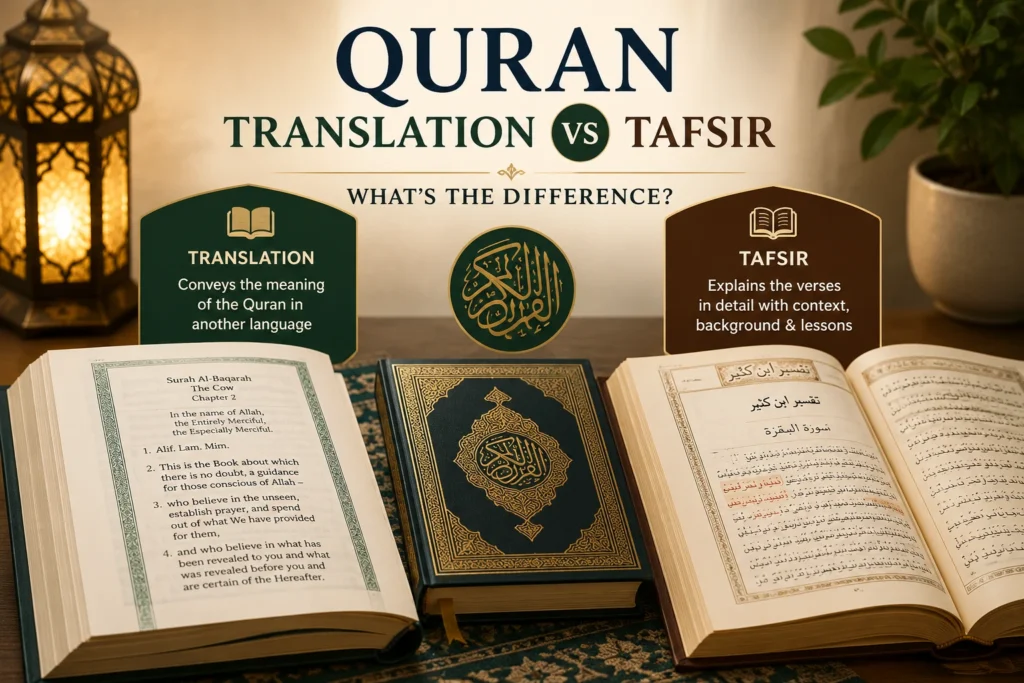
Quran Translation vs Tafsir
Understand the difference between reading a translation of the Quran and studying its detailed explanation through Tafsir. -
10 Foods Mentioned in the Quran and Their Benefits
Learn about the blessed foods mentioned in the Quran and explore their significance in Islamic tradition and everyday life.