Understanding Christianity and Islam Through Their Scriptures
Christianity and Islam are two of the world’s largest religions, and both have deep historical connections to the Abrahamic tradition. Muslims and Christians share a number of important figures, including Abraham, Moses, David, Solomon, John the Baptist, and Jesus. However, they understand these figures—and especially Jesus—in significantly different ways.
One of the most important differences between the two faiths concerns the identity and mission of Jesus Christ. Christians generally regard Jesus as the Son of God, the Messiah, and central to God’s plan of salvation. Mainstream Christian theology teaches that Jesus is divine and that his death and resurrection are central to the Christian faith.
Islam also gives Jesus an exceptionally important position. Muslims call him Isa ibn Maryam (Jesus, son of Mary) and believe that he was the Messiah, a great prophet and messenger of God, and born miraculously to Mary. However, Islam rejects the idea that Jesus is God or the literal Son of God. Muslims believe that God is absolutely One and that Jesus was a human messenger sent by God.
Islam also recognizes Prophet Muhammad ﷺ as the final prophet and messenger of God. Muslims believe that the Qur’an was revealed to Muhammad ﷺ and represents the final revelation from God, confirming the original divine messages given to earlier prophets.
This article examines these beliefs in detail. It looks at the Bible, its major books and versions, the Qur’an, the biblical accounts of Jesus, the Qur’anic account of Jesus, the life and teachings of Prophet Muhammad ﷺ, and the principal theological differences between Christianity and Islam.
1. The Bible: What Is It?
The Bible is not a single book written by one author. It is a collection of many books written over a long period of history by different authors and communities.
Christian Bibles are generally divided into two major sections:
- The Old Testament
- The New Testament
The Old Testament contains writings that Christians share, in varying forms, with the Jewish Scriptures. The New Testament contains Christian writings about Jesus and the early Christian movement.
The exact number of books differs between Christian traditions.
Protestant Bible
Most Protestant Bibles contain 66 books:
- 39 books in the Old Testament
- 27 books in the New Testament
Catholic Bible
The Catholic Bible contains 73 books:
- 46 books in the Old Testament
- 27 books in the New Testament
The additional Old Testament books are commonly called the Deuterocanonical books by Catholics and are generally known as the Apocrypha in many Protestant contexts.
Eastern Orthodox Bibles
Eastern Orthodox traditions generally contain a larger Old Testament collection than Protestant Bibles, although the exact contents can vary among Orthodox churches.
This is important when someone says, “What does the Bible say?” because the answer can sometimes depend on which biblical canon or translation is being discussed.
The Old Testament
The Old Testament contains writings concerning creation, the history of ancient Israel, laws, wisdom literature, poetry, prophecy and other religious traditions.
Some of its most well-known books include:
- Genesis
- Exodus
- Leviticus
- Numbers
- Deuteronomy
- Joshua
- Judges
- Ruth
- 1 and 2 Samuel
- 1 and 2 Kings
- Psalms
- Proverbs
- Isaiah
- Jeremiah
- Ezekiel
- Daniel
The first five books are traditionally known as the Pentateuch or Torah.
These books are particularly important because they contain narratives and teachings concerning figures whom Muslims also recognize as prophets, including Adam, Noah, Abraham, Isaac, Jacob, Joseph and Moses.
Islam, however, does not simply equate the present-day Bible with the original revelations given to these prophets. Islamic theology distinguishes between the original revelations from God and the later scriptural traditions and texts through which those traditions have been transmitted.
The New Testament
The New Testament contains 27 books in mainstream Catholic, Protestant and Eastern Orthodox Christianity.
It begins with four books known as the Gospels:
- Matthew
- Mark
- Luke
- John
These are followed by:
- Acts of the Apostles
- Letters attributed to Paul
- Other epistles
- Revelation
The four Gospels are particularly important for understanding the Christian account of Jesus.
They are not four separate “Bibles.” Rather, they are four canonical accounts of Jesus and his ministry within the New Testament.
The Four Gospels
Matthew
The Gospel according to Matthew begins with a genealogy connecting Jesus to Abraham and David.
Matthew emphasizes Jesus’ Jewish context and frequently connects events in Jesus’ life with passages from the Hebrew Scriptures.
It includes important teachings attributed to Jesus, including the Sermon on the Mount, which contains teachings about prayer, morality, forgiveness, charity and relations with others.
Matthew also contains the birth narrative of Jesus and the account of his resurrection.
Mark
Mark is generally regarded as the shortest of the four canonical Gospels.
It begins with the ministry of John the Baptist and quickly moves into the public ministry of Jesus.
Mark places considerable emphasis on Jesus’ actions, miracles, encounters with people and his journey toward Jerusalem.
The Gospel contains accounts of Jesus’ suffering and crucifixion and concludes with resurrection-related material.
Luke
Luke provides an extensive narrative of Jesus’ life and ministry.
It includes the well-known accounts of:
- The annunciation
- The birth of Jesus
- Mary
- John the Baptist
- The Good Samaritan
- The Prodigal Son
- Jesus’ teachings about compassion and forgiveness
Luke also emphasizes the importance of people who were socially marginalized.
The Gospel continues into the Acts of the Apostles, which describes the early Christian community and the spread of the Christian message.
John
The Gospel of John differs significantly in style and presentation from Matthew, Mark and Luke.
Matthew, Mark and Luke are commonly called the Synoptic Gospels because they share substantial similarities in structure and content.
John contains a distinctive theological presentation of Jesus.
Its opening passage is particularly important in Christian theology because it speaks of the Word (Logos) and describes the Word in relation to God and the incarnation.
For Christians, John’s Gospel is one of the major sources used in discussions about the divine identity of Jesus.
Muslim readers often interpret these passages differently because Islamic theology does not accept the doctrine that Jesus is God incarnate.
Major Bible Versions and Translations
The Bible has been translated into thousands of languages. Even within English, there are many translations.
A translation is not necessarily a different religion or a different Bible. It is often an attempt to communicate the biblical texts in a particular language and style.
Some well-known English Bible versions include:
King James Version (KJV)
The King James Version was published in 1611 and became one of the most influential English Bible translations.
Its language is associated with Early Modern English and has had a major influence on English literature and Christian culture.
New King James Version (NKJV)
The NKJV updates the language of the KJV while attempting to retain much of its traditional style.
New International Version (NIV)
The NIV is one of the most widely used modern English Bible translations.
It seeks to communicate the biblical text in contemporary English.
English Standard Version (ESV)
The ESV is a modern translation that is particularly popular among many evangelical and Protestant Christians.
New American Standard Bible (NASB)
The NASB is known for a relatively formal translation philosophy and is frequently used for detailed Bible study.
New Revised Standard Version (NRSV)
The NRSV is widely used in academic, scholarly and ecumenical contexts.
New Living Translation (NLT)
The NLT uses contemporary language and generally aims for readability and accessibility.
Christian Standard Bible (CSB)
The CSB is another modern English translation used widely in contemporary Protestant Christianity.
There are many additional translations, including the Revised Standard Version, Douay-Rheims, New Jerusalem Bible and others.
Bible Translation Does Not Mean There Are Hundreds of Different Christian Religions
It is important to avoid a common misunderstanding.
Different Bible translations do not automatically represent different Christian beliefs.
For example, the KJV, NIV and ESV are English translations of biblical texts. They may differ in wording, punctuation, manuscript choices and translation philosophy, but they are not simply separate religions.
At the same time, textual differences do matter, especially when studying individual passages. Scholars sometimes debate the earliest recoverable wording of particular verses because biblical manuscripts were copied by hand over centuries.
This is why serious comparative study should identify:
- The biblical book
- Chapter and verse
- Translation
- Manuscript tradition when relevant
- Historical and theological context
The Christian Understanding of Jesus
Jesus is the central figure of Christianity.
Christian denominations differ on some theological details, but mainstream Christianity traditionally teaches several foundational beliefs concerning Jesus.
These include:
- Jesus is the Messiah or Christ.
- Jesus is the Son of God.
- Jesus has a divine nature.
- Jesus became human.
- Jesus was crucified.
- Jesus died.
- Jesus was resurrected.
- Jesus’ death and resurrection are central to Christian salvation theology.
The exact theological formulation developed through centuries of Christian reflection and church councils.
The Nicene Creed, associated with the Council of Nicaea in the fourth century and subsequent developments, became an important statement of mainstream Christian belief concerning the Father, Son and Holy Spirit.
The Trinity
One of the most important Christian doctrines is the Trinity.
In mainstream Christian theology, God is one God who exists as three distinct persons:
- The Father
- The Son
- The Holy Spirit
Christian theology does not normally describe this as belief in three separate gods. Rather, Christians maintain that God is one in essence while existing as three persons.
This doctrine is one of the major points of difference between Christianity and Islam.
The Islamic Understanding of God
Islam is built around the concept of Tawhid, the absolute oneness and uniqueness of God.
The Qur’an describes God as Allah and repeatedly emphasizes that He has no partner, equal or offspring.
The central Islamic position is that God alone deserves worship.
This principle is fundamental to Islam and affects how Muslims understand every prophet, including Jesus and Muhammad ﷺ.
From the Islamic perspective, prophets are servants and messengers of God rather than divine beings.
Jesus in the Qur’an
The Qur’an gives Jesus an important and honored position.
Jesus is called Isa ibn Maryam, meaning Jesus, son of Mary.
The Qur’an describes him as:
- The Messiah
- A prophet
- A messenger of Allah
- A servant of Allah
- Born miraculously to Mary
- Supported by miracles by God’s permission
The Qur’an also contains an entire chapter named Surah Maryam (Chapter 19), which discusses Mary and the miraculous birth of Jesus.
Islam therefore does not reject Jesus.
Quite the opposite: Muslims are required to believe in Jesus as one of God’s messengers.
However, Muslims reject the idea that Jesus should be worshipped.
The Virgin Birth
Both the Bible and the Qur’an contain accounts of the miraculous birth of Jesus.
The New Testament describes Jesus’ birth in Matthew and Luke.
The Qur’an also describes Mary’s pregnancy and the birth of Jesus in considerable detail.
The Islamic account emphasizes that Jesus was created by God’s command.
The Qur’an compares Jesus’ creation with Adam, emphasizing God’s power to create without the ordinary process of human parentage.
Was Jesus the Son of God?
This is one of the most significant theological differences.
Christian position
Mainstream Christianity uses the title Son of God for Jesus in a theological sense and connects it with the doctrine of Jesus’ divine nature.
Islamic position
Islam rejects the literal idea that God has a biological or divine offspring.
The Qur’an emphasizes God’s absolute uniqueness.
Muslims therefore understand Jesus as the Messiah and a great messenger, but not as God or God’s literal son.
This difference is not a minor disagreement. It is one of the fundamental distinctions between Christian and Islamic theology.
The Crucifixion
The crucifixion of Jesus is central to mainstream Christianity.
Christian theology generally teaches that Jesus was crucified under Pontius Pilate, died, was buried and was resurrected.
The resurrection is especially important because it is central to Christian teachings concerning salvation and Jesus’ victory over death.
Islamic theology differs.
The Qur’an states that Jesus was not killed or crucified in the manner claimed by his opponents and teaches that Allah raised him.
Muslim scholars have offered different explanations concerning how the crucifixion scene should be understood, but the central traditional Islamic position is that Jesus was not ultimately killed by crucifixion.
This is therefore another major difference between Christianity and Islam.
Jesus as Messiah
Interestingly, both Muslims and Christians call Jesus the Messiah.
However, the theological meaning is not identical.
For Christians, Jesus’ identity as the Christ is connected with his divine sonship, crucifixion and resurrection.
For Muslims, Jesus is Al-Masih, the Messiah, but remains a human prophet and servant of Allah.
Islamic belief also holds that Jesus has an important role in future events.
Who Is Prophet Muhammad ﷺ?
Prophet Muhammad ﷺ was born in Makkah in the sixth century CE.
Muslims believe that he was chosen by Allah as His final prophet and messenger.
According to Islamic tradition, Muhammad ﷺ began receiving revelation through the angel Jibril (Gabriel) when he was approximately forty years old.
These revelations continued over approximately twenty-three years.
The revelations were eventually collected as the Qur’an, which Muslims regard as the word of God.
Muhammad ﷺ taught the worship of one God and called people to righteousness, justice, charity, repentance and moral responsibility.
The Qur’an
The Qur’an is the central scripture of Islam.
Muslims believe that the Qur’an is the direct revelation of Allah given to Prophet Muhammad ﷺ.
It contains 114 surahs (chapters).
The chapters vary considerably in length.
The Qur’an addresses subjects including:
- The oneness of God
- Prophets
- Creation
- Human responsibility
- Worship
- Morality
- Justice
- Family
- Charity
- The afterlife
- Paradise
- Hell
- Repentance
- Social responsibilities
The Qur’an also mentions numerous biblical figures, including:
- Adam
- Noah
- Abraham
- Lot
- Ishmael
- Isaac
- Jacob
- Joseph
- Moses
- Aaron
- David
- Solomon
- Jonah
- John the Baptist
- Jesus
- Mary
This is one of the strongest historical and theological connections between Islam, Judaism and Christianity.
The Qur’an’s View of Earlier Revelation
Islam teaches that Allah sent revelation to earlier prophets.
The Qur’an mentions the Tawrat (Torah) associated with Moses, the Zabur (Psalms) associated with David and the Injil (Gospel) associated with Jesus.
However, Muslims make an important distinction between the original revelation given by God and the biblical collections that exist today.
From the traditional Islamic perspective, the original revelations were divine, but the Qur’an is the final revelation and serves as the decisive criterion for Muslims.
Therefore, when Muslims refer to the “Injil,” they do not necessarily mean the four canonical Gospels as a single book.
Muhammad ﷺ and Jesus
Islam does not present Muhammad ﷺ as replacing or insulting Jesus.
Instead, Muslims believe that Muhammad ﷺ continued the prophetic tradition that included Jesus.
The Qur’an presents prophets as belonging to a single chain of divine guidance.
From the Islamic perspective:
Adam → Noah → Abraham → Moses → Jesus → Muhammad ﷺ
does not mean that every prophet taught exactly the same legal details. Rather, Muslims believe that the fundamental message—worship the One God and live righteously—was consistent.
What Do Muslims Believe About Jesus?
A Muslim is expected to believe that:
- Jesus was a real historical person.
- Jesus was the Messiah.
- Jesus was born miraculously to Mary.
- Mary was a specially honored woman.
- Jesus was a prophet and messenger of Allah.
- Jesus performed miracles by God’s permission.
- Jesus was not God.
- Jesus should not be worshipped.
- Jesus was not the literal Son of God.
- Jesus received divine revelation.
- Jesus has an important role in Islamic eschatology.
Rejecting Jesus completely would be incompatible with Islamic faith.
What Do Christians Believe About Muhammad ﷺ?
Christianity does not have one universally accepted theological position regarding Muhammad ﷺ.
Most mainstream Christian traditions do not recognize Muhammad ﷺ as a prophet in the Islamic sense.
Some Christian writers have historically viewed him negatively, while others have studied Islam more sympathetically and have recognized him as an important religious and historical figure.
Modern Christian scholarship includes a wide range of perspectives.
Some Christian scholars focus on Muhammad’s role as the founder of Islam and political and religious leader of seventh-century Arabia. Muslim scholarship, by contrast, regards him as God’s final messenger.
Are Muslims and Christians Worshipping the Same God?
This question requires careful treatment.
Both religions teach belief in one supreme Creator and connect themselves to the Abrahamic tradition.
Arabic-speaking Christians also use the word Allah for God.
However, the theological understanding of God differs significantly.
Islam rejects the Trinity and teaches God’s absolute oneness.
Mainstream Christianity teaches the Trinity.
Therefore, while there are important shared concepts concerning the one Creator, the two religions have substantial differences in their understanding of God’s nature.
Salvation in Christianity and Islam
Another major difference concerns salvation.
Christianity
Mainstream Christianity connects salvation with God’s grace and the role of Jesus Christ. Different Christian traditions explain the relationship between faith, grace, works, baptism and the Church in different ways.
The death and resurrection of Jesus are central to Christian salvation theology.
Islam
Islam teaches that salvation ultimately comes through God’s mercy.
Muslims are expected to have faith, worship God, repent from sins and perform righteous deeds.
Islam does not teach that human beings inherit Adam’s sin in the same way that many Christian traditions understand original sin.
The Qur’an emphasizes individual moral responsibility.
Original Sin
The doctrine of original sin is particularly important in many Christian traditions.
Christian understandings vary, but traditionally the doctrine is connected with Adam’s fall and humanity’s sinful condition.
Islam does not accept the idea that every human being inherits Adam’s personal sin.
In the Qur’anic account, Adam and Eve repent, and God forgives them.
Islam therefore emphasizes that every person is accountable for his or her own actions.
The Role of Prophets
Christianity and Islam both contain prophetic traditions, but Islam places an especially strong emphasis on the continuity of prophecy.
Muslims believe that God sent prophets to different nations throughout history.
The prophets include figures known from the Bible as well as figures whose stories are less familiar to Christians.
Muslims believe Muhammad ﷺ was the final prophet.
This is known as the Seal of the Prophets.
Why Do Muslim and Christian Discussions Become Controversial?
Discussions between Muslims and Christians can become controversial when people move from discussing beliefs to attacking individuals or communities.
Common areas of disagreement include:
- The identity of Jesus
- The Trinity
- The crucifixion
- The resurrection
- The reliability and interpretation of biblical texts
- The Qur’an
- Muhammad ﷺ
- Prophecy
- Salvation
- Original sin
- The nature of revelation
These subjects are deeply important, but they should be discussed using reliable sources and respectful language.
A statement such as “Christians believe…” should ideally be qualified when Christian denominations differ.
Likewise, “Muslims believe…” should recognize that Islamic schools and scholars can sometimes differ over interpretation.
A Note About “The Bible Says” and “The Qur’an Says”
When comparing the Bible and Qur’an, it is important to quote accurately.
The Bible is a collection of books with different authors, genres and historical contexts.
The Qur’an is a single Arabic revelation consisting of 114 surahs.
Therefore, the two scriptures have different structures.
A responsible comparison should identify:
Bible: Book → Chapter → Verse → Translation
Qur’an: Surah → Verse (Ayah) → Translation
Translations should also be identified because translated wording can differ.
Similarities Between Christianity and Islam
Despite major theological disagreements, Muslims and Christians share many important beliefs.
Both traditions:
- Believe in one supreme Creator.
- Respect Abraham.
- Respect Moses.
- Believe in divine revelation.
- Believe in angels.
- Believe in prophets.
- Believe in an afterlife.
- Believe in divine judgment.
- Encourage charity.
- Encourage compassion.
- Condemn murder and injustice.
- Teach moral responsibility.
- Give importance to prayer.
- Recognize Jesus as an important religious figure.
- Recognize Mary as an important figure.
These similarities provide an important foundation for constructive dialogue.
Major Differences at a Glance
| Subject | Mainstream Christian Understanding | Mainstream Islamic Understanding |
|---|---|---|
| God | Trinity | Absolute Oneness (Tawhid) |
| Jesus | Divine Son of God and Messiah | Human prophet and Messiah |
| Birth of Jesus | Virgin birth | Virgin birth |
| Jesus’ miracles | Central to Gospel accounts | Accepted, by God’s permission |
| Crucifixion | Jesus was crucified | Traditional Islam rejects that Jesus was killed by crucifixion |
| Resurrection | Central Christian doctrine | Different Islamic account |
| Muhammad ﷺ | Not generally accepted as a Christian prophet | Final prophet and messenger |
| Qur’an | Not Christian scripture | Final revelation |
| Bible | Christian sacred Scripture | Muslims respect original revelation but do not regard today’s Bible as identical to the original revelations |
| Salvation | Centered on Christ, grace and resurrection, with differences among denominations | Faith, righteous action, repentance and God’s mercy |
| Original sin | Important in many Christian traditions | Not accepted in the same theological sense |
| Final prophet | No Islamic-style final prophet doctrine | Muhammad ﷺ is the final prophet |
Conclusion
The relationship between Christianity and Islam is complex because the two religions share many prophets and historical traditions while reaching very different theological conclusions.
Jesus is perhaps the clearest example.
For Christians, Jesus is the central figure of faith, understood in mainstream Christianity as the divine Son of God, Messiah, crucified Savior and risen Lord.
For Muslims, Jesus is also deeply loved and respected, but he is understood as the Messiah and a mighty prophet of God—not as God Himself.
The second major figure in this discussion is Prophet Muhammad ﷺ.
Muslims believe that Muhammad ﷺ was the final messenger in the long line of prophets and that the Qur’an revealed to him is God’s final revelation.
Christians generally do not accept Muhammad ﷺ as a prophet, although Christian approaches to his life and legacy vary considerably.
The differences between the two religions are therefore real and profound. But understanding those differences does not require hatred.
A serious study of Christianity and Islam should begin with the primary sources, recognize denominational differences, distinguish scripture from later interpretation, and avoid caricaturing the beliefs of either community.
The most productive question is not simply:
“Which religion is right?”
but also:
“What does each religion actually teach, and why do its followers believe it?”
Only after understanding the beliefs of another community can meaningful theological dialogue truly begin.
Final Thought
Muslims and Christians do not need to agree on every theological question in order to discuss those questions respectfully.
Jesus remains central to both traditions—but Christianity and Islam understand his identity, mission and relationship with God in fundamentally different ways.
Likewise, Muhammad ﷺ is central to Islam but is understood very differently outside the Islamic tradition.
Studying the Bible, the Qur’an, the Gospels, and the historical development of Christian and Islamic theology can help readers move beyond social-media arguments and toward a more informed understanding of two of the world’s most influential religious traditions.
Explore More About the Quran
Continue your journey of learning by exploring our helpful articles about the Holy Quran, its meanings, understanding, and guidance for everyday life.
-
The Quran: A Light for Every Heart
Discover why the Holy Quran is a timeless source of guidance, hope, and spiritual peace for every believer. -
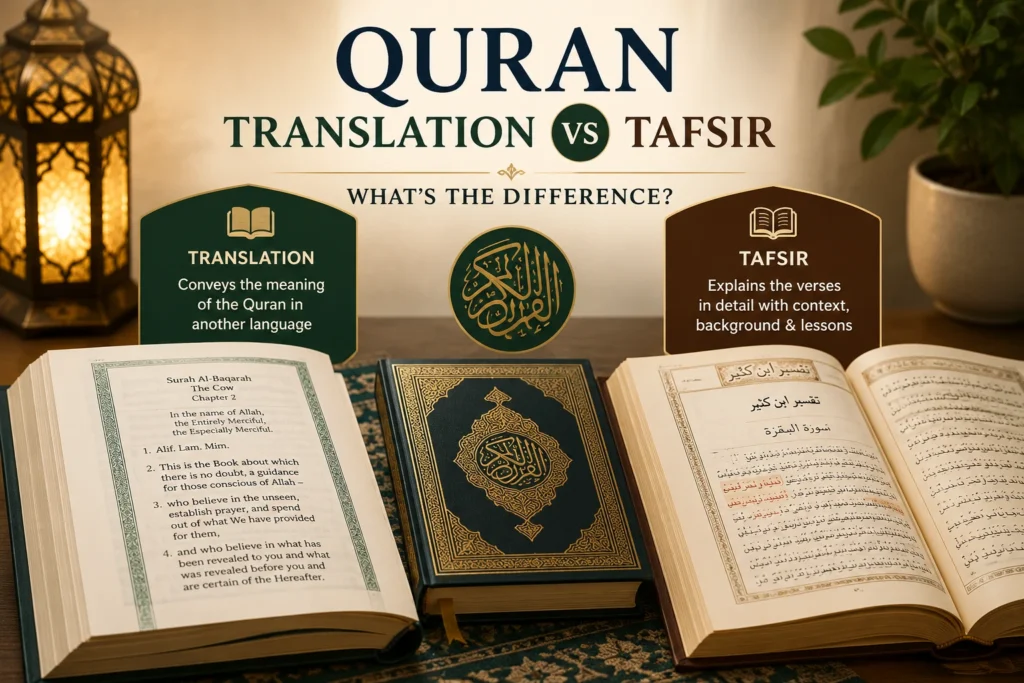
Quran Translation vs Tafsir
Understand the difference between reading a translation of the Quran and studying its detailed explanation through Tafsir. -
10 Foods Mentioned in the Quran and Their Benefits
Learn about the blessed foods mentioned in the Quran and explore their significance in Islamic tradition and everyday life.
Frequently Asked Questions (FAQs)
📚 External Academic & Interfaith References
Official documentation and guidelines regarding Christian-Muslim relations, historical dialogue, and shared ethical values.
Read Interreligious Dialogue Documents →Scholarly studies comparing theological perspectives, historical interactions, and scripture interpretation between Islam and Christianity.
Explore Georgetown Academic Papers →Detailed comparative analyses of the lives of Jesus and Prophet Muhammad, along with the textual history of the Bible and Qur’an.
Read Comparative Reference Articles →