Introduction
The Holy Books in Islam are part of the divine guidance that Allah revealed to humanity through His prophets and messengers. From the very beginning of human history, Allah has never left humanity without guidance. According to Islamic belief, He chose righteous men as Prophets and Messengers to teach people the truth, call them to worship Allah alone, and guide them toward a life of righteousness.
To support these prophets in their mission, Allah revealed divine scriptures containing His guidance, commandments, wisdom, and reminders. These revelations were not sent all at once or to one nation alone. Instead, different books were revealed to different prophets across different periods of history, each addressing the needs of the people to whom they were sent.
Islam teaches that every revealed book originally came from Allah and contained the truth. Muslims are required to believe in all of Allah’s revealed scriptures, even though they also believe that the Quran is the final revelation and that it has been preserved in its original form.
In this complete guide, we’ll explore the holy books mentioned in Islam, the prophets who received them, their purpose, the communities they were revealed to, and how they relate to the Holy Quran.
Why Did Allah Reveal Different Holy Books?
One question many people ask is:
“If Allah is One, why were different holy books revealed?”
Islam explains that humanity has existed for thousands of years, and different nations lived in different places and times. Every community faced unique circumstances, languages, cultures, and challenges.
For this reason, Allah sent prophets to various nations, each bringing guidance that addressed the needs of their people while calling them to the same fundamental belief.
Although the laws given to different communities could vary in some matters, the central message remained consistent throughout history:
- Believe in Allah alone.
- Worship Him without partners.
- Live with honesty and justice.
- Show kindness to others.
- Prepare for the Hereafter.
This continuity is one of the key teachings of Islam. Muslims believe that all true prophets shared the same foundation of faith, even though they lived centuries apart.
What Is Wahy (Divine Revelation)?
The Arabic word “Wahy” refers to divine revelation from Allah to His chosen prophets.
Unlike ordinary human knowledge, revelation is not something that a prophet discovers through study or personal opinion. It is guidance that Allah communicates directly in the manner He wills.
The Quran describes revelation as a source of guidance, wisdom, and mercy for humanity.
Through revelation, prophets received:
- Commands from Allah.
- Moral guidance.
- Laws for their communities.
- Warnings against wrongdoing.
- Glad tidings for those who believed and did righteous deeds.
Every holy book revealed by Allah was part of this divine process of guidance.
The Difference Between a Prophet and a Messenger
Many people use the words Prophet and Messenger interchangeably, but in Islamic scholarship there is a distinction.
Prophet (Nabi)
A Prophet is a person chosen by Allah to guide people according to His revelation.
Some prophets were sent to uphold and teach an existing divine law.
Messenger (Rasul)
A Messenger is a prophet who was given a specific revelation or scripture and sent to deliver Allah’s message to a particular people.
Examples include:
- Prophet Musa (Moses) عليه السلام
- Prophet Dawud (David) عليه السلام
- Prophet Isa (Jesus) عليه السلام
- Prophet Muhammad ﷺ
Both prophets and messengers were chosen by Allah because of their righteousness, honesty, and trustworthiness.
The Scrolls (Suhuf) of Prophet Ibrahim (Abraham) عليه السلام
Before the Torah, Psalms, Gospel, and Quran, Allah revealed scriptures known as the Suhuf, or Scrolls, to Prophet Ibrahim (Abraham) عليه السلام.
Although these scrolls are not available today in their original revealed form, the Quran confirms that they were among the earliest divine revelations.
Allah mentions them in Surah Al-A’la (87:18–19):
“Indeed, this is in the former scriptures—the scriptures of Abraham and Moses.”
The Scrolls of Ibrahim are believed to have contained guidance, wisdom, and reminders that encouraged people to worship Allah sincerely and live righteous lives.
Tawrat (The Torah)
Which Prophet Received the Tawrat?
The Tawrat was revealed to Prophet Musa (Moses) عليه السلام, one of the greatest messengers in Islam.
Musa عليه السلام was sent to guide Bani Israel (the Children of Israel) after rescuing them from the oppression of Pharaoh.
What Was the Purpose of the Tawrat?
According to Islamic belief, the Tawrat contained divine guidance, laws, and commandments for Bani Israel.
It provided instructions on worship, justice, social responsibilities, and moral conduct.
The Quran praises the original Tawrat as a source of guidance and light for the people to whom it was revealed.
Who Was It Revealed To?
The Tawrat was specifically revealed for the Children of Israel during the time of Prophet Musa عليه السلام.
It addressed their circumstances and guided them according to Allah’s commands.
What Do Muslims Believe About the Tawrat?
Muslims believe:
- The original Tawrat was revealed by Allah.
- Prophet Musa عليه السلام faithfully delivered Allah’s message.
- The original revelation was true guidance for its people.
At the same time, Muslims believe that the Quran is the final revelation and serves as the ultimate criterion for matters of faith.
Zabur (The Psalms)
Which Prophet Received the Zabur?
The Zabur was revealed to Prophet Dawud (David) عليه السلام.
Prophet Dawud was not only a king but also a prophet known for his devotion, justice, and beautiful recitation in the worship of Allah.
What Was the Purpose of the Zabur?
The Zabur focused on:
- Praising Allah.
- Spiritual reflection.
- Wisdom.
- Gratitude.
- Encouraging righteousness.
Unlike some other scriptures, Islamic tradition describes the Zabur primarily as a book of guidance and praise rather than a detailed legal code.
Who Was It Revealed To?
The Zabur was revealed to Prophet Dawud عليه السلام for the guidance of his people, continuing Allah’s message to Bani Israel.
What Do Muslims Believe About the Zabur?
Muslims believe that the original Zabur was revealed by Allah and formed part of His guidance to humanity through His prophets.
The Injil (The Gospel)
Which Prophet Received the Injil?
The Injil was revealed by Allah to Prophet Isa (Jesus) عليه السلام, one of the greatest prophets in Islam.
Muslims believe that Prophet Isa (A.S.) was born miraculously to Maryam (Mary) عليها السلام without a father, by Allah’s command. He was sent to guide the Children of Israel and to confirm the truth of the revelations that came before him.
What Was the Purpose of the Injil?
According to Islamic belief, the Injil was revealed to:
- Guide the Children of Israel.
- Confirm the original message of the Tawrat.
- Encourage righteousness and compassion.
- Call people to worship Allah alone.
- Strengthen faith in Allah and prepare people for accountability in the Hereafter.
The Quran describes the Injil as a source of guidance and light for those to whom it was revealed.
Who Was It Revealed To?
The Injil was revealed specifically to the Children of Israel through Prophet Isa (A.S.).
Like previous revelations, it addressed the needs of the community living during that period.
What Do Muslims Believe About the Injil?
Muslims believe:
- The original Injil was a true revelation from Allah.
- Prophet Isa (A.S.) faithfully conveyed Allah’s message.
- The original revelation was a source of divine guidance.
Muslims also distinguish between the original Injil revealed to Prophet Isa (A.S.) and the later written Gospel accounts found in the New Testament. In Islamic belief, the Injil refers specifically to the revelation given directly to Prophet Isa (A.S.).
The Holy Quran
Which Prophet Received the Quran?
The Holy Quran was revealed to Prophet Muhammad ﷺ, the final Messenger of Allah.
The revelation began when Prophet Muhammad ﷺ was approximately forty years old and continued over a period of about 23 years.
The first verses were revealed in the Cave of Hira near Makkah through the Angel Jibreel (Gabriel) عليه السلام.
What Is the Purpose of the Quran?
The Quran was revealed as complete guidance for humanity.
It teaches:
- Belief in One God (Allah).
- Worship and devotion.
- Justice and honesty.
- Compassion and mercy.
- Family values.
- Charity and helping others.
- Moral character.
- Preparation for the Hereafter.
Unlike earlier revelations that were sent to particular communities, the Quran presents itself as guidance for all people until the Day of Judgment.
Who Was It Revealed To?
Although revealed to Prophet Muhammad ﷺ in Arabia, the Quran’s message is universal.
It is intended for:
- Every nation.
- Every race.
- Every language.
- Every generation.
This universal nature is one of the distinguishing characteristics of the Quran in Islamic belief.
What Do Muslims Believe About the Quran?
Muslims believe that:
- The Quran is the final revelation from Allah.
- It confirms the truth of earlier revelations in their original form.
- It serves as the final criterion between truth and falsehood.
- Allah has preserved the Quran in its original Arabic text.
For Muslims around the world, the Quran remains the primary source of faith, guidance, and daily life.
Comparison of Allah’s Revealed Scriptures
| Revealed Scripture | Prophet | Revealed For | Main Purpose |
|---|---|---|---|
| Suhuf (Scrolls) | Ibrahim (A.S.) | His people | Early divine guidance and wisdom |
| Tawrat (Torah) | Musa (A.S.) | Bani Israel | Laws, guidance, and commandments |
| Zabur (Psalms) | Dawud (A.S.) | Bani Israel | Praise, wisdom, and spiritual reflection |
| Injil (Gospel) | Isa (A.S.) | Bani Israel | Guidance, mercy, and confirmation of previous revelation |
| Holy Quran | Muhammad ﷺ | All humanity | Final and complete guidance for mankind |
What Do All the Holy Books Have in Common?
Although revealed at different times, Muslims believe that all of Allah’s revealed scriptures originally shared the same foundation.
Their common teachings included:
- Belief in Allah alone.
- Calling people toward righteousness.
- Encouraging honesty and justice.
- Teaching compassion and mercy.
- Warning against wrongdoing.
- Preparing people for the Hereafter.
These shared principles demonstrate the unity of Allah’s message throughout history.
How Is the Quran Different from Earlier Revelations?
According to Islamic belief, the Quran has several unique characteristics.
Final Revelation
The Quran is believed to be the last divine scripture revealed by Allah.
No new revealed book will come after it.
Universal Message
Earlier scriptures were revealed to specific communities.
The Quran, however, is described as guidance for all humanity regardless of nationality or ethnicity.
Preservation
Muslims believe Allah has protected the Quran from alteration.
Millions of Muslims have memorized the Quran throughout history, and its original Arabic text continues to be preserved.
Comprehensive Guidance
The Quran provides guidance on:
- Faith.
- Worship.
- Morality.
- Family life.
- Business ethics.
- Social justice.
- Personal conduct.
- Spiritual development.
Why Do Muslims Believe in All Divine Books?
Belief in Allah’s revealed books is one of the six articles of faith in Islam.
A Muslim believes that Allah sent revelations to many prophets throughout history.
This belief reflects respect for Allah’s guidance and for all the prophets He chose.
While Muslims believe the Quran is the final revelation, they also affirm that the original revelations given to earlier prophets came from Allah.
Common Misconceptions
“Muslims Believe Only in the Quran.”
This is not correct.
Muslims believe in all of Allah’s original revealed scriptures while recognizing the Quran as the final revelation.
“The Quran Replaced Every Previous Prophet.”
The Quran did not replace the prophets.
Rather, it confirms the message brought by earlier prophets while presenting the final revelation through Prophet Muhammad ﷺ.
“All Prophets Taught Different Religions.”
Islam teaches that all prophets called people to worship Allah alone.
Although some laws differed according to time and community, the core message remained the same.
Conclusion
The story of Allah’s revealed scriptures is a story of continuous divine guidance for humanity. From the Scrolls of Prophet Ibrahim (A.S.) to the Tawrat of Prophet Musa (A.S.), the Zabur of Prophet Dawud (A.S.), the Injil of Prophet Isa (A.S.), and finally the Holy Quran revealed to Prophet Muhammad ﷺ, each revelation played an important role in guiding people toward faith and righteousness.
Muslims believe in all of these original revelations because they came from the same Creator. At the same time, they regard the Holy Quran as Allah’s final and preserved guidance for all humanity—a message that continues to inspire millions of people around the world today.
Explore More About the Quran
Continue your journey of learning by exploring our helpful articles about the Holy Quran, its meanings, understanding, and guidance for everyday life.
-
The Quran: A Light for Every Heart
Discover why the Holy Quran is a timeless source of guidance, hope, and spiritual peace for every believer. -
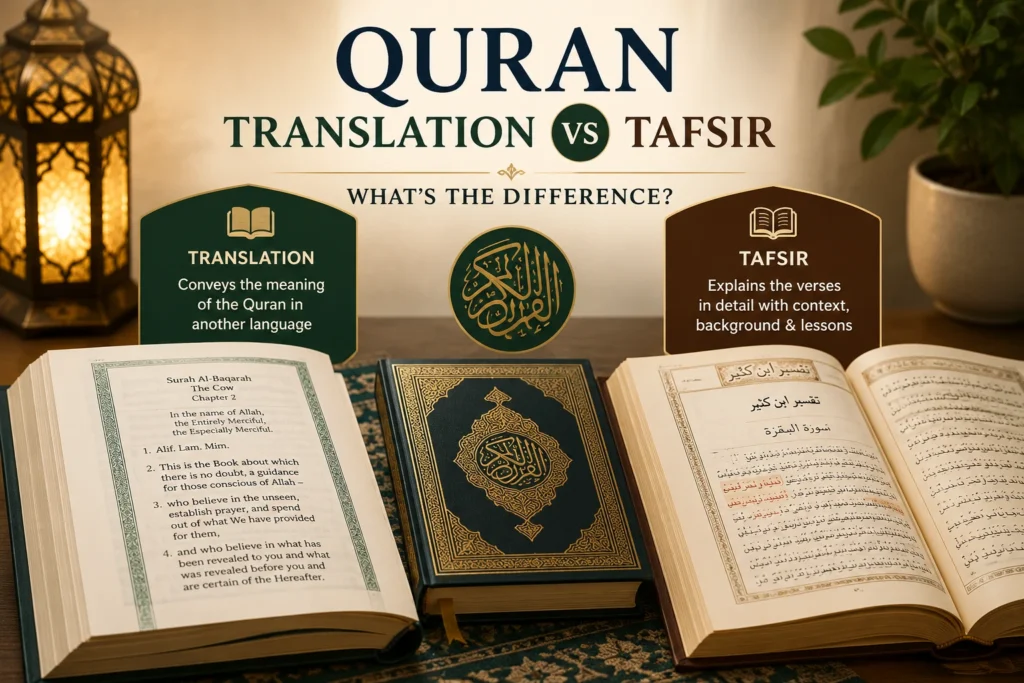
Quran Translation vs Tafsir
Understand the difference between reading a translation of the Quran and studying its detailed explanation through Tafsir. -
10 Foods Mentioned in the Quran and Their Benefits
Learn about the blessed foods mentioned in the Quran and explore their significance in Islamic tradition and everyday life.
✦ Educational Resources on Divine Scriptures in Islam
Quran.com (Digital Quran & Tafsir)
Direct Quranic verses referencing the prior scriptures (Tawrat, Zabur, and Injil) alongside classic translations and commentaries.
Islamic Texts Society (ITS Cambridge)
Academic research and authoritative publications on classical Islamic theology, prophets, and divine revelation history.
Al-Azhar Global Center for Islamic Studies
Scholarly explanations on the articles of faith (Iman), including belief in all divine books revealed to the prophets.